Building the Lean AI Stack for Solo SaaS
A solo founder can now assemble capabilities that once required a small company. An AI model can draft and classify content. APIs can move data between products. Workflow tools can coordinate repetitive jobs. Browser agents can sometimes operate software that has no suitable integration.
That does not mean one person can safely place an entire business on autopilot. The new advantage is narrower and more useful: a founder can build a small system in which software performs defined operational tasks while the human retains control over judgment, spending, policy, and customer relationships.
For the web entrepreneur in 2026, this is the emerging solo-founder stack: AI operators for flexible work, APIs for dependable execution, and lean SaaS principles for keeping the business focused. Marketing professionals and brand managers should pay attention because many promising applications sit directly inside revenue workflows—from campaign production and lead qualification to customer onboarding and reporting.
What the New Solo-Founder Stack Actually Contains
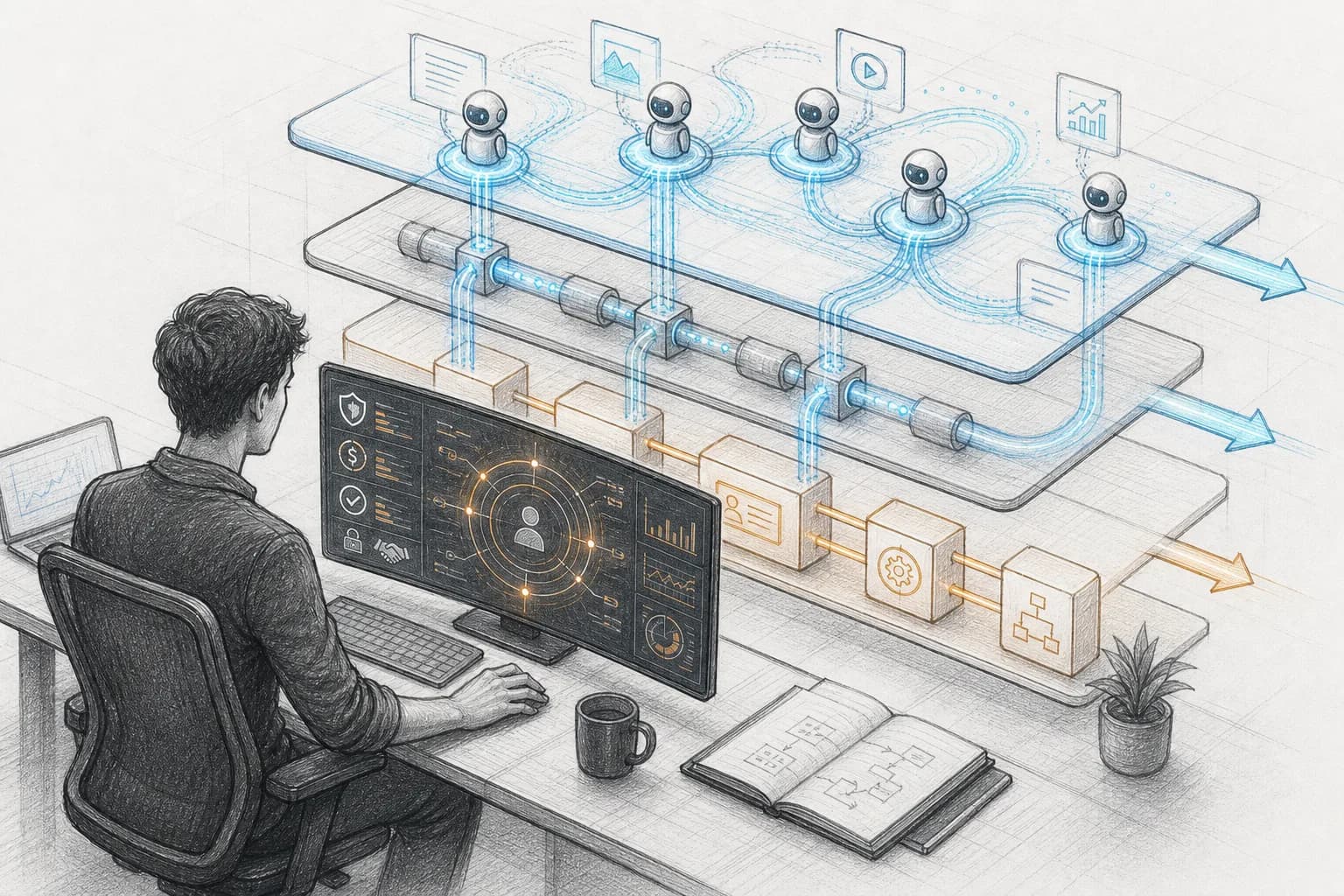
An AI operator is best understood as a software worker with a limited assignment. It receives context, chooses among allowed actions, uses tools, and returns a result. Unlike a conventional automation, it can handle some ambiguity, such as interpreting an inbound message before assigning a category.
The strongest stacks separate this flexible reasoning from deterministic infrastructure. Each layer has a different job.
1. The workspace and system of record
Customer details, campaign briefs, approved claims, brand rules, and workflow status need a stable home. This might be a structured database such as PostgreSQL, a customer relationship management system, or a workspace built around tables and records.
The important feature is not the brand of software. It is having one authoritative location for operational state. If an agent must reconstruct the truth from scattered documents and chat histories every time it runs, errors become difficult to diagnose.
2. The orchestration layer
Workflow automation tools such as n8n, Zapier, or Make can trigger jobs, pass information between services, and enforce ordinary business rules. A new form submission might start an enrichment job, send qualified records for review, and update a pipeline after approval.
These systems are generally better than AI at predictable instructions: when event A happens, perform action B. There is little reason to pay a model to make a decision that a simple rule can make consistently.
3. The intelligence layer
Large language models can classify, summarize, extract fields, compare text with a policy, or prepare a draft. They are especially useful where the input is messy but the desired output can be clearly specified.
This layer should receive only the context required for the task. A support-triage operator, for example, may need the customer’s message, plan, recent incidents, and approved response policies. It rarely needs unrestricted access to every customer record.
4. The action layer
Official APIs should perform consequential actions whenever they are available. APIs provide documented permissions, structured inputs, predictable responses, and better observability than clicking around a website.
Browser agents fill gaps when software lacks an appropriate API. They can navigate pages, enter information, or retrieve data from interfaces built for humans. But they should be treated as a less reliable adapter, not the foundation of the business.
5. The control layer
Logs, usage limits, approval queues, alerts, and access controls turn a collection of AI tools into an operating system. Without this layer, the founder cannot tell whether an operator is helping, silently failing, or generating an expensive loop.
A useful design principle is simple: AI proposes, policy constrains, software records, and humans approve high-impact decisions.
Start With a Revenue-Linked Workflow, Not a General Agent
The appeal of a universal digital employee is understandable. It is also a poor starting point for lean SaaS. Broad agents are difficult to evaluate because success depends on many changing tasks, interfaces, and interpretations.
A stronger product owns one painful workflow with an observable beginning and end. Sales and marketing are fertile areas because the connection to commercial value can be measured.
Consider a focused prospecting assistant. Its workflow might be:
- Import prospect records from an authorized source.
- Normalize job titles, company information, and campaign fields.
- Compare each record with a defined ideal-customer profile.
- Draft personalized outreach using approved positioning.
- Route drafts or sensitive claims to a human reviewer.
- Schedule permitted follow-ups through an official integration.
- Classify replies and update lead status.
- Report outcomes by segment, message, and campaign.
This is not one autonomous agent. It is a controlled sequence containing rules, model calls, APIs, and human decisions. That distinction matters because each step can be tested separately.
Marketers should define success using business outcomes rather than content volume. Useful measures could include qualified-reply rate, time from response to human follow-up, cost per reviewed lead, approval rate, and the percentage of records requiring correction. The exact metric depends on the workflow; there is no defensible universal improvement figure.
Vendor-published claims about faster pipelines or higher returns may indicate potential, but they should not become a founder’s forecast without access to the underlying studies. A lean product should establish its own baseline, run a limited pilot, and compare results with the previous process.
The same pattern applies beyond outreach. A narrow AI operator could prepare campaign briefs from approved customer research, triage support requests, flag churn signals, assemble onboarding checklists, or organize search-marketing research. The product becomes valuable when it closes a specific operational loop—not merely when it generates plausible text.
Design the Architecture Around Control
A practical lean architecture does not need to be exotic. It needs clear boundaries.
A typical request might move through the system like this:
Trigger -> validate input -> retrieve authorized context
        -> apply rules -> call AI model if needed
        -> validate output -> request approval if required
        -> execute through API -> record result -> monitor
The validation steps are essential. Model output should be treated as untrusted input, just like information submitted through a public form. If the system expects a lead score, category, and explanation, require those fields in a structured format and reject malformed results.
Prefer APIs over simulated clicking
An API-first design is easier to test, monitor, and secure. OAuth 2.0 can grant scoped access without asking customers to hand over passwords. Webhooks can report events as they occur, while idempotency controls can prevent the same payment, message, or record update from being executed twice.
Platform policy is part of architecture, not a legal note to address after launch. LinkedIn illustrates the issue. Official interfaces can support areas such as company-page publishing and advertising, while access involving people, profiles, and connections remains substantially more restricted and may require approval.
A compliant workflow must therefore be designed around what the platform actually permits. Automating prohibited account behavior through a browser does not become safe simply because an AI agent performs the clicks.
For brand managers, this has an additional dimension. Unauthorized automation can create account risk and reputational risk at the same time. The fastest workflow is not valuable if it distributes an unapproved claim, contacts the wrong person, or makes a brand appear careless.
Give operators narrow permissions
Each operator should have its own identity and minimum necessary access. A drafting agent does not need permission to publish. A lead-scoring service does not need billing privileges. A reporting process should usually read data rather than edit it.
Store secrets in a managed secret store rather than prompts, spreadsheets, or source code. Keep customer data separated, record who initiated each action, and define retention rules before sensitive information accumulates.
This approach also limits damage from prompt injection. A malicious instruction hidden in a webpage or customer message is less dangerous when the reading agent cannot send money, export a database, or publish content.
Keep the Business Lean Without Making It Fragile
Lean SaaS is not simply software built cheaply. It is a discipline of reducing assumptions, fixed costs, and operational surface area until customer demand justifies expansion.
One vendor estimate places a broad solo-founder AI toolkit in the hundreds of dollars per month, but that should be treated as directional rather than universal. Costs vary with model usage, customer volume, data processing, and how many overlapping subscriptions the founder carries.
Custom agentic systems can cost considerably more than ordinary rule-based automation because they require integration work, monitoring, and ongoing tuning. The lesson is not that agents are unaffordable. It is that they should earn their place in the stack.
A sensible cost model tracks expenses at the workflow level:
- model cost per completed job;
- external API and enrichment charges;
- storage and data-transfer costs;
- failed or retried runs;
- human review time;
- support burden created by errors;
- gross margin by customer or plan.
Free tiers and cloud credits can help during validation, but they can disguise weak economics. A bug, abusive request pattern, or uncontrolled retry loop can rapidly increase usage. Set hard limits before opening the product to customers.
Pricing should reflect the value unit customers understand. A product may charge per workspace, completed workflow, processed record, or usage allowance. Recurring and usage-based models both appear in lean AI SaaS, but either can fail if expensive jobs are bundled into an unlimited plan.
The founder should also resist premature infrastructure. Start with managed authentication, a hosted database, a queue, basic monitoring, and one model provider if those components satisfy the pilot. Add redundancy when observed demand or failure patterns justify it—not because an architecture diagram looks more impressive with extra boxes.
Reliability Is a Product Feature
Browser agents have improved, but benchmark performance should be interpreted carefully. OpenAI’s BrowseComp measures whether an agent can locate hard-to-find information online. It does not demonstrate that the same system can safely complete transactions, submit forms, or approve purchases from end to end.
Silverstream reported solving 94% of tasks on a public ServiceNow benchmark, compared with a previous state-of-the-art result of 63.8%. That is meaningful progress. It also implies that roughly one task in 17 still fails under those benchmark conditions.
Production workflows introduce additional complications: expired sessions, interface changes, ambiguous buttons, rate limits, incomplete records, and unexpected confirmation screens. A benchmark score cannot remove those operational risks.
A solo founder therefore needs several forms of protection:
- Human approval: Require confirmation before publishing, purchasing, deleting, or contacting sensitive audiences.
- Retries with limits: Retry temporary failures, but stop after a small number of attempts.
- Circuit breakers: Pause a workflow when failure rates, costs, or unusual outputs cross a threshold.
- Usage caps: Limit spending by customer, operator, and time period.
- Alerts: Notify the founder about stalled jobs, permission failures, or abnormal consumption.
- Audit logs: Preserve inputs, decisions, approvals, actions, and results.
- Fallback paths: Send uncertain cases to a queue instead of guessing.
Confidence scores alone are not enough. Models can sound certain while being wrong. Approval rules should consider the consequence of an error, not merely the model’s self-reported confidence.
This is particularly important in marketing. A low-risk internal summary may run unattended. A public claim, discount approval, sensitive reply, or bulk outreach campaign deserves stronger review because the cost of a mistake extends beyond the software session.
Quick Checklist
- Choose one narrow workflow with a measurable customer or revenue outcome.
- Separate deterministic rules from tasks that genuinely require AI interpretation.
- Use official, authorized APIs before considering browser-based automation.
- Give every operator the minimum data and permissions required for its assignment.
- Add structured outputs, validation, logs, spending caps, and limited retries.
- Require human approval for public, financial, destructive, or policy-sensitive actions.
- Track cost and failure rate per completed workflow, not only per model call.
- Pilot with real users and compare results against a documented manual baseline.
Frequently Asked Questions
Does a solo founder need autonomous agents to build an AI SaaS?
No. Many useful products combine ordinary workflow automation with a few targeted model calls. Full autonomy adds complexity and should be reserved for cases where flexible decision-making creates enough value to justify additional monitoring and risk.
When should a browser agent be used instead of an API?
Use a browser agent when a necessary system has no suitable authorized API and its policies permit the intended activity. Keep the task narrow, verify the result, and require approval for consequential submissions. An official API remains preferable when one exists.
What is the best first AI workflow for a marketing team?
Choose a repetitive bottleneck tied to an existing metric. Examples include classifying inbound leads, preparing campaign briefs from approved materials, routing replies, or checking drafts against brand rules. Avoid starting with unrestricted automated outreach or publishing.
How can a founder prevent AI costs from getting out of control?
Set per-user and system-wide budgets, cap input size, cache reusable results, restrict retries, and alert on abnormal activity. Measure the total cost of successful workflows, including human review and external APIs, rather than watching token charges alone.
Can one person support a reliable SaaS business?
A tightly scoped product can reduce the support and operational load enough for one person to manage it. The practical limit depends on workflow complexity, customer expectations, security obligations, and failure frequency. AI expands capacity, but it does not eliminate accountability.
Final Thoughts
The most important shift is not that AI lets one founder imitate a large company. It is that a founder can design a smaller company around software-native operations from the beginning. That can create speed, but only when the product remains narrow enough to understand.
In practice, APIs and ordinary rules should carry more of the business than the fashionable language of agents suggests. AI is most valuable at the ambiguous edges: interpreting a message, extracting meaning, comparing a draft with policy, or preparing a decision. Stable execution still belongs to conventional software.
The second judgment is that reliability and brand safety are part of the product’s value proposition. Human approvals, scoped permissions, and circuit breakers may look like limits on automation, but they are what make automation commercially credible.
The bigger picture is a move from software as a collection of screens toward software as a managed workflow. Solo founders are well positioned to explore that model because they can focus intensely and change direction quickly. Their durable advantage, however, will not come from owning the most AI tools. It will come from choosing the right work to automate—and knowing exactly where automation should stop.
Sources
- 7 AI SaaS Ideas You Can Build As A Solo Founder in 2025
- One-Person Company Software: The Solo AI Tool Stack ...
- 10 AI tools for solo founders to boost productivity | Hussain Asghar posted on the topic | LinkedIn
- Building a Generative AI-Powered SaaS: A Solo ...
- AI Agent Integration Cost for Small Business (2026) | ADEVS
- 9 Best AI Agents for SaaS, Compared by Workflow | RankUp
- 100 Customer Interviews Before Writing a Line of Code | SaaS Club
- Build a LinkedIn Automation Stack with Official APIs in 2025
- 7 LinkedIn Automation Tools to Boost Sales in 2025
- LinkedIn Data Automation Limitations
- 63%->94%: Silverstream Hits 2σ Reliability for Web Agents | Silverstream AI Team
- BrowseComp: a benchmark for browsing agents
Ready to Get Started?
Explore production-ready 3D models for your next project. Browse the 3D model catalog to download assets you can use right away.
Turn this workflow into real deliverables
Browse production-ready 3D models for your next project, then step into 3d modeling if you need a custom build.