Where Ecommerce Returns Automation Really Saves Money
Introduction
A return looks simple from the customer’s side: choose a reason, print a label and wait for a refund. Behind that button sits a chain of customer-service work, payment decisions, shipping movements, warehouse inspections and inventory updates.
That complexity explains why returns technology can produce meaningful savings—and why many automation projects disappoint. A polished portal may remove a few emails while leaving the expensive parts of the process untouched. Faster refunds may improve the experience but increase exposure to empty-box claims or unsellable merchandise.
The useful question is not whether returns should be automated. It is which decisions can be automated safely, which costs disappear, and which costs merely move elsewhere.
For ecommerce leaders, marketing professionals and brand managers, the answer reaches beyond logistics. Returns influence customer lifetime value, campaign profitability, product feedback and the likelihood that a disappointed shopper will buy again. A credible business case must connect these commercial outcomes to operational efficiency without counting uncertain revenue as guaranteed savings.
Start With the Full Cost of a Return
A return is not one warehouse task. It is a transaction that passes through several teams and systems, often with repeated manual checks.
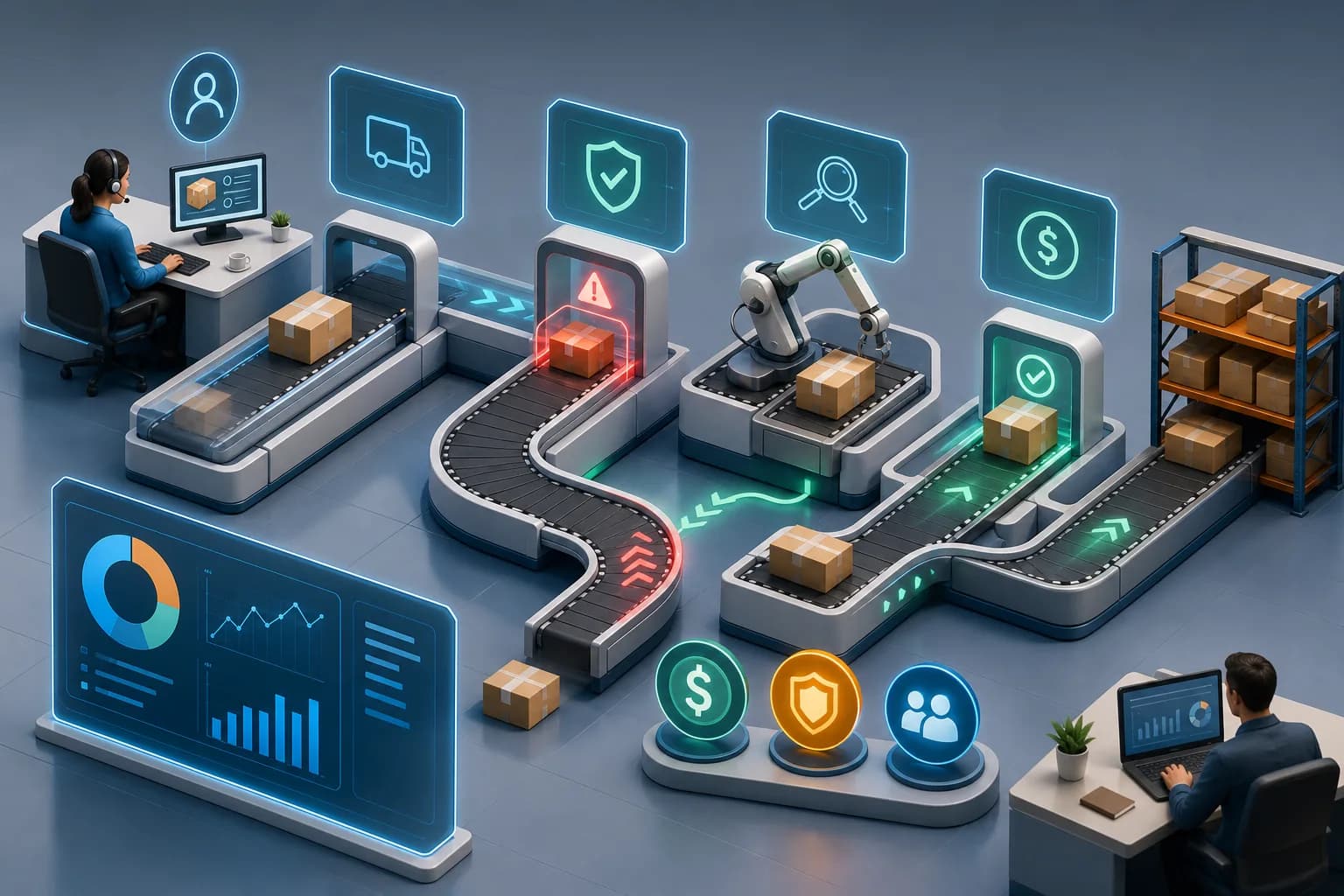
A typical workflow can include:
- The customer asks whether the item qualifies.
- An agent locates the order and interprets the policy.
- Someone approves or rejects the request.
- A label or QR code is generated.
- The customer asks for a status update.
- A warehouse receives and inspects the item.
- The item is restocked, refurbished, liquidated or discarded.
- A refund, exchange or store credit is issued.
- Inventory, finance and customer records are updated.
The cost therefore extends beyond return postage. It includes support time, payment fees, warehouse touches, packaging, fraud losses, lost inventory value and the delay before an item can be sold again.
Establish a baseline before buying software
Start by measuring the existing process for several weeks. Record return volume, handling time, support contacts, carrier spending, refund time, inspection results and final disposition. Separate ordinary cases from exceptions such as missing orders, damaged goods and suspected abuse.
This matters because vendor benchmarks vary widely. One vendor-published analysis estimates manual processing at $12.50 to $26.50 per return, compared with $2.50 to $5.50 for an automated workflow. Those figures imply substantial savings, but they are operational estimates rather than independent, universal benchmarks.
A fashion retailer handling frequent size exchanges will not have the same economics as a furniture seller arranging bulky-item collections. Your own baseline is more valuable than an industry average that blends incompatible categories.
Distinguish eliminated cost from displaced cost
Suppose a portal removes five minutes of agent work but encourages more customers to ship low-value merchandise back. The labor saving is real, yet the total cost may rise.
Track each cost in one of three ways:
- Eliminated: The activity no longer occurs, such as manual label creation.
- Reduced: The task remains but requires less time, such as reviewing a prevalidated request.
- Displaced: Work moves to another team, system or stage of the journey.
This distinction prevents a common ROI mistake: celebrating efficiency in customer service while overlooking higher carrier or warehouse expenses.
The Automation Use Cases With the Clearest Savings
Returns platforms can coordinate many activities, but four areas tend to offer the most defensible cost reductions.
1. Self-service and contact deflection
A self-service portal lets customers find an order, see eligible options, select a reason and generate a label without waiting for an agent. Automated notifications can then confirm authorization, shipment scans, receipt and refund status.
The savings come from avoiding repetitive questions rather than eliminating customer support altogether. Policy inquiries, label requests and “Where is my refund?” messages are predictable enough for rules-based automation.
Vendor-reported research claims brands without self-service portals receive 4.2 times as many inbound contacts per return. The same source reports that 61% of customers follow up if they receive no proactive update within 24 hours. These figures require independent validation, but the underlying mechanism is credible: uncertainty creates contacts, and timely information removes the need for many of them.
The portal must still provide a clear route to a person. Customers dealing with defective products, lost parcels or unusual circumstances should not be trapped in an automated loop.
2. Workflow orchestration
The second opportunity is the administrative chain between request and resolution. Returns management automation can validate the order, check the policy, generate shipping documents, notify the warehouse and trigger the appropriate payment action.
Robotic process automation can also bridge older systems by reproducing repetitive actions that employees would otherwise perform across multiple screens. It is useful when direct integrations are unavailable, although it can be fragile if interfaces change.
LateShipment.com says its OneReturn platform can reduce returns-processing time by as much as 90% by removing manual review, label creation, coordination and messaging. That is a vendor claim, not a general guarantee. Still, it illustrates an important point: the best target is usually an end-to-end workflow, not one isolated click.
Tools such as ShipHero and Extensiv can support warehouse management system workflows after an item arrives. The value depends on whether the portal, order management system, warehouse management system and payment platform share consistent data. Automation that stops at the warehouse door delivers only part of the possible saving.
3. Smarter reverse-logistics routing
Sending every product back to the same distribution center is easy to administer but often expensive. Rules can route a return according to the customer’s location, product type, reason, expected condition and resale value.
For example:
- An unopened item may go to the nearest fulfillment center for rapid restocking.
- A damaged electronic product may go directly to a repair partner.
- A bulky, low-value item may qualify for a returnless refund when recovery would cost more than the merchandise.
- A product with limited resale potential may go to liquidation rather than occupying warehouse space.
This is where reverse-logistics technology can affect shipping, handling and inventory recovery simultaneously. The objective is not simply to move the parcel cheaply. It is to send it to the destination that preserves the most value after transport and processing costs.
Returnless refunds require careful thresholds. Used too broadly, they can encourage abuse and make product defects less visible to quality teams.
4. Automated exchanges and controlled refunds
An exchange can preserve revenue that would otherwise leave the business. A portal can show available sizes or colors, reserve replacement inventory and calculate price differences without an agent rebuilding the order.
Refund-at-drop-off can also shorten the customer’s wait by releasing funds after a carrier or partner scans the parcel. That may improve confidence, but it transfers risk to the merchant because the contents have not yet been inspected.
A better design uses risk tiers. Established customers returning ordinary products may receive an early refund, while high-value orders or unusual claims wait for inspection. Fraud controls should consider order history, item value, return frequency, shipping events and claim patterns without treating every customer as suspicious.
Good automation makes low-risk cases faster and directs ambiguous cases to human review. It does not pretend ambiguity has disappeared.
Where Technology Does Not Automatically Cut Costs
Returns software cannot repair an uneconomic policy, unreliable product information or poor operational data. It may simply accelerate the wrong decision.
Shipping and product-value losses remain
A portal can choose a lower-cost route, but it cannot make a large parcel physically smaller. Nor can workflow automation restore the full value of a used, seasonal or damaged product.
Brands should therefore separate process cost from value loss. The first includes labor and system work; the second reflects markdowns, damage and products that cannot be resold. Technology can influence both, but it has much more direct control over the first.
Bad reason codes produce bad decisions
Customers often choose whichever return reason is easiest or offers free shipping. If the reason taxonomy is vague, routing rules and product reports become unreliable.
Use a short set of customer-friendly choices, then allow warehouse teams to record the inspected condition separately. “Too small” is a customer observation; “unopened and resellable” is an operational assessment. Combining them into one field weakens both marketing analysis and warehouse decision-making.
Automation can hide exception work
A headline such as “zero agent time” may describe straightforward cases while excluding exceptions. Yuma AI, for example, describes a jewelry brand replacing multiple emails, manual validation and agent-initiated refunds with automatic labels and refund processing. That workflow is plausible for eligible cases, but any ROI review should ask what happens when an order cannot be found, tracking stalls or the returned item differs from the claim.
Measure the percentage processed without intervention, the time spent on exceptions and the rate at which automated decisions are reversed. Otherwise, a team may appear more efficient simply because difficult work has moved into a less visible queue.
Build an ROI Model Marketing and Operations Can Trust
The most useful returns scorecard combines direct savings, recovered value and customer outcomes. These categories should remain separate because they carry different levels of certainty.
Direct, measurable savings
These are the strongest inputs to a business case:
- Agent minutes avoided per return
- Fewer inbound support contacts
- Lower label and carrier costs through routing
- Fewer warehouse touches
- Reduced manual payment and inventory updates
- Lower error and rework rates
Calculate savings using actual loaded labor costs and observed volumes. Subtract platform fees, integration work, implementation labor, maintenance and added fraud losses.
Recovered and retained value
Next, measure the contribution from exchanges, faster restocking and better disposition. Use contribution margin, not gross revenue, so product cost, fulfillment and discounts are not mistaken for profit.
If automation turns a refund into an exchange, do not count the entire replacement order as incremental revenue. Some customers would have exchanged without the new system. A holdout group or staged rollout can reveal how much behavior actually changed.
Post-return retention
Returns are also a marketing moment. A clear and predictable resolution may preserve trust, while delays and confusing status messages can end the relationship.
A vendor-published case series released in 2026 reported that three brands collectively lowered annual processing costs by $284,000. It also reported repeat-purchase rates among customers who returned products were 22% to 31% higher after automation, with retention and win-back revenue matching or exceeding labor savings.
Those results are notable but should not be treated as independent benchmarks. Changes in promotions, product mix, seasonality or customer acquisition could also affect repurchase. Brands should compare similar cohorts, use a consistent post-return window and measure incremental contribution margin.
For marketing teams, returns data can support carefully targeted messages. A shopper who returned shoes because of fit needs sizing guidance, not a generic discount for the same item. A customer who received a defective product may need reassurance that the issue was addressed before any win-back campaign begins.
A Practical Implementation Sequence
Start with the repetitive, high-volume path rather than trying to automate every exception at once.
A sensible sequence is:
- Map the current workflow. Identify every handoff, decision, delay and duplicate data entry.
- Clean policy and product data. Automation needs clear eligibility rules, order records and reason codes.
- Launch self-service for standard cases. Begin with common, low-risk products and return reasons.
- Add proactive status messages. Notify customers when the request, shipment, receipt and resolution change state.
- Integrate warehouse and payment systems. Avoid creating a fast front end attached to a manual back office.
- Introduce routing and risk tiers. Use configurable rules before attempting more complex predictive models.
- Test retention programs. Compare post-return behavior with an appropriate control or holdout group.
- Expand only after reviewing exceptions. The exception queue reveals where rules, data or policies remain weak.
This phased approach makes attribution easier. If every process changes at once, it becomes difficult to tell whether savings came from contact deflection, routing, policy changes or reduced return volume.
Quick Checklist
- Measure current cost per return across support, shipping, warehouse, payment and inventory work.
- Separate eliminated costs from costs reduced or shifted to another team.
- Identify the highest-volume repetitive contacts and manual decisions.
- Connect portal data to order, warehouse, carrier and refund systems.
- Create routing rules based on location, product value, condition and recovery options.
- Use risk tiers for early refunds, returnless refunds and manual fraud review.
- Track exchange margin, restocking speed and post-return repurchase separately.
- Audit exceptions and customer complaints before expanding automation.
Frequently Asked Questions
What is returns automation?
Returns automation uses portals, business rules and system integrations to manage activities such as eligibility checks, label creation, routing, customer notifications, exchanges and refunds. It can also send unusual or risky cases to employees for review.
Which returns technology usually pays back first?
For many retailers, self-service combined with proactive status updates is a practical first step because it targets frequent support contacts and manual label work. Actual payback depends on return volume, contact rates, integration costs and how much of the workflow can be completed without intervention.
Should every eligible customer receive an instant refund?
No. Early refunds improve speed but expose the retailer before inspection. A tiered policy can approve low-risk cases quickly while holding high-value, inconsistent or unusual claims for carrier confirmation or warehouse review.
How should a brand measure retention after a return?
Compare customers with similar products, purchase histories and return reasons over a consistent period. Where possible, use a holdout group or phased rollout. Measure incremental contribution margin rather than attributing every later purchase to the returns experience.
Can automation reduce the number of returns?
Its most direct role is reducing processing cost and improving resolution. However, structured reason and condition data can reveal recurring fit, quality or description problems. Product and marketing teams can then address those causes, but the improvement comes from acting on the data rather than from automation alone.
Final Thoughts
In practice, the strongest returns investments automate coordination, not judgment. Eligibility checks, labels, notifications and routine system updates are excellent candidates. Questions involving fraud, unusual damage or valuable merchandise still benefit from informed human review.
The bigger picture is that a return should be managed as both a cost event and a customer relationship event. Labor savings are easier to verify, while retention and win-back gains may ultimately be larger but require stronger attribution. Combining them prematurely makes an ROI case look impressive and less trustworthy.
What this suggests for brand leaders is a disciplined order of operations: establish the baseline, automate the ordinary path, expose the exceptions and then optimize routing and retention. The winning ecommerce trend is not automation everywhere. It is automation applied precisely where repetition, delay and fragmented data create avoidable expense.
Sources
- Ecommerce Returns Automation: 3 Case Studies With Real Data 2026
- Unlocking the ROI of Automation: Case Studies on Time and Cost Savings
- Customer Support Automation ROI: Real Numbers & Case Studies 2024 | Agerra
- Anti-Fraud & Returns Automation: Reducing Cost Without Harming CX
- Your Complete Guide to Returns Management Automation in 2025
- eCommerce Return Management: Cost Reduction Guide
- How Return Rates Vary by Industry and What to Do About It
- What Is the Average Ecommerce Return Rate? (2026) - 3PL Insider
- How returns automation can help your business grow | Refundid
- How Returns Automation Helps Improve Your eCommerce ...
- Instantly process returns and refunds with zero agent time | Yuma AI
- Optimizing Customer Returns: Strategies for Minimizing Costs and Maximizing Value
Ready to Get Started?
Explore production-ready 3D models for your next project. Browse the 3D model catalog to download assets you can use right away.
Turn this workflow into real deliverables
Browse production-ready 3D models for your next project, then step into 3d modeling if you need a custom build.