Navigating 2026 Marketing Automation: Native AI vs Composable Stacks
Introduction
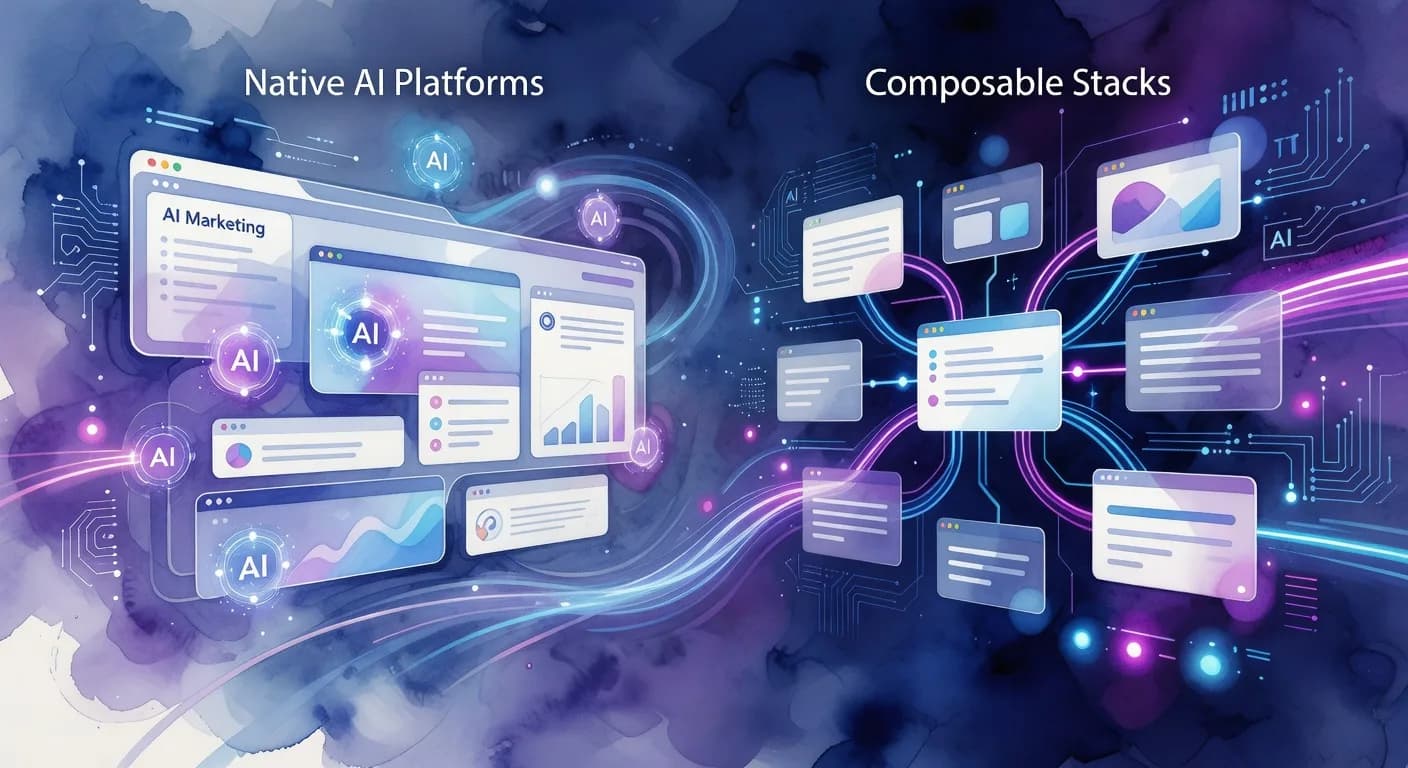
In 2026, marketing automation has evolved beyond simple email triggers and static workflows. With artificial intelligence now a foundational element, marketing professionals face a pivotal choice: should they adopt native AI platforms that embed AI directly within their marketing suites, or build composable stacks by integrating best-of-breed tools through flexible APIs? This article unpacks these two approaches, clarifying their strengths and challenges so brand managers and marketers can make informed decisions.
What Are Native AI Platforms?
Native AI platforms come with AI capabilities deeply woven into their core software. Think of HubSpot’s Breeze, Salesforce Einstein, or Adobe Generative AI—these are AI features designed and optimized by the platform vendor to work seamlessly within their marketing automation tools.
Advantages of Native AI
- Tight integration: AI-powered segmentation, personalization, and analytics operate smoothly within the platform.
- Speed to value: Less setup time since AI features are built-in, ideal for mid-market or inbound-focused teams.
- Unified data: Customer data and AI insights reside in one system, reducing data silos.
Limitations
- Less flexibility: Customization options may be limited to the vendor’s roadmap.
- Vendor lock-in: Switching platforms can be costly and disruptive.
Understanding Composable Stacks
Composable stacks take a modular approach. Instead of relying on a single vendor, marketers assemble a collection of specialized tools—like Rasa for AI-driven lead routing, Snowflake for centralized data warehousing, and best-in-class marketing automation platforms—connected via APIs.
Benefits of Composable Stacks
- Flexibility: Choose the best tool for each function and swap components as needs evolve.
- Advanced personalization: Composable architectures enable AI personalization that can increase average order value by up to 369%.
- Data governance: Centralizing data in cloud warehouses like Databricks or BigQuery improves accuracy and model reliability.
Challenges
- Complex integration: Requires skilled IT resources to maintain API connections and data flows.
- Potential for stack sprawl: Without clear strategy, multiple tools can create operational risks and fragmented data.
Key Considerations for Marketing Teams
When deciding between native AI and composable stacks, consider these factors:
- Organizational size and complexity: Enterprises with complex sales cycles and multi-region governance may benefit from composable stacks (e.g., Adobe Marketo with Salesforce).
- Speed and simplicity: Mid-market teams often find native AI platforms like HubSpot faster to deploy and easier to manage.
- Total Cost of Ownership (TCO): Platforms like Creatio, with no-code capabilities, report a 37% reduction in TCO by simplifying development and integration.
- Data strategy: Composable stacks excel when a company has a mature data warehouse strategy and API-first mindset.
Practical Examples
- HubSpot Marketing Hub: Offers unified CRM and marketing automation with native AI, perfect for scale-ups needing rapid deployment.
- Creatio Marketing: Combines AI-native features with composable intelligence, supporting no-code customization and contextual AI agents.
- Rasa: Provides a composable AI agent framework layering large language models with deterministic logic, enhancing lead routing and fallback flows.
Checklist: Choosing Your 2026 Marketing Automation Approach
- Assess your current marketing complexity and integration capabilities.
- Evaluate your team’s technical resources for managing composable stacks.
- Determine your priority: speed-to-value or maximum customization.
- Review TCO and ROI data from case studies relevant to your industry.
- Consider data governance needs and your cloud data warehouse strategy.
- Test AI features in sandbox environments before full rollout.
- Plan for ongoing maintenance and scalability.
- Explore available 3D marketing assets and integrations to enhance digital campaigns, such as those found in the free 3D model catalog.
Frequently Asked Questions
What exactly is a composable stack?
A composable stack is a marketing technology setup where individual best-of-breed tools are connected via APIs, allowing marketers to build a flexible, customizable system tailored to their needs.
Why is AI considered table stakes in marketing automation?
AI enables predictive analytics, hyper-personalization, and scalable engagement, transforming how brands connect with customers. Without AI, marketing automation risks falling behind in efficiency and effectiveness.
Can I combine native AI platforms with composable tools?
Yes, many organizations use a hybrid approach, leveraging native AI features for core tasks while integrating specialized composable tools for advanced functions like lead routing or complex analytics.
How do composable stacks impact data management?
They encourage centralizing data in cloud warehouses, reducing duplication and fragmentation, which improves AI model accuracy and governance.
What role do no-code tools play in marketing automation?
No-code platforms reduce reliance on developers, speeding up deployment and lowering costs. Creatio’s no-code capabilities, for example, have been shown to reduce total cost of ownership by 37%.
Conclusion
Choosing between native AI platforms and composable stacks in 2026 depends on your organization's size, technical resources, and marketing goals. Native AI suits teams seeking quick implementation and unified systems, while composable stacks offer flexibility and advanced personalization for complex environments. Regardless of choice, prioritizing data governance, AI integration, and scalability is essential. For marketers exploring creative digital assets to complement their automation efforts, browsing the free 3D model catalog can provide fresh inspiration and enhance campaign impact.
Understanding these options will empower your team to build a marketing automation strategy that drives growth, efficiency, and customer engagement in today’s AI-driven landscape.
Sources
- 15 Best AI-Powered ABM Tools (2026) | Pricing | Autobound
- AI CRM Software: Benefits, Use Cases & Top Platforms in 2026
- Forrester Wave 2026
- Top Marketing Automation Tools and AI Strategies for 2026
- Best AI Marketing Tools for 2026 (Full Guide) - The Smarketers
- 12 Best AI Marketing Automation Tools for 2026 (Reviewed)
- FAQ on martech: How AI agents and composable stacks are reshaping marketing technology in 2026
- The Martech Stack ROI Game-Plan: What to Keep, Kill, and Scale in 2026 for AI-Ready Growth - Marrina Decisions
- Your martech stack for 2026: fewer tools, more impact
- The CFO's Guide to Composable Commerce: ROI vs TCO in 2026 - CLEARgo Insights
- Creatio’s No-Code capabilities reduce TCO by 37 percent
- Creatio’s AI-Native Evolution: Transforming Marketing Automation with Composable Intelligence
Ready to Get Started?
Explore production-ready 3D models for your next project. Browse the 3D model catalog to download assets you can use right away.
Turn this workflow into real deliverables
Browse production-ready 3D models for your next project, then step into 3d modeling if you need a custom build.