Why Repeatable Social Shows Are Winning the Feed
Introduction
The most valuable social post may no longer be the one that gets the biggest burst of views. It may be the one that makes people recognize the next episode.
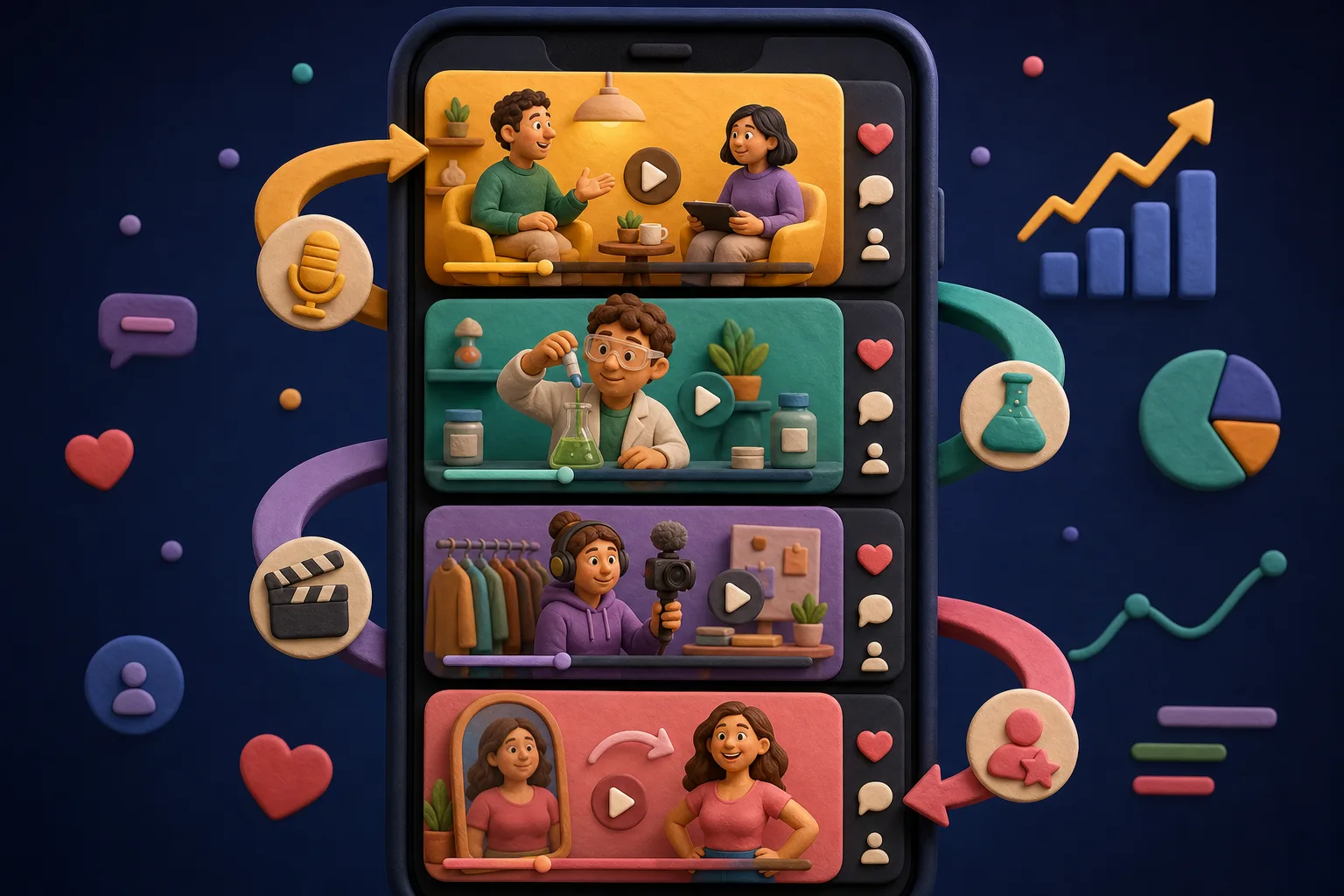
Across TikTok, Instagram, and YouTube, creators and brands are adopting recurring formats: weekly expert answers, workplace mockumentaries, product experiments, customer transformations, behind-the-scenes diaries, and short educational shows. Each episode stands alone, but the premise stays familiar.
That familiarity matters in a crowded feed. According to Sprout Social, 57% of more than 2,000 global social media users surveyed wanted brands to prioritize original content series in 2026. The finding does not mean every audience wants conventional television from brands. It points to demand for recognizable programming rather than a stream of disconnected announcements.
Platforms do not necessarily award distribution simply because a post belongs to a named series. The advantage is indirect but powerful: repeatable shows are designed to generate the audience behaviors recommendation systems can observe, including sustained viewing, repeat engagement, completion, and return visits.
For marketing professionals, this represents more than a creative trend. It changes how teams plan ideas, allocate production resources, measure performance, and build brand memory.
Why the Feed Is Becoming a Programming Environment
Social feeds once felt like chronological updates from accounts people had deliberately followed. Modern recommendation feeds behave more like personalized programming schedules. They continuously select individual pieces of content according to what each user appears likely to watch or engage with.
In that environment, a one-off post starts from zero. Its subject, visual language, presenter, and value proposition may all be unfamiliar. A recurring show carries some context forward from earlier episodes.
Familiarity reduces the decision cost
Every swipe is a tiny decision: Is this worth another few seconds? A recognizable opening, host, setting, or question format helps viewers answer more quickly.
Consider a financial brand posting five unrelated videos: an office tour, a budgeting tip, a product announcement, a trend joke, and an interview. Even if each is competent, the audience must decode a new proposition every time.
Now imagine a recurring format called “One-Minute Money Myth.” The topic changes, but the audience understands the exchange immediately: a familiar claim will be tested and explained. Recognition becomes part of the hook.
This does not guarantee attention. It removes avoidable friction before the content has earned it.
Series create opportunities for return behavior
A successful standalone post can produce views, likes, or shares. A successful episode can also prompt viewers to watch earlier installments, follow for the next one, or recognize the series when it returns.
Those actions are especially useful because recommendation systems learn from behavior, not from a brand’s editorial intentions. A “Part 7” label has little value by itself. What matters is whether people actually watch Part 7, seek out Part 6, and respond when Part 8 appears.
Recurring formats therefore align with platform incentives without requiring marketers to guess at a secret algorithm. They create more chances to generate consistent evidence that a particular audience values a particular content promise.
Platforms can evaluate more than raw reach
YouTube provides measurements such as views, interactions, view rate, completion progress, average impression frequency, unique reach, and earned actions. These allow marketers to compare not just how many people encountered an episode, but how exposure translated into attention and subsequent behavior.
TikTok’s Brand Lift Study adds another layer for advertisers by examining effects such as awareness and perception. This matters because a show may be strategically useful even when it is not the week’s largest post. Repeated exposure to a distinctive premise can support recognition that a raw view count cannot describe on its own.
The practical lesson is not that every metric must rise simultaneously. It is that recurring programming gives teams multiple episodes over which to identify a pattern.
Why Repeatability Works for Audiences and Teams
The audience benefit is anticipation. The operational benefit is a reusable system. Strong social shows deliver both.
A show makes a continuing promise
A content series is not simply a group of posts with matching graphics. It offers a stable reason to return.
That promise might be:
- Utility: one practical skill in every episode.
- Access: a regular view behind the scenes.
- Transformation: a process followed from problem to result.
- Judgment: an expert reacts to a new case each week.
- Entertainment: recurring characters encounter a fresh situation.
- Participation: audience questions or submissions shape future episodes.
Short educational series are particularly clear examples. Each 15-to-90-second episode can teach one concept while reinforcing the creator’s broader subject-matter authority. Viewers do not need to start at the beginning, yet the format still rewards continued attention.
Narrative formats operate differently. A workplace mockumentary or project diary can give each installment a small payoff while maintaining a longer storyline. The strongest versions balance accessibility with continuity: newcomers understand today’s episode, while regular viewers notice the accumulated context.
Repetition strengthens memory without demanding sameness
Brand managers often worry that repeating a format will become dull. That risk is real, but it confuses consistency with uniformity.
A useful analogy is a magazine. Readers expect recurring departments, but not the same article every month. A social show similarly needs a stable frame with variable material inside it.
Teams can preserve recognition through a consistent host, title, visual cue, opening question, or episode structure. They can create variety by changing the subject, guest, setting, emotional tone, or audience challenge.
This balance is important because feeds also reward creative diversity. Publishing one rigid execution indefinitely can exhaust both viewers and makers. A brand is usually better served by a small rotation of recognizable formats than by a single template repeated until it loses meaning.
A format turns production into a system
One-off content often carries hidden costs. Every post may require a fresh concept, approval logic, setting, script structure, and design treatment. Teams spend creative energy rebuilding the container instead of improving what goes inside it.
A repeatable show establishes useful constraints. Once the premise and workflow are defined, producers can batch research, record several episodes in one session, reuse a set, and create a predictable review process. The result is not automatically cheaper or better, but it is easier to plan and refine.
This is one reason creator-led formats have influenced brand production. Successful creators frequently work with recognizable structures: reactions, tests, explainers, interviews, challenges, or recurring characters. The structure speeds execution while leaving room for a topical hook.
For brand teams, the deeper advantage is organizational learning. After several comparable episodes, they can identify whether the host, topic, opening, duration, or publishing window is helping or hurting performance. Five unrelated posts offer far less diagnostic clarity.
How to Design a Social Show Without Making Bad Television
A social series should be designed for the feed where it will live. Shrinking a conventional television concept into a vertical frame is rarely enough.
1. Start with an audience tension
Do not begin with “We need a weekly video.” Begin with a recurring question, frustration, curiosity, or aspiration.
A software company might answer awkward questions buyers are afraid to ask. A food brand might test whether popular kitchen shortcuts work. A university might follow one research problem from hypothesis to result. A retailer might invite staff to solve customer styling dilemmas under a constraint.
The subject must support multiple episodes without becoming vague. If the team can imagine only three worthwhile installments, the idea is probably a campaign rather than a durable show.
2. Write the format as a simple sentence
A good format can usually be explained without a presentation deck:
In every episode, our specialist receives one real audience question and demonstrates the answer in under a minute.
That sentence defines the participant, source material, action, and approximate duration. It gives creators enough structure to reproduce the concept while preserving room for surprise.
If a format requires a long explanation, viewers may also struggle to understand it before swiping away.
3. Build a recognizable opening, not a long introduction
Recognition must not become ceremony. A lengthy logo animation or repeated verbal preamble consumes the exact attention the show is supposed to earn.
Open with the episode’s tension: the questionable claim, unfinished result, difficult customer question, unexpected object, or sharpest line. Branding can come from the host, setting, typography, or editorial voice rather than a conventional title sequence.
Native analytics should guide refinement. Compare which topics, lengths, and openings consistently hold attention. Technical specifications and pacing can then be adapted for TikTok, Instagram Reels, or YouTube Shorts without abandoning the central premise.
4. Plan seasons and format rotations
“Repeatable” should not mean “permanent.” A short season gives the team a sensible test boundary and gives the story an endpoint.
Alongside the flagship show, maintain a small portfolio of formats. For example:
- Tuesday: a practical micro-tutorial.
- Thursday: an expert response to an audience question.
- Twice monthly: a behind-the-scenes project update.
- Occasionally: a timely standalone post when the subject demands it.
This approach combines consistency with variety. It also prevents the calendar from forcing every idea into the same container.
5. Design interaction into the premise
Comments should not be treated only as reactions after publication. They can become raw material for future episodes.
Ask viewers to submit cases, vote on the next test, challenge an expert, or predict an outcome. Then visibly carry selected contributions into the next installment. This turns interaction into editorial continuity and gives participants a concrete reason to return.
The device must be genuine. Asking a generic question at the end of every post is not community building if the answers never influence what happens next.
Measure the Show, Not Just the Episodes
A recurring format needs two levels of evaluation. Marketers should assess each episode as a piece of content and the series as a developing audience asset.
At the episode level, examine:
- Whether the opening retains attention.
- View rate and completion behavior.
- Meaningful comments, shares, saves, and interactions.
- Differences among topics, guests, durations, and publishing times.
- Actions taken after viewing, where the platform reports them.
At the series level, look for directional evidence:
- Do returning episodes produce more recognition in comments?
- Are viewers navigating to previous installments?
- Does average performance become more reliable over time?
- Are followers asking when the next episode will appear?
- Is the format improving brand recall or perception in available studies?
- Can the team produce it sustainably without lowering standards?
Avoid judging a new series after one weak episode. Equally, do not protect a format indefinitely because the team likes making it. Set a test period, define success before launch, and review the pattern across multiple installments.
Timing also deserves attention. Publishing when the intended audience is active can support early interaction, but there is no universal best hour. Use native platform data rather than generic posting-time advice.
Most importantly, separate format failure from execution failure. A strong premise can be undermined by a slow opening or weak topic. A beautifully produced episode cannot rescue a show that lacks a repeatable audience promise.
Quick Checklist
- Define the recurring audience need the show will address.
- Express the format in one clear sentence.
- List at least ten credible episode ideas before committing.
- Create a recognizable opening that reaches the tension quickly.
- Decide which elements stay consistent and which can vary.
- Establish a test season with episode-level and series-level metrics.
- Use native analytics to refine topics, length, timing, and hooks.
- Build audience questions or submissions into future episodes.
Frequently Asked Questions
Do algorithms explicitly favor content series?
There is no universal public rule stating that a post receives extra reach merely because it belongs to a series. The advantage comes from audience behavior. A recognizable, valuable show can encourage completion, repeat viewing, interaction, and return visits—signals platforms can measure.
How often should a recurring show be published?
Choose a schedule the team can sustain without sacrificing relevance or quality. Weekly may suit a simple expert Q&A, while a production-heavy documentary format may work monthly. Predictability matters more than forcing an unnecessarily high frequency.
Should every episode use the same visual template?
No. Retain enough cues to establish recognition, such as the host, premise, framing, or title treatment, but allow topics and execution to evolve. Consistency should help viewers orient themselves, not make every episode feel interchangeable.
Can a series work without a large existing audience?
Yes, provided individual episodes are understandable to newcomers. Avoid making every installment dependent on extensive backstory. A clear standalone payoff allows recommendation feeds to introduce the show to people who have never seen it before.
Are one-off posts becoming obsolete?
No. Timely announcements, reactive commentary, major campaigns, and unusual stories may deserve singular treatment. The better strategy is a portfolio: recurring shows create continuity, while one-off posts preserve responsiveness and creative range.
Final Thoughts
In practice, social platforms are not turning into television so much as they are becoming environments where programming discipline matters. A clear premise, recognizable structure, and reason to return can outperform creative randomness—not because repetition is inherently rewarded, but because audiences can understand and remember the offer.
The central tradeoff is between familiarity and fatigue. Brands that confuse a show with a fixed template will eventually produce wallpaper. Brands that preserve the promise while varying the substance can create something more durable: a format that belongs to them but remains useful to the audience.
The bigger picture is organizational. Repeatable shows make social media marketing easier to learn from. Comparable episodes reveal patterns, reusable workflows reduce needless reinvention, and audience participation can feed the editorial process. Those benefits remain valuable even when an individual installment does not become a breakout hit.
What this suggests for 2026 is a shift from filling calendars to building recognizable programming. The brands most likely to benefit will not be those that imitate television most literally. They will be those that understand what a show really is: a reliable promise, renewed one episode at a time.
Sources
- [57% of social users want original content series in 2026, is your team ready? 🎬
Episodic content isn’t just for entertainment. It’s a smart way to grab attention, keep people coming back, and build](https://www.facebook.com/SproutSocialInc/posts/57-of-social-users-want-original-content-series-in-2026-is-your-team-ready-episo/1320454100116486)
- Social Media Algorithms in 2025 | Stay Visible to Buyers
- Social Media Trends: What Will Shape 2026 (and How to Stay Ahead) – Slate
- 10 Content Creation Best Practices for Repeatable Growth
- Social Media Content Ideas for 2026 (With Examples) | Entrepedia
- 12 TikTok Video Formats Brands Should Copy to Boost Engagement (2026)
- episodic-social-content-for-growth
- Episodic series Service in Mumbai | Episodic Brand Content
- Why Social Media Is Shifting Toward TV-Style Storytelling ...
- 57% of consumers say brands should prioritize original ...
- Creating a Social Media Content Series | Sprout Social
- Serial servings: How reoccurring content can connect brands and consumers - The Martin Group
Ready to Get Started?
Explore production-ready 3D models for your next project. Browse the 3D model catalog to download assets you can use right away.
Turn this workflow into real deliverables
Browse production-ready 3D models for your next project, then step into 3d modeling if you need a custom build.