AI Dubbing Rewrites the Economics of Creator Video
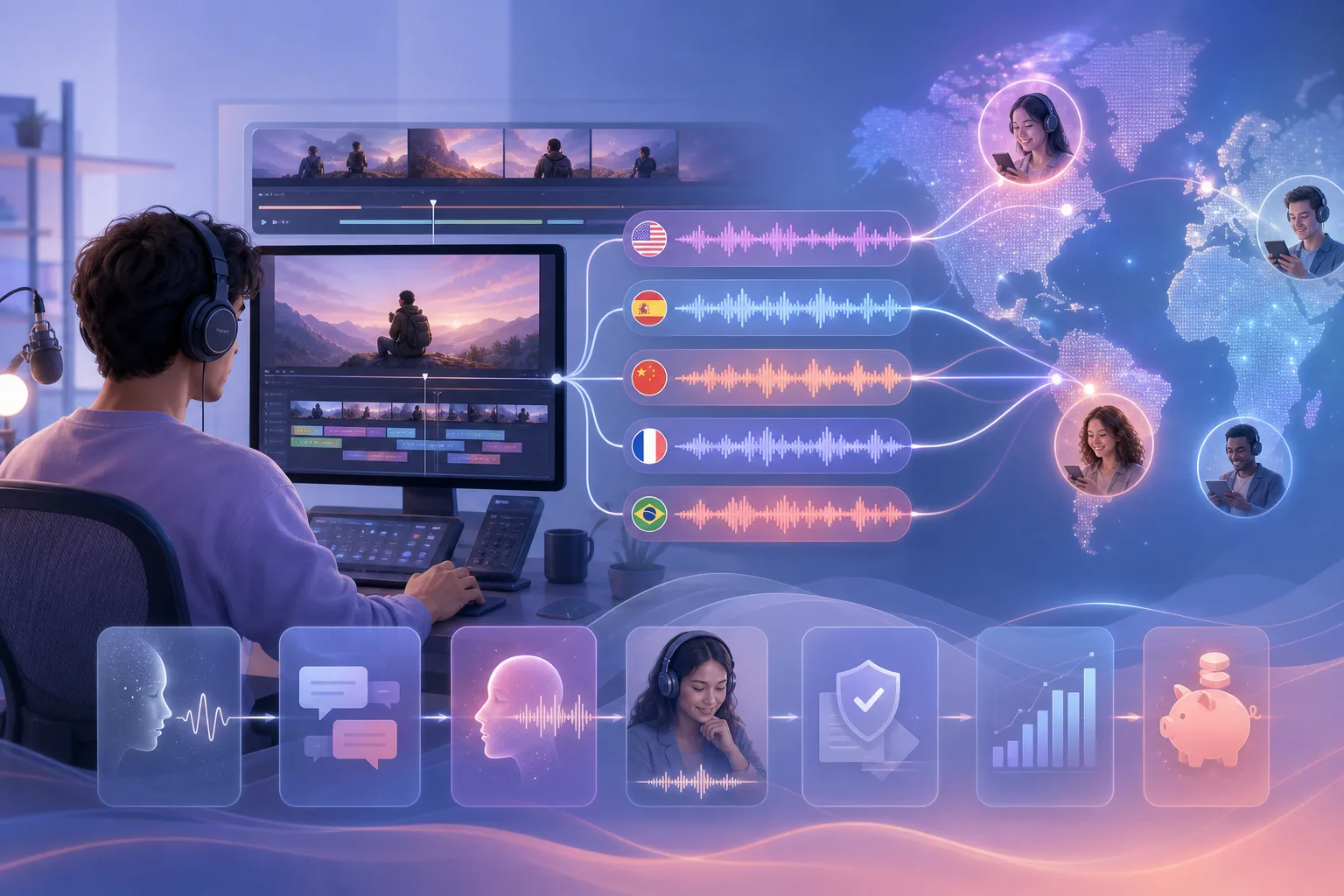
A successful creator video can cross borders instantly, but understanding does not travel at the same speed. Language has traditionally divided global audiences into separate production markets, each requiring translators, actors, recording sessions, editors, and quality checks.
AI dubbing is changing that calculation. Instead of treating every language as a new production, creators can use speech recognition, machine translation, synthetic speech, and automated timing to produce localized audio much faster. A video can remain on one YouTube page while viewers choose among multiple audio tracks, preserving comments, engagement signals, and analytics around the original upload.
The important change is not simply that dubbing has become cheaper. It is that the marginal cost and delay of testing another language have fallen. That gives creators, publishers, marketers, and brand managers a new way to think about international growth: not as a single expensive launch, but as a portfolio of measurable experiments.
Yet lower production cost does not guarantee profitable reach. Poor translation can weaken trust, synthetic delivery can flatten personality, and careless voice cloning can create legal and reputational problems. AI dubbing improves the economics only when it sits inside a disciplined localization strategy.
Why the Cost Structure Is Changing
Traditional dubbing is a chain of specialized work. A team translates and adapts the script, casts performers, records dialogue, directs delivery, synchronizes speech, mixes the audio, and reviews the finished program. That model remains valuable when dramatic performance, precise lip synchronization, or cultural sensitivity is central to the experience.
It is also difficult to scale across dozens of creator videos and languages. Every added market introduces another block of studio time, coordination, and fixed expense.
An AI-assisted workflow turns much of that process into software:
- Automatic speech recognition converts the original dialogue into text.
- Machine translation creates a first version in the target language.
- Script adaptation shortens or reshapes phrases to match timing and local usage.
- Text-to-speech generation produces a new voice track, sometimes using an authorized synthetic version of the creator’s voice.
- Automated alignment fits the translated speech to the video’s pacing.
- Audio mixing and human review correct errors and balance the dub against music and sound effects.
Industry estimates illustrate the potential difference, although they are not universal price lists. One localization provider estimates AI dubbing at roughly $2 to $30 per finished minute, compared with approximately $50 to $200 per minute for studio dubbing. Another analysis estimates that AI with human review can reduce feature-film dubbing costs by 40% to 70%.
These comparisons require caution. A clean tutorial recorded by one speaker is not equivalent to a feature film with multiple actors, overlapping dialogue, songs, emotional scenes, and complex sound design. Some dramatic vendor claims also compare episodes, films, and production standards that are not directly comparable.
The defensible conclusion is narrower: AI can reduce the cost of the repeatable parts of dubbing, especially for straightforward spoken video. Human attention remains necessary, but it can move from producing every line manually to reviewing the moments where mistakes carry the greatest risk.
Speed has economic value too
Market forecasts disagree sharply about the size of the AI dubbing industry because analysts include different combinations of voice generation, localization software, services, and media workflows. Their common signal is more useful than any single total: demand is expected to rise as global video volume grows and synthetic voices improve.
Turnaround time helps explain that demand. Traditional film and television dubbing can take several weeks, while automated workflows may produce an initial output within a day or two. For creators covering news, sports, products, or trends, a delayed translation may lose much of its value before publication.
Faster dubbing therefore changes more than the production budget. It increases the useful life of timely content and allows localized versions to participate in the same attention cycle as the original.
From One Global Bet to Many Local Experiments
Before AI dubbing, international expansion often required confidence upfront. A creator or brand had to select a language, fund localization, and hope that enough viewers would arrive to justify the investment.
Lower costs support a different model. Teams can test several languages on a limited set of proven videos, observe audience behavior, and expand only where demand becomes visible. Localization starts to resemble performance marketing: launch a controlled experiment, measure results, and reallocate resources.
A practical evaluation can be framed without complicated mathematics:
Incremental return = new revenue and strategic value − total localization cost
The phrase total localization cost matters. It should include more than the software fee:
- Translation and cultural adaptation
- Native-speaker review
- Voice licensing or performer compensation
- Audio cleanup and mixing
- Thumbnail, title, description, and caption localization
- Project management
- Corrections after publication
- Rights, privacy, and compliance review
Revenue also requires a broad definition. Advertising income may be the most visible result, but creators and brands can gain sponsorship inventory, affiliate sales, leads, subscriptions, licensing opportunities, or greater recognition in a priority market. Conversely, a large increase in low-value views may produce less business impact than a modest audience in a strategically important region.
Case studies show possibility, not certainty
Reported creator and media experiments demonstrate the scale now available. A secondary case-study account says Fremantle generated nearly six million plays in three months after automating multilingual dubbing, with views, watch time, and subscribers increasing by percentages described as being in the thousands.
That is a striking result, but it does not prove dubbing alone caused the growth. Content selection, distribution, recommendation systems, existing demand, and channel promotion may all contribute. Nor does audience growth automatically reveal profit after localization and operating costs.
Erling Haaland’s YouTube localization offers another useful signal. A dubbing provider described a rollout covering 44 languages and framed the project around subscriber and revenue expansion rather than voice-model benchmarks. The strategic shift is clear: dubbing is becoming an audience-development system, not merely a post-production task.
Marketers should treat such examples as evidence of feasibility, not as guaranteed performance standards. The relevant question is not, “Did multilingual dubbing work for a famous channel?” It is, “Which language-content combinations produce incremental value for this channel?”
Platform Distribution Changes the Return
Dubbing has always existed, but platform architecture now makes it more economically attractive. YouTube multilingual audio can attach several language tracks to one video. Viewers select the audio they prefer without leaving the original upload.
This matters because the creator does not necessarily need a separate channel, duplicate video page, or fragmented comment section for every language. A unified asset can concentrate social proof and simplify performance analysis.
Audio tracks and captions are still separate. Captions help viewers who watch silently, need accessibility support, or prefer reading the original dialogue. A dubbed track serves a different purpose: it makes the video easier to follow while cooking, commuting, exercising, or watching on a television.
A complete localization strategy should therefore consider four distinct layers:
- Audio: What language does the viewer hear?
- Captions: What can the viewer read?
- Metadata: Can the viewer discover and understand the video from its title and description?
- Creative context: Do examples, humor, units, offers, and calls to action make sense locally?
Dubbing only the audio can leave the surrounding experience inconsistent. A polished Spanish voice track paired with untranslated on-screen graphics, an irrelevant offer, or a culturally confusing joke may increase reach without building trust.
Measure markets, not just languages
Language is not the same as market. Spanish-speaking viewers may live in countries with different purchasing behavior, cultural references, platform habits, and advertising economics. English reaches many regions but does not represent one uniform commercial audience.
Brand managers should segment results by geography where platform data and privacy rules permit. Useful measurements include:
- Dubbed-track selection and playback share
- Watch time and completion rate by language and region
- Subscriber or follower growth
- Returning-viewer behavior
- Comments indicating translation or voice problems
- Revenue per thousand views where available
- Clicks, leads, conversions, or sales tied to the market
- Correction cost and review time per finished minute
Compare dubbed performance with the original carefully. A new language track may reach an audience with different baseline behavior, so identical completion rates are not always realistic. The better question is whether each localized version clears the organization’s own threshold for further investment.
Quality, Consent, and Brand Risk Are Economic Variables
An AI dub can be technically fluent and still be wrong. Translation systems may mishandle names, sarcasm, product terminology, measurements, legal wording, slang, or jokes. Speech synthesis may emphasize the wrong word or deliver an emotional moment with inappropriate cheerfulness.
These are not merely creative imperfections. For a brand, they can become customer-service costs, compliance exposure, misinformation, or loss of credibility.
The strongest workflow treats the machine-generated track as a first draft. Native speakers should review meaning, pronunciation, tone, timing, and cultural fit before publication. High-risk content—such as health, finance, safety instructions, contracts, or regulated product claims—requires deeper specialist review than entertainment or casual commentary.
Voice cloning requires explicit governance
Voice cloning can preserve a creator’s recognizable identity across languages, but technical capability does not create permission. Contracts should state whether a voice may be synthesized, which languages and territories are allowed, how long authorization lasts, and whether the model can be reused for future material.
Teams should also decide:
- Who owns or controls the synthetic voice model
- Where voice data and generated files are stored
- Who may approve new uses
- Whether the speaker can revoke future use
- How impersonation or unauthorized output will be reported
- Whether viewers should be informed that the voice is synthetic
These controls may add cost, but omitting them transfers risk into the future. A cheap dub can become expensive if a creator disputes consent, a translation changes a product claim, or audiences feel deceived.
Quality spending should be proportional to consequence. A useful approach is to classify content into tiers:
- Low risk: Evergreen tutorials, simple explainers, and casual creator updates may need native-language review and spot checks.
- Medium risk: Sponsored content, product demonstrations, and branded storytelling need terminology controls, claim verification, and careful tone review.
- High risk: Legal, medical, financial, safety, or crisis communication should receive specialist translation, formal approval, and documented quality assurance.
This tiered system preserves the cost advantage of automation without applying the lightest workflow to every situation.
Building a Profitable AI Dubbing Portfolio
The best starting point is rarely the entire archive. Begin with videos that already show durable demand, clear speech, limited speaker overlap, and relevance outside the original market. Evergreen explainers, interviews, educational series, product demonstrations, and repeatable entertainment formats are often easier to localize than wordplay-heavy comedy or highly regional commentary.
Language selection should combine audience evidence with business logic. Look at existing international views, caption usage, search demand, comments, customer locations, distribution plans, and sponsorship priorities. A large language population is not enough if the content has little local relevance.
Run a pilot as a controlled portfolio:
- Select a small group of proven videos.
- Choose a few languages based on existing audience signals.
- Establish quality and consent requirements before generating audio.
- Publish tracks with localized metadata and captions where practical.
- Observe performance over an appropriate content cycle.
- Compare incremental value with the complete cost of production and review.
- Expand, revise, or stop each language independently.
This process prevents enthusiasm for global reach from becoming indiscriminate spending. It also creates a translation memory, pronunciation guide, brand glossary, and review network that can reduce friction in later releases.
Quick Checklist
- Choose videos with proven demand, clear dialogue, and international relevance.
- Prioritize languages using audience, geographic, and commercial evidence.
- Calculate total localization cost, including human review and corrections.
- Obtain explicit permission for voice cloning and define reuse rights.
- Give reviewers a glossary for names, products, claims, and preferred terminology.
- Localize captions, metadata, graphics, and offers where they affect comprehension.
- Track watch time, retention, revenue, conversions, and audience feedback by market.
- Set clear rules for expanding, revising, or discontinuing each language.
Frequently Asked Questions
Is AI dubbing always cheaper than human dubbing?
Not always. It tends to reduce costs for clear, repeatable spoken content, particularly at scale. Complex drama, multiple speakers, songs, emotional performance, heavy sound design, or strict lip synchronization may require substantial human work, narrowing the savings.
Should a creator clone their own voice or use a stock synthetic voice?
A cloned voice can preserve familiarity, but it requires explicit consent, secure handling, and clear usage rights. A stock voice may be simpler for informational content, although it can weaken the connection between the creator’s identity and delivery. The decision should reflect brand value, audience expectations, and risk.
How many languages should a brand launch at once?
There is no universal number. Start with enough languages to compare outcomes without overwhelming the review process. Existing international viewership, customer geography, strategic markets, and access to qualified reviewers should guide the pilot.
Can AI dubbing replace captions?
No. Dubbed audio and captions solve different problems. Captions support accessibility, silent viewing, language learning, and comprehension, while dubbing supports more passive and immersive listening. Strong localization programs often use both.
What is the most important metric for AI dubbing ROI?
No single metric is sufficient. Watch time reveals engagement, while revenue, leads, subscriptions, or sales reveal business value. Teams should evaluate incremental outcomes against the full cost of localization and review rather than relying on raw view counts.
Final Thoughts
In practice, AI dubbing’s most important contribution is not a perfect synthetic voice. It is the conversion of international expansion from a large upfront commitment into a sequence of smaller, measurable decisions. That shift gives independent creators and marketing teams access to a strategy once reserved for media companies with substantial localization budgets.
The second judgment is that distribution and quality matter more than raw generation speed. A cheap audio track has little value if viewers cannot discover it, the translation misses the creator’s intent, or the surrounding metadata and offers remain culturally out of place.
Third, human review is not evidence that the technology has failed. It is the control layer that makes automation commercially usable. The winning economics are likely to come from assigning software the high-volume work and people the context-heavy decisions—not from removing people altogether.
The bigger picture is a more competitive global creator economy. As the cost of crossing language barriers falls, novelty will fade quickly. Creators and brands will no longer stand out merely because they dub content. They will stand out by choosing the right markets, respecting the people whose voices they synthesize, and making localized audiences feel addressed rather than processed.
Sources
- AI Dubbing Market Research Report 2034
- AI Dubbing 2025: How Technology is Transforming the Video Localization Market
- Deepfake Dubbing and the Impact of a $1B Market
- YouTube
- YouTube's AI-Powered Multi-Language Audio Dubbing Now Available to All Creators
- Inside DittoDub, The AI Dubbing Startup Behind Erling Haaland’s Multilingual YouTube Push
- The Future of Video Dubbing: AI Trends for 2026
- AI Video Dubbing Market 2026 to 2034 - Intelmarketresearch
- AI Dubbing Tools Market Report 2026 - Research and Markets
- Artificial Intelligence (AI) Dubbing Tools Market Report 2025
- AI Voice Generator Market by Voice Generation Platform, Technology, Application - Global Forecast to 2031
- AI Movie Dubbing Guide For Filmmakers: Costs, Tools & Tips
Ready to Get Started?
Explore production-ready 3D models for your next project. Browse the 3D model catalog to download assets you can use right away.
Turn this workflow into real deliverables
Browse production-ready 3D models for your next project, then step into 3d modeling if you need a custom build.