How Neural Rendering Is Merging 3D Scenes and Video
Introduction
A conventional video gives its audience one route through a scene: the route chosen by the camera operator and editor. A conventional 3D scene offers freedom of movement, but only after artists have built its geometry, materials, lighting, and animation.
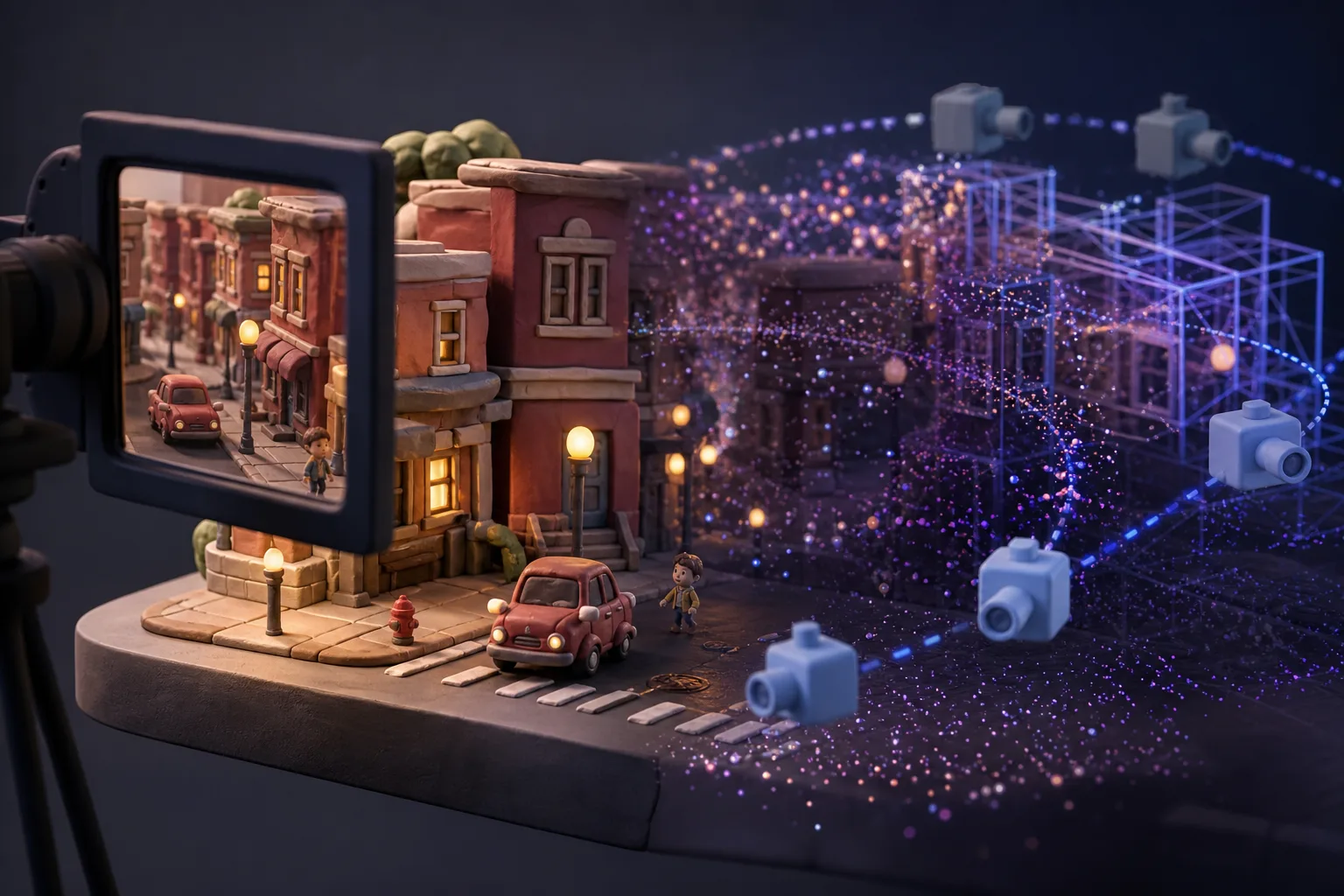
Neural rendering is beginning to dissolve that distinction. Instead of treating images merely as flat records, it learns a representation of the scene that produced them. The result can look like video while behaving more like 3D: viewers may move the camera, revisit an event from another angle, or place captured reality inside an interactive experience.
This is not simply a better special effect. It changes what a piece of footage is. For marketers and brand managers, that raises practical questions about production, reuse, approval, measurement, and rights. It also demands caution: a convincing reconstruction is not automatically accurate, editable, lightweight, or ready for every device.
From Recorded Frames to Navigable Scenes
The easiest way to understand neural rendering is to compare it with two familiar production methods.
A camera records the light reaching its sensor from a particular viewpoint. Move outside that viewpoint after filming, and the missing visual information does not magically exist. Traditional 3D graphics solves this by building a scene from models, textures, lights, and cameras, but that requires substantial manual work.
Neural rendering occupies the territory between them. It learns how a captured subject or environment should appear from viewpoints that were not present in the original footage. This task is known as novel-view synthesis.
NeRF: a scene stored as a learned field
A Neural Radiance Field, usually shortened to NeRF, represents a scene implicitly. Given a position and viewing direction, a neural network estimates properties such as color and density. A renderer samples many points along each camera ray and combines those estimates into an image.
The intuition is simpler than the implementation: rather than storing a conventional mesh, NeRF learns a compact function that answers, “What would this part of the scene look like from here?”
NeRF demonstrated that collections of ordinary images could produce strikingly realistic new views. Its implicit representation can describe fine appearance effects, but rendering normally requires repeated neural-network evaluation. That can make training and playback expensive compared with established real-time graphics techniques.
3D Gaussian Splatting: visible building blocks
3D Gaussian Splatting takes a more explicit approach. It represents a scene with many soft, stretched ellipsoids called anisotropic Gaussians. Each primitive carries visual properties and can be projected—or “splatted”— onto the screen using GPU-friendly rasterization.
Because the representation consists of explicit primitives, it can avoid neural-network inference during rendering. Well-optimized implementations can deliver photorealistic views at interactive rates, and practitioner reports describe performance above 100 frames per second on consumer hardware. Such figures are not universal benchmarks: resolution, scene complexity, implementation, and hardware all matter.
The method has already appeared in capture and reconstruction workflows associated with tools such as DJI Terra, Polycam, and Luma AI. Its practical appeal is clear: it makes a scanned environment feel less like a slow research demonstration and more like media that can be explored.
Why the Boundary Between 3D and Video Is Moving
The shift is not that video is becoming a conventional polygon model. It is that capture, reconstruction, rendering, and generation are merging into a new media layer.
A neural scene can preserve photographic detail while allowing virtual camera movement. That creates several possibilities:
- Reframing after capture: A production team may choose alternate angles or camera paths after recording, within the coverage supported by the source images.
- Interactive product viewing: A physical display, vehicle interior, property, or event installation can become a navigable experience rather than a fixed clip.
- Reusable campaign environments: One capture may support linear video, interactive web content, spatial presentations, and virtual-production backgrounds.
- Telepresence and events: A scene can potentially convey both the appearance and spatial arrangement of a place instead of transmitting only a rectangular feed.
- Visual effects integration: Captured locations can become camera-aware elements in a compositing or virtual-production workflow.
Static scenes are only part of the story. Dynamic Neural Radiance Fields and 4D Gaussian Splatting add time to the representation. Instead of describing only where visual content exists, they also model how it changes.
In Gaussian approaches, that can mean giving primitives time-varying positions, shapes, or appearance. One public 4DGaussians implementation reports optimization times of roughly eight minutes on D-NeRF datasets and 30 minutes on HyperNeRF datasets. These are dataset-specific research results, not promises for commercial shoots, but they show why explicit dynamic representations are attracting attention.
Generative AI is entering the same pipeline. Researchers are exploring feed-forward systems that predict Gaussian representations directly, potentially reducing the need to optimize every scene from scratch. Other work seeks more structured control in image space. The direction is toward systems that capture faster and respond more predictably to creative instructions, although the level of control still falls short of a mature, fully authored 3D scene in many cases.
What the Benchmarks Reveal—and Conceal
Neural-rendering comparisons often emphasize speed or image quality, but headline numbers can be misleading without a controlled setup.
Common image metrics include:
- PSNR, which measures pixel-level reconstruction error. Higher values usually indicate closer reproduction.
- SSIM, which compares structural similarity rather than only raw pixel differences.
- LPIPS, which uses learned visual features to estimate perceptual similarity.
For example, the gsplat evaluation of a 30,000-step, single-GPU 3D Gaussian Splatting implementation reports an average PSNR of 28.95 and SSIM of 0.870 across seven Mip-NeRF 360 scenes, with 5.7 GB of training memory. Those figures are useful because the dataset and setup are identified. They should not be turned into a universal promise about all scenes or devices.
Broad comparisons sometimes place 3D Gaussian Splatting above 100 frames per second and NeRF near 5 frames per second, with Gaussian training measured in minutes rather than hours. These estimates communicate the general performance difference between explicit rasterization and repeated network evaluation. They do not replace same-hardware tests at the same resolution with equally optimized code.
More importantly, visual fidelity is not geometric truth. A reconstruction can produce persuasive views while locating surfaces incorrectly. Image metrics may reward plausible appearance even when depth, scale, edges, or object boundaries are unsuitable for measurement.
That distinction changes the buying question. A campaign background may only need to look convincing from approved camera paths. A digital twin used for inspection, robotics, sizing, or product fit needs dependable geometry. In those contexts, teams should evaluate depth error, surface consistency, and geometric measures such as Chamfer distance alongside image quality.
The right benchmark therefore depends on the job:
- For linear content, inspect the exact shots that will be delivered.
- For interactive content, test motion quality, latency, and artifacts across the allowed viewing area.
- For spatially accurate applications, validate geometry independently of visual appearance.
- For distribution, measure model size, startup time, memory consumption, and target-device performance.
What This Changes for Brand and Production Teams
The most immediate opportunity is not replacing every existing 3D pipeline. It is capturing real places and objects that would otherwise be expensive to rebuild manually.
Consider a temporary retail installation. A standard video records a guided tour. A neural reconstruction could preserve the space as a navigable scene, support multiple edits, and provide new virtual camera paths after the installation has been dismantled. The value comes from extending the useful life of the capture.
The same logic applies to product launches, hospitality spaces, exhibitions, property marketing, automotive interiors, and behind-the-scenes content. Yet success depends on designing the capture for future viewpoints rather than treating reconstruction as an automatic rescue process.
Production planning must move upstream
Teams should decide before shooting whether the output is a fixed film, a free-viewpoint experience, or both. Neural reconstruction benefits from broad visual coverage, stable exposure, visible surface detail, and controlled motion. Reflective objects, transparent materials, changing light, and moving people can complicate the learned scene.
Brand governance also becomes more important. If viewers can move the camera, they may see angles that were never composed for publication. Sets, packaging, safety details, bystanders, and licensed material need review across a volume, not just across an edit timeline.
Approval processes should therefore specify:
- permitted camera regions and viewing angles;
- which parts of the scene may be cropped or masked;
- whether visual realism or spatial accuracy is the priority;
- where the experience will run and on which devices;
- how source footage, reconstructed scenes, and derived edits may be reused.
This is a change in asset strategy. The master may no longer be a final video file. It may be a captured scene from which videos, stills, and interactive outputs are rendered.
The Obstacles Between a Demo and a Durable Workflow
3D Gaussian Splatting improves rendering speed, but it can create scenes containing millions of primitives. That produces storage, memory, and transmission costs—especially when content must load quickly over a network or run on compact hardware.
Compression research attacks this problem in two distinct ways. Compaction reduces the number of Gaussians through better densification or pruning. Compression reduces the number of bits needed to store each primitive. The distinction matters: fewer primitives and smaller primitives are not the same optimization.
Aggressive quantization can shrink files but eventually harms rendering quality. NeuralGS explores a hybrid solution, combining the compactness of neural fields with the efficient rendering of Gaussian splats. This convergence suggests that the long-term winner may not be one pure representation, but a practical mixture of learned and explicit components.
Real-time use imposes another constraint. A 60-frames-per-second experience has only about 16.67 milliseconds for each frame, and neural rendering must share that budget with interaction, animation, interface logic, and display work. Mobile devices add power, heat, and memory limits. Compression, quantization, pruning, and hardware-aware optimization are therefore deployment requirements, not finishing touches.
Creative control remains uneven as well. Traditional 3D pipelines separate geometry, materials, lights, and animation so artists can adjust each component. Neural representations often entangle those properties. Relighting a capture, removing an object, changing a material, or correcting one moving element may be much harder than moving a conventional 3D light or editing a mesh.
For now, the strongest workflows are often hybrid: neural capture for photographic richness, conventional tools for layout and control, and compositing for the final presentation.
Quick Checklist
- Define whether the output needs fixed shots, limited navigation, or free exploration.
- Capture enough viewpoints to cover every approved camera region.
- Test reflective, transparent, moving, and weakly textured subjects early.
- Evaluate visual quality and geometric accuracy as separate requirements.
- Benchmark loading time, memory, latency, and frame rate on target devices.
- Establish rights and approval rules for the entire visible scene, not only selected shots.
- Keep conventional 3D or compositing options available where precise editing is essential.
- Archive source images, camera information, trained representations, and final renders separately.
Frequently Asked Questions
Is neural rendering the same as generative video?
No. Neural rendering usually reconstructs or renders a scene from captured observations, while generative video may synthesize frames from prompts or other inputs. The fields increasingly overlap when generative models predict scene representations or fill missing observations, but their goals and reliability are not identical.
Will 3D Gaussian Splatting replace NeRF?
Not necessarily. Gaussian splats offer major advantages in rendering speed and explicit manipulation, while neural fields can provide compact, continuous representations. Work such as NeuralGS indicates that future systems may combine their strengths rather than select only one.
Can a neural reconstruction be used for measurement?
Only after geometric validation. Photorealistic novel views do not prove that surfaces, scale, or depth are correct. Measurement-sensitive applications require appropriate calibration and geometry-focused evaluation.
Does neural rendering eliminate traditional 3D work?
It can reduce manual reconstruction for captured environments, but it does not automatically provide clean topology, separate materials, controllable lighting, or production-ready animation. Conventional 3D remains valuable wherever exact structure and art direction matter.
What should marketers test first?
Choose one bounded use case with clear camera limits, such as an interactive showroom area or a set of post-capture product angles. Compare it with a conventional video and 3D workflow using quality, turnaround, editability, loading performance, and reuse—not novelty alone.
Final Thoughts
Neural rendering matters because it makes capture computational rather than final. A recorded scene can become a source of new viewpoints and formats, shifting production from “choose the shot now” toward “define the navigable scene.” For brands, that is a meaningful expansion of what filmed content can become.
The bigger picture is not a simple contest between video and 3D, or between NeRF and Gaussian splats. The evidence points toward hybrid systems that combine photographic capture, learned representations, explicit primitives, and conventional rendering. Each component solves a different part of the problem.
In practice, visual plausibility will arrive before universal controllability. Teams should embrace the new flexibility without confusing a beautiful reconstruction with accurate geometry or a research benchmark with deployment readiness.
What matters most is not whether neural rendering can produce an impressive orbit around a scene. It is whether the resulting representation is governable, editable, distributable, and useful across the life of a campaign. That is the boundary worth watching: not merely where 3D meets video, but where footage becomes a reusable spatial medium.
Sources
- 3D Gaussian Splatting vs NeRF: Neural Rendering Methods Compared | THE FUTURE 3D
- NeuralGS: Bridging Neural Fields and 3D Gaussian Splatting for Compact 3D Representations
- A Comparative Evaluation of Geometric Accuracy in NeRF and Gaussian Splatting
- 4D Gaussian Splatting for Sparse-Frame Dynamic Scene ...
- Neural Rendering Fundamentals
- GitHub - hustvl/4DGaussians: [CVPR 2024] 4D Gaussian Splatting for Real-Time Dynamic Scene Rendering · GitHub
- [PDF] Neural rendering and deep learning in virtual production
- Comparing Neural Rendering Techniques for Video Game Graphics
- How to Reduce Latency in Neural Rendering Applications
- 3D generation with NeRF
- Evaluation - gsplat documentation
- NeuralGS: Bridging Neural Fields and 3D Gaussian ...
Ready to Get Started?
Explore production-ready 3D models for your next project. Browse the 3D model catalog to download assets you can use right away.
Turn this workflow into real deliverables
Browse production-ready 3D models for your next project, then step into 3d product animation if you need a custom build.