Build an Ecommerce AI Evaluation Set That Reflects Reality
Introduction
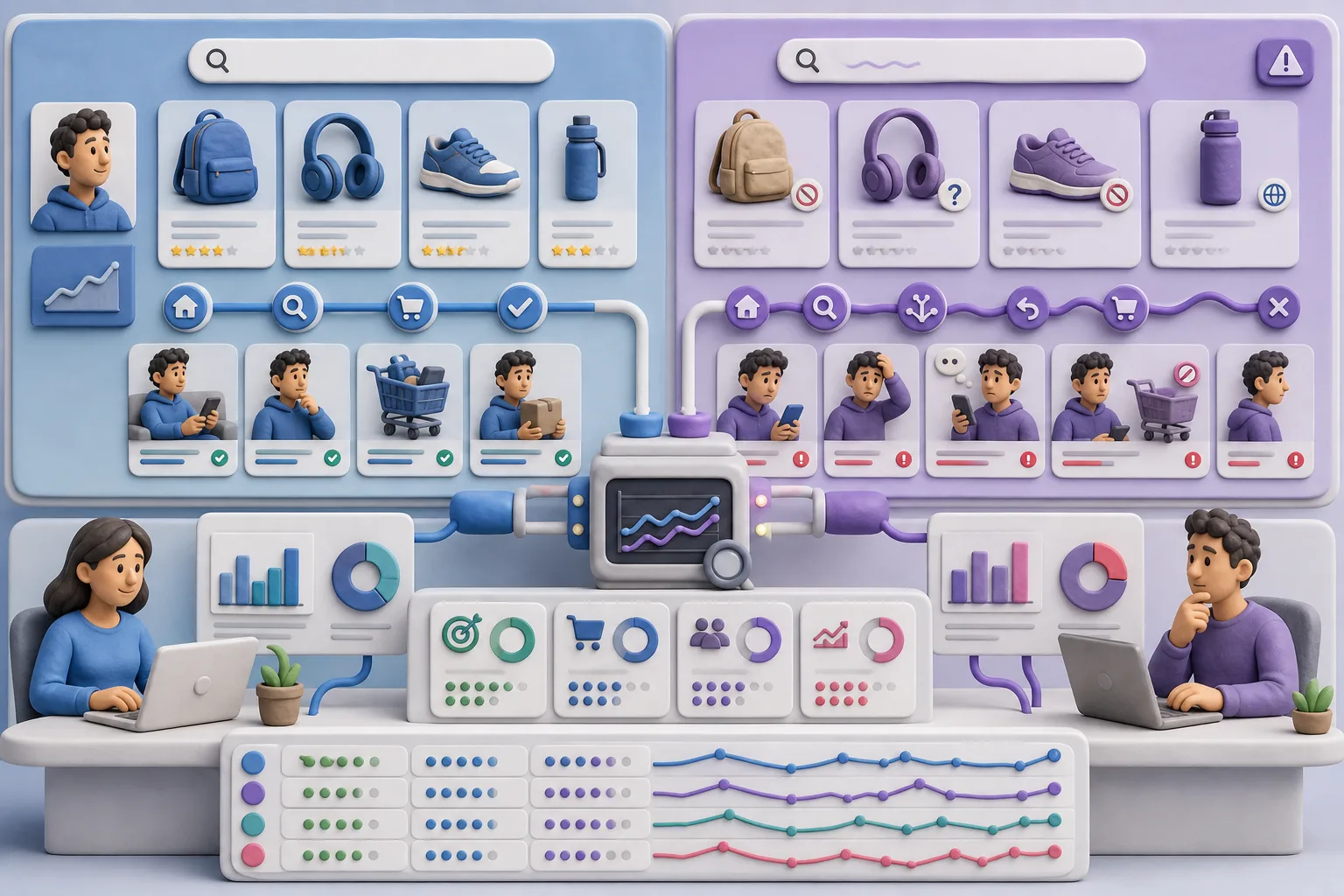
A polished AI demonstration can make buying decisions feel deceptively easy. The assistant understands every question, product search results look immaculate, and recommendations seem almost clairvoyant. Then the system meets a real catalog full of missing attributes, regional restrictions, discontinued products, misspelled queries, and customers who change their minds halfway through a conversation.
That gap is why ecommerce AI should be evaluated against a real-world test set before contracts are signed. A test set is a controlled collection of customer requests, catalog conditions, expected outcomes, and known failure cases. It turns an impressive demonstration into a repeatable business assessment.
Vendor benchmarks still have value, especially when they involve similar industries, languages, and data types. But they are preliminary evidence—not proof that a tool will perform well in your environment. The purchasing decision should rest on a paid proof of concept using your data, measured against your current system and predeclared acceptance thresholds.
For marketing professionals and brand managers, this is not merely a technical exercise. Search relevance affects product discovery. Incorrect claims affect trust. Recommendation quality shapes merchandising. Response speed influences the customer experience. The evaluation set connects all of those commercial concerns to evidence that procurement teams can compare.
Start With the Business Decision, Not the AI Model
Before collecting test cases, define what the proposed ecommerce AI is supposed to improve. “Deliver better personalization” is too vague to evaluate. “Increase the share of relevant products shown for high-intent searches without displaying unavailable items” is considerably more useful.
Each objective should identify four things:
- The task: What will the system actually do?
- The current baseline: How well does the existing process perform?
- The acceptance threshold: What minimum improvement justifies adoption?
- The guardrails: Which failures are unacceptable, regardless of average performance?
Baselines may include conversion, response time, processing time, error rate, labor cost, manual-review rate, or escalation rate. The right measure depends on the use case. A customer-service assistant and a catalog-enrichment system should not be judged by the same definition of success.
Thresholds must be fixed before testing. Otherwise, teams can unconsciously favor a preferred vendor by emphasizing whichever metric looks strongest afterward. A system should not win simply because it is the best of a weak shortlist; it should clear the minimum level the business established in advance.
Guardrails deserve special attention. An assistant that produces fluent answers but invents product specifications may score well in a broad satisfaction review while creating serious commercial risk. The same applies to recommendations for unavailable products, incorrect return-policy claims, or an automated action that should have required human approval.
Treat those outcomes as pass-or-fail conditions rather than minor deductions in a blended score. Averages can hide rare but costly mistakes.
Build the Evaluation Set From Real Commerce
The strongest evaluation material usually comes from the business itself: search logs, support conversations, product catalog records, purchase histories, merchandising rules, returns, and failed customer journeys. Data should be appropriately authorized, minimized, and sanitized before it is shared with vendors.
Do not simply draw a random sample and call it representative. A useful set contains routine cases in realistic proportions, but it also deliberately includes unusual situations that could harm customers or the brand. Rare failures deserve more attention than their frequency alone might suggest.
Each case should record:
- The customer input or business request
- Relevant context, such as locale, device, customer status, and conversation history
- The catalog, inventory, pricing, and policy state at that moment
- The expected result or acceptable range of results
- Explicitly forbidden outcomes
- The case source and review date
- Business importance and failure severity
- Any reason the case requires human escalation
Time matters. A product answer that was correct three months ago may be wrong today because stock, pricing, specifications, or policies changed. Keep dated catalog snapshots where historical reproduction is necessary, and use current feeds when the product promises live grounding.
Cover the Full Customer Journey
An ecommerce AI evaluation set should extend beyond a handful of product questions. Include cases from multiple stages of the journey.
Intent and discovery: Test autocomplete, vague queries, spelling mistakes, synonyms, category language, and searches that combine several requirements. “Lightweight waterproof coat for commuting” is more revealing than a simple product-name lookup.
Comparison and refinement: Ask the system to distinguish between similar products, apply filters, explain relevant differences, and preserve constraints as shoppers refine their requests. Verify every factual comparison against catalog data.
Recommendations: Use representative behavioral signals, purchase history, stated preferences, and product availability. Generic prompts cannot reveal whether personalization is useful, repetitive, insensitive to context, or overly dependent on popular products.
Purchase confidence: Test questions about dimensions, compatibility, ingredients, materials, delivery, returns, warranties, pricing, and stock. One reliability source reports that 89% of shoppers verify AI-provided information before buying, which illustrates the commercial importance of factual claims. Buyers should still interpret any single externally reported statistic cautiously and focus on their own observed customer behavior.
Post-purchase service: Include order changes, delivery problems, return eligibility, damaged goods, and cases requiring an expert. Multi-turn scenarios should verify that the system gathers the necessary information, recommends an appropriate action, and transfers the customer without making them repeat the entire story.
Operational workflows: If the purchase covers catalog enrichment, forecasting, or other internal tasks, create separate cases with their own expected outputs and review rules. Do not assume success in a customer-facing chatbot proves competence in back-office operations.
Include Difficult and Unfamiliar Inputs
Real customers do not communicate like demonstration scripts. Add noisy, incomplete, contradictory, and out-of-distribution inputs—requests unlike the system’s usual examples.
Useful cases include:
- Misspellings, slang, abbreviations, and mixed-language queries
- Products with incomplete or conflicting attributes
- Recently discontinued or out-of-stock items
- Nonexistent products and unsupported specifications
- Stale inventory or pricing data
- Requests combining incompatible constraints
- Customers who reverse a preference mid-conversation
- Questions outside the assistant’s approved scope
- Attempts to obtain private, restricted, or internal information
- Situations where the correct response is uncertainty or escalation
The point is not to trick the system. It is to observe how performance degrades when reality becomes messy. A trustworthy tool should fail safely rather than compensate for missing information with confident invention.
Separate Development Cases From Final Tests
Vendors need some visible examples to configure integrations, map catalog fields, and understand business rules. However, if they tune directly against every evaluation case, the final score may reflect familiarity with the test rather than general performance.
Keep a hidden portion for the final assessment. The vendor can understand the schema and evaluation rules without seeing every input and expected answer. Refresh this set as products, policies, customer language, and failure patterns evolve.
Score Quality, Speed, Risk, and Commercial Value
No single metric captures whether ecommerce AI is worth buying. The scorecard should combine task quality with reliability, operational performance, implementation effort, and business impact.
Match Metrics to the Task
For classification tasks, accuracy may be sufficient when categories are balanced and mistakes have similar consequences. When missed cases and false alarms matter differently, measures such as precision, recall, or F1 provide a more informative view. F1 is simply a combined measure that rewards systems for both finding relevant cases and avoiding incorrect flags.
Generative answers need human review as well as automated checks. Reviewers can score factual grounding, completeness, policy compliance, clarity, actionability, and whether an escalation was handled correctly. Define the rating instructions before anyone sees vendor identities or aggregate results.
Search and recommendation cases should be judged on whether the returned products satisfy the customer’s intent, constraints, availability requirements, and merchandising rules. A click is not automatically proof of relevance, and relevance is not automatically proof of incremental revenue.
Measure the Experience Customers Actually Receive
Latency is the time between a request and a response. An average can conceal slow experiences, so measure multiple points in the distribution, including P50, P95, and P99. P50 represents a typical response, while P95 and P99 expose what customers encounter near the slower end.
Test latency under realistic traffic and with real integrations enabled. Promotional claims about extremely fast search can be useful prompts for investigation, but they should not become procurement benchmarks without controlled verification.
Also track error rates, timeouts, failed tool calls, abandoned conversations, manual interventions, and escalation quality. A fast answer is not valuable if it uses stale stock data or forces an agent to repair the interaction.
Connect Offline Scores to Business Economics
The evaluation set shows whether a system can perform defined tasks. It does not, by itself, prove return on investment. A promising vendor should advance to a controlled pilot where teams can measure customer and operational outcomes against the incumbent process.
Relevant outcomes may include conversion, gross margin, labor saved, resolution time, manual-review volume, returns, or support demand. Include the full cost of integration, data preparation, monitoring, human oversight, vendor fees, and ongoing maintenance.
Keep causal claims modest. If conversion rises during a seasonal campaign, AI may not deserve all the credit. Comparable evaluation windows and controlled exposure make the evidence more credible.
Run a Fair, Decision-Grade Proof of Concept
Shortlisted vendors should face the same historical data, catalog conditions, acceptance criteria, and evaluation window. Run them in parallel where practical and compare every candidate with the existing system. Changing the dataset or success definition between vendors turns the process into separate demonstrations rather than a head-to-head test.
Fairness also means offering equivalent configuration opportunities. One supplier should not receive weeks of tuning, direct access to subject-matter experts, and complete data mappings while another receives a raw export and two days. Record integration hours and internal support effort because hidden implementation burden affects the business case.
A decision-grade proof of concept should include:
- A frozen evaluation set and a protected final-test subset
- The incumbent system as a baseline
- Identical quality, latency, and guardrail definitions
- Realistic integrations and catalog feeds
- Load tests reflecting expected demand
- Blind or standardized human review where possible
- A documented analysis of failure patterns, not just total scores
- Operational measures such as integration effort and support responsiveness
Some procurement guidance recommends a proof of concept lasting at least four weeks rather than relying on a brief demo environment. The appropriate duration depends on traffic, seasonality, use case, and sample volume, but the pilot must be long enough to expose recurring operational problems.
Legal and procurement review should run alongside technical testing. Clarify ownership of inputs and outputs, retention of customer data, security controls, data portability at exit, and dependence on an underlying foundation model. A strong test score does not neutralize unacceptable contract or compliance risk.
Finally, require vendors to explain failures. Look for candor about performance degradation, monitoring, data freshness, fallback behavior, and model changes. A supplier that acknowledges limitations and provides a credible control plan may be safer than one promising near-perfect intelligence.
Quick Checklist
- Define the business task, current baseline, minimum improvement, and non-negotiable guardrails before contacting vendors.
- Build cases from real searches, conversations, catalog records, customer behavior, and operational workflows.
- Include noisy inputs, stale data, unavailable products, unsupported claims, multi-turn journeys, and safe-escalation cases.
- Record expected outcomes, forbidden outcomes, context, data date, severity, and reviewer guidance for every case.
- Give shortlisted vendors equivalent data, configuration support, criteria, and evaluation windows.
- Measure task quality, factual grounding, P50/P95/P99 latency, error rates, integration effort, and commercial outcomes.
- Review security, compliance, intellectual property, data portability, and foundation-model dependency before purchase.
Frequently Asked Questions
How large should an ecommerce AI evaluation set be?
There is no universally correct size. It must be large and varied enough to cover important tasks, customer segments, languages, catalog conditions, and harmful edge cases. Prioritize coverage and reviewer consistency over collecting a large volume of repetitive examples.
Can vendor benchmark results replace an internal evaluation?
No. Benchmarks can reveal whether a vendor has experience with similar industries, languages, and data types, but they do not reproduce your catalog, customer behavior, policies, integrations, or brand risks. Treat them as evidence for shortlisting, then test with your own data.
Should all evaluation cases come from historical logs?
No. Historical data provides realism but may omit new products, emerging customer language, rare failures, and situations the current system never handled. Combine observed cases with carefully designed scenarios for high-risk and unfamiliar conditions.
What is the biggest warning sign during a pilot?
Confidently wrong answers are especially dangerous in commerce. Watch for fabricated specifications, nonexistent products, incorrect policies, stale pricing, and recommendations for unavailable items. Also investigate whether the system admits uncertainty and escalates appropriately.
Does the vendor with the highest average score automatically win?
Not necessarily. Averages can hide severe failures, slow tail latency, high integration costs, or contract risks. The winning system must clear every acceptance threshold and guardrail while producing a credible business case—not merely outperform another weak candidate.
Final Thoughts
In practice, the evaluation set is less a machine-learning artifact than a written definition of what the business considers acceptable. It forces marketing, merchandising, service, engineering, legal, and procurement teams to agree on customer value and risk before vendor enthusiasm takes over.
The most important judgment is that realism matters more than theatrical difficulty. A test should not be a collection of riddles designed to embarrass an AI system. It should reproduce the ordinary complexity of commerce, while giving disproportionate attention to failures that could mislead customers or damage trust.
The second judgment is that quality and speed cannot be separated from implementation and governance. A highly capable model may still be the wrong purchase if it requires excessive manual oversight, performs poorly at peak demand, or creates unacceptable control over data and infrastructure.
The bigger picture is that ecommerce AI procurement should resemble disciplined product development, not software shopping. Define the customer problem, measure the current experience, test competing approaches under equal conditions, and be willing to reject every vendor if none clears the threshold. The evaluation set gives decision-makers something more valuable than confidence in a demo: a defensible reason to buy—or not to buy.
Sources
- AI Vendor Selection: Evaluation Criteria and Checklist
- A Step-by-Step Guide to Building Robust Evaluation Datasets for AI Agents
- AI Vendor Evaluation: You Decided to Buy AI. Now What?
- E-Commerce AI Accuracy & Reliability Engineering
- AI Contract Risk Detection: How Procurement Teams Evaluates?
- AI Vendor Selection Framework: Evaluate, Score & Choose
- AI Agent Evaluation Checklist for Ecommerce (2026)
- AI Commerce Checklist for BFCM: 10 Essential Steps | Gavin Hewitt posted on the topic | LinkedIn
- E-commerce Test Automation: AI Testing for Online Stores 2025
- AI in Ecommerce: A Comprehensive Guide + 10 Use Cases | Constructor
- AI customer service use cases: Top 5 examples - ASAPP
- Ecommerce Customer Experience: 7 Proven Strategies
Ready to Get Started?
Explore production-ready 3D models for your next project. Browse the 3D model catalog to download assets you can use right away.
Turn this workflow into real deliverables
Browse production-ready 3D models for your next project, then step into 3d modeling if you need a custom build.