How AI Marketing Automation Rewires the Customer Lifecycle
Introduction
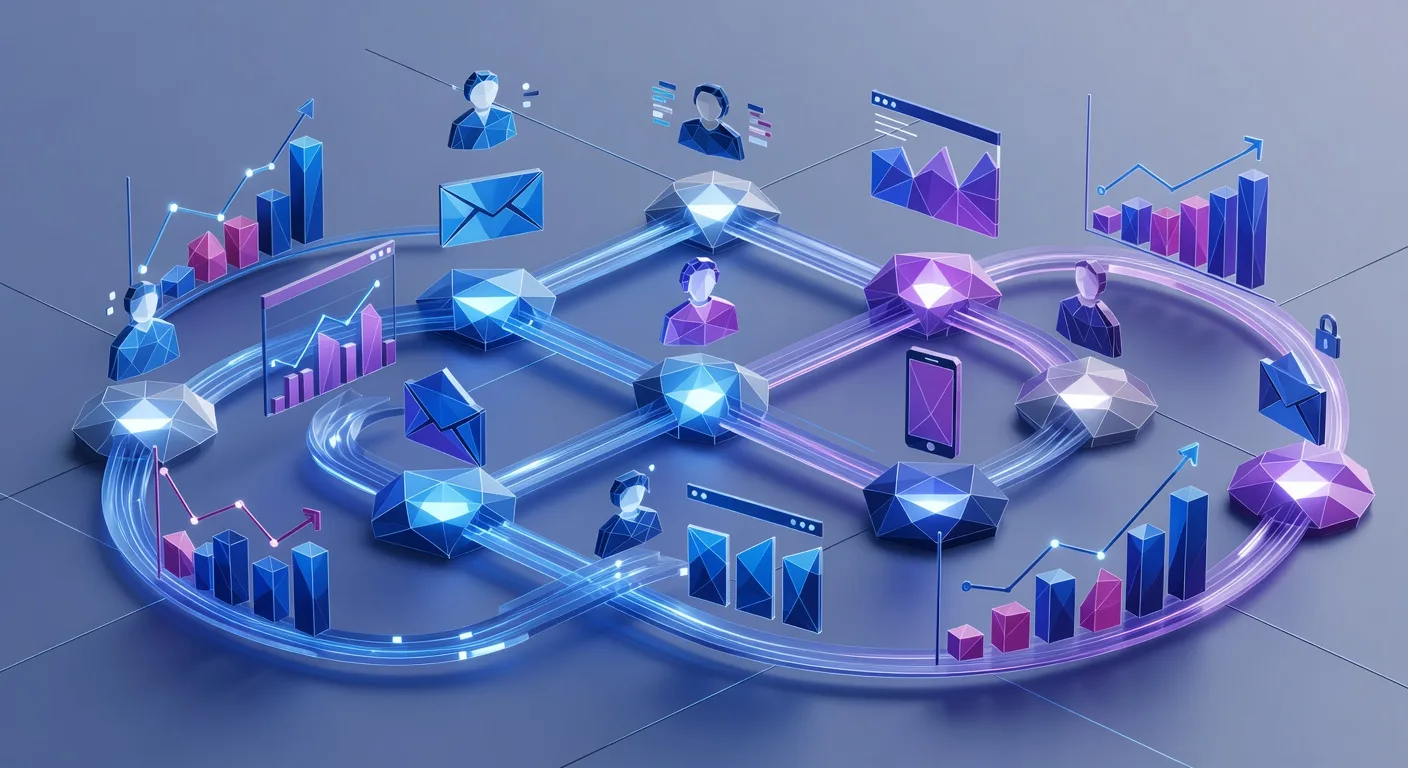
Across every industry, the customer journey is becoming a living system instead of a linear funnel. AI-powered marketing automation now reads behavior in real time, predicts what will matter next, and coordinates the best action across channels. The practical impact is felt across the lifecycle: cleaner onboarding, steadier engagement, fewer defections, and smarter win-back.
Evidence from recent research and case work points to a simple principle: optimize for long-term value, not single-campaign wins. Predictive customer lifetime value (CLV) models help marketers focus on where sustained profit comes from, while journey orchestration ensures each touchpoint earns its keep. Combined, these capabilities are turning lifecycle marketing from a playbook into an operating system.
This article explains what materially changes, how to measure it, and how to deploy responsibly. It is written for marketing leaders who want results without wading through math-heavy jargon.
From campaigns to lifecycle systems
Traditional campaigns push the same message to broad segments on a schedule. AI-powered systems do the opposite: they watch, predict, and adapt. Instead of manual handoffs between teams, a shared decisioning layer coordinates content, channel, and timing.
Three shifts define this change:
- Decisions move from batch to real time, reacting to behavior the moment it happens.
- Optimization moves from click-throughs to CLV, emphasizing compounding gains over quick spikes.
- Personalization moves from static segments to next-best-action recommendations.
A peer-reviewed perspective on predictive CLV argues that profit growth accelerates when marketers prioritize high-value segments and reallocate spend across the journey. That means fewer blunt discounts and more targeted investments where the odds of long-term return are highest. In parallel, journey orchestration tools align teams on a single playbook, reducing conflicting offers and message fatigue.
The result is more than incremental lift. When the system reinforces itself—better onboarding begets more engaged users, which makes churn prevention easier—small improvements stack into durable growth.
What AI changes at each stage
Acquisition
Acquisition used to optimize for the cheapest conversion. AI reframes that goal around predicted value. Instead of bidding equally on every lookalike, marketers weight media and offers by expected CLV. This avoids flooding the pipeline with low-value signups that will soon churn. Cross-channel orchestration then chooses whether to follow up with targeted ads, email, or both, based on a person’s responsiveness and context.
Onboarding
Onboarding is where momentum is won or lost. AI analyzes early behaviors—pages visited, features tried, support interactions—to predict the moments that build habit. It then serves micro-journeys that remove friction: a concise tutorial for one cohort, a first-purchase nudge for another. Brands see the effect in fewer drop-offs and a stronger first-week engagement curve, which later makes retention less costly.
Growth and engagement
Real-time personalization shifts growth from “send more” to “send right.” Platforms like Braze use behavioral triggers and automated A/B testing to tailor content, choose the best channel, and optimize send time. Litmus reports that email remains a central lever for engagement across lifecycle stages, with KPIs tuned to where a customer is in the journey. AI extends that playbook beyond email to in-app messaging, push, and paid media, maintaining consistency across surfaces.
Retention and churn prevention
Predictive churn models flag accounts that look likely to leave. A 2026 guide reports that churn prevention typically saves 30–50% of at-risk accounts when paired with targeted interventions. The key is to act before frustration hardens: escalate service, simplify billing, or reframe value with a personalized offer. Because retention protects prior acquisition spend, these saves compound; the payoff grows after year one as more customers remain active.
Win-back and reactivation
Win-back is no longer a single discount email sent months later. AI can infer why a customer disengaged—price sensitivity, feature confusion, competing priorities—and test messages tailored to that cause. Platforms like CleverTap have documented sizable retention lifts from automated journeys; in one public case, a consumer app achieved a material improvement in retention using real-time segmentation and triggered messaging. The broader lesson: timing, cause, and channel selection matter more than blunt incentives.
Orchestration in practice: real time, right channel
AI is most impactful when it coordinates decisions across tools. Tealium’s Next Best Action pattern illustrates how this works: ingest live events, enrich profiles with predictive scores, then pick the action—serve an ad, trigger an email, suppress a push—in milliseconds. Because orchestration spans hundreds of integrations, the same decisioning logic governs websites, apps, email, and media.
Braze adds a complementary layer: content optimization and send-time selection. Journey orchestration stitches steps so that if a customer reacts on one channel, the system adapts the next step automatically. Automated A/B testing keeps exploration running without manual effort, enabling the system to tighten its aim over time.
Practically, this reduces both over- and under-communication. High-intent users can be fast-tracked with fewer touches. Low-intent or fatigued users can be suppressed, saving budget and goodwill. The organization benefits, too: shared rules reduce channel turf wars and conflicting offers.
Measuring what matters: CLV-first KPIs
If you cannot measure CLV, you cannot optimize for it. A 2026 guide advises teams to set up CLV tracking before deploying automation. The reason is simple: personalization gains compound. AI-driven personalization typically lifts CLV by 20–35%, while churn prevention saves a large share of at-risk accounts; those two effects reinforce each other after the first year.
Translating CLV-first thinking into day-to-day KPIs:
- Acquisition: cost per predicted high-value customer, not just cost per lead.
- Onboarding: time to first value and first-week activation, sliced by predicted segment.
- Engagement: revenue per message and session depth by lifecycle stage (Litmus highlights stage-specific KPIs for email; extend that logic cross-channel).
- Retention: saves versus baseline churn and the margin impact of save tactics.
- Win-back: incremental reactivation rate and post-return survival.
Budget allocation should then reflect expected lifetime impact, not last-click attribution. That might mean funding message suppression for low-likelihood buyers—because preserving attention for a future launch is worth more than forcing an extra email today.
Governance and trust: designing for compliance
As automation grows more autonomous, so do the responsibilities. Several rules define the guardrails in 2026:
- Under GDPR Article 22, people can object to decisions made solely by automated processing. For significant decisions, offer meaningful human review to avoid falling into a prohibited category.
- In California, new rules effective January 1, 2026 allow consumers to opt out of Automated Decisionmaking Technology for significant decisions. Providing human review can change how that opt-out applies. Pre-use notices are required when profiling; generic privacy statements are not enough.
- Under the EU AI Act, high-risk AI obligations become enforceable on August 2, 2026. Customer journey mapping now doubles as a compliance artifact: document data sources, lawful bases, model purposes, and the touchpoints where decisions occur.
What does privacy-by-design look like in lifecycle marketing?
- Map the end-to-end journey with data lineage: what you collect, why, where it flows.
- Capture explicit consent for profiling, with clear value exchange and the ability to withdraw.
- Provide a path to human review for consequential decisions (e.g., eligibility, pricing tiers).
- Log automated decisions and outcomes for audit and model improvement.
- Respect channel preferences and frequency caps; suppression is a trust feature.
Treating these rules as design constraints makes systems stronger. Clear governance minimizes “model drift” into ethically messy terrain and protects hard-won customer goodwill.
Building a practical lifecycle playbook
You do not need a moonshot to see value. Start with a thin slice that improves a measurable stage, then expand.
- Align on CLV and stage KPIs
- Define how you will calculate CLV and how often you will refresh it.
- Set stage metrics that ladder up to CLV: activation, revenue per message, save rate.
- Stand up event and profile basics
- Stream key events (signup, browse, purchase, support) into a unified profile.
- Enrich with recency, frequency, and value signals to support predictions.
- Pilot next-best action on one journey
- Choose a high-traffic path, like onboarding or cart abandonment.
- Use Tealium-style orchestration to pick channel and Braze-style testing for content.
- Add churn prediction and save playbooks
- Score churn risk daily and trigger human or automated interventions based on severity.
- Track saved revenue and margin impact, not just counts of “wins.”
- Scale content and suppression together
- Grow your library of messages and offers, but scale suppression rules with equal care.
- Use Litmus-informed email KPIs as the backbone, then extend to push, in-app, and media.
- Bake in compliance and transparency
- Provide pre-use notices for profiling and a human-review path for meaningful decisions.
- Keep a living journey map; update it as you launch new automations.
Quick Checklist
Use this checklist to pressure-test your readiness and next steps.
- CLV calculation defined, refreshed regularly, and tied to budgets
- Stage KPIs set for acquisition, onboarding, engagement, retention, win-back
- Real-time events unified into a single, activation-ready customer profile
- Next-best-action pilot running with cross-channel orchestration
- Churn scoring live with tiered save tactics and measurement
- Email remains a backbone channel with stage-specific KPIs
- Consent, pre-use notices, and human review flows implemented
- Journey map and decision logs maintained for audit and learning
FAQ
How is AI-powered lifecycle marketing different from traditional automation?
Traditional automation triggers messages on static rules and fixed schedules. AI-powered systems adapt decisions based on real-time behavior and predicted outcomes. They coordinate content, channel, and timing as one decision, optimizing for CLV rather than single conversions.
Do I need complex models to start?
No. Begin by organizing events, profiles, and stage KPIs. A simple churn score or propensity model can drive meaningful gains when paired with clear interventions. As orchestration matures, incrementally add sophistication, guided by measurable lift against CLV.
What evidence suggests the ROI is durable, not a novelty spike?
A 2026 guide reports that AI-driven personalization typically increases CLV by 20–35%, while predictive churn prevention saves a large share of at-risk accounts. Because retention protects earlier acquisition spend, benefits compound—often strongest after the first year of disciplined execution.
Which channels matter most in a lifecycle system?
Email remains a central lever for engagement across stages, with KPIs tailored to each stage. AI extends this backbone across push, in-app, web, and paid media. Orchestration platforms like Tealium and Braze help choose the best channel per moment, suppressing noise and coordinating follow-ups.
How do privacy rules change day-to-day operations?
Plan for consent, pre-use notices, and the ability to route significant decisions to human review. Maintain a living journey map that documents data flows and decision points. These steps satisfy GDPR, California rules, and the EU AI Act—and they improve customer trust.
Final Thoughts
In practice, the biggest unlock is not algorithmic—it is managerial. When leaders make CLV the organizing metric and align budgets to it, AI becomes a force multiplier rather than a novelty. Gains from personalization and churn prevention then reinforce each other, building strength over time.
The bigger picture is orchestration. Tools that coordinate content, channel, and timing across systems beat any single-channel tactic. Email remains a dependable spine, but the win comes from harmonizing every touch—ads, app, push, and service—around the same decisioning logic.
On governance, the tradeoff is clarity for speed, and it is worth it. Consent, human review, and transparent profiling are not red tape; they are design inputs that reduce risk and deepen trust. With new obligations taking effect in 2026, teams that bake compliance into the journey will move faster later.
What this suggests for the year ahead: invest first in data plumbing and CLV measurement, pilot one tightly scoped next-best-action loop, and pair every new message with an equally thoughtful suppression rule. The brands that compound advantages are the ones that play the long game—measured, orchestrated, and trusted.
Sources
- AI-Powered Predictive Customer Lifetime Value: Maximizing Long-Term Profits
- AI-Driven Marketing Automation: Complete 2026 Guide
- [PDF] Lifecycle Marketing Report - Litmus
- AI Activation Use Case: AI-Powered Next Best Action - Tealium
- The case for AI marketing personalization | Braze
- Mobile Marketing eBooks, Webinars, Case Studies - CleverTap
- Customer Journey Mapping Under GDPR & CCPA: How to Embed Privacy at Every Touchpoint | Secure Privacy Blog
- AI Data Privacy: Navigating GDPR and CCPA - Reform.app
- The ethics of AI in CX: Balancing innovation with privacy | CallMiner
Ready to Get Started?
Explore production-ready 3D models for your next project. Browse the 3D model catalog to download assets you can use right away.
Turn this workflow into real deliverables
Browse production-ready 3D models for your next project, then step into 3d modeling if you need a custom build.