How MCP Is Rewiring AI Workflow Interoperability
Introduction
Marketing teams once treated artificial intelligence as a clever writing assistant. Now the ambition is broader: ask an AI system to inspect campaign results, retrieve approved claims, update a brief, and open a task without hopping across five applications. The obstacle is rarely the language model alone. It is the plumbing between models, data, permissions, and software. Every custom connector adds cost, fragility, and another place where governance can fail. Model Context Protocol, usually called MCP, proposes a common connection pattern. Its promise is not magical autonomy. It is more reusable infrastructure for AI workflow automation, with important limits.
Why MCP Matters Now
Traditional application programming interfaces already let software exchange data and trigger actions. The problem is that AI applications need more than a fixed endpoint. They must discover available tools, understand descriptions, receive context, and know what interactions a connected system supports. Teams have often solved this with one-off integrations written for a particular model, assistant, or workflow. That approach scales poorly. A change to authentication, tool naming, or output structure can ripple through every assistant that uses it. MCP addresses the interface layer so builders can spend less effort reinventing connections and more effort designing outcomes.
How the Host, Client, and Server Fit Together
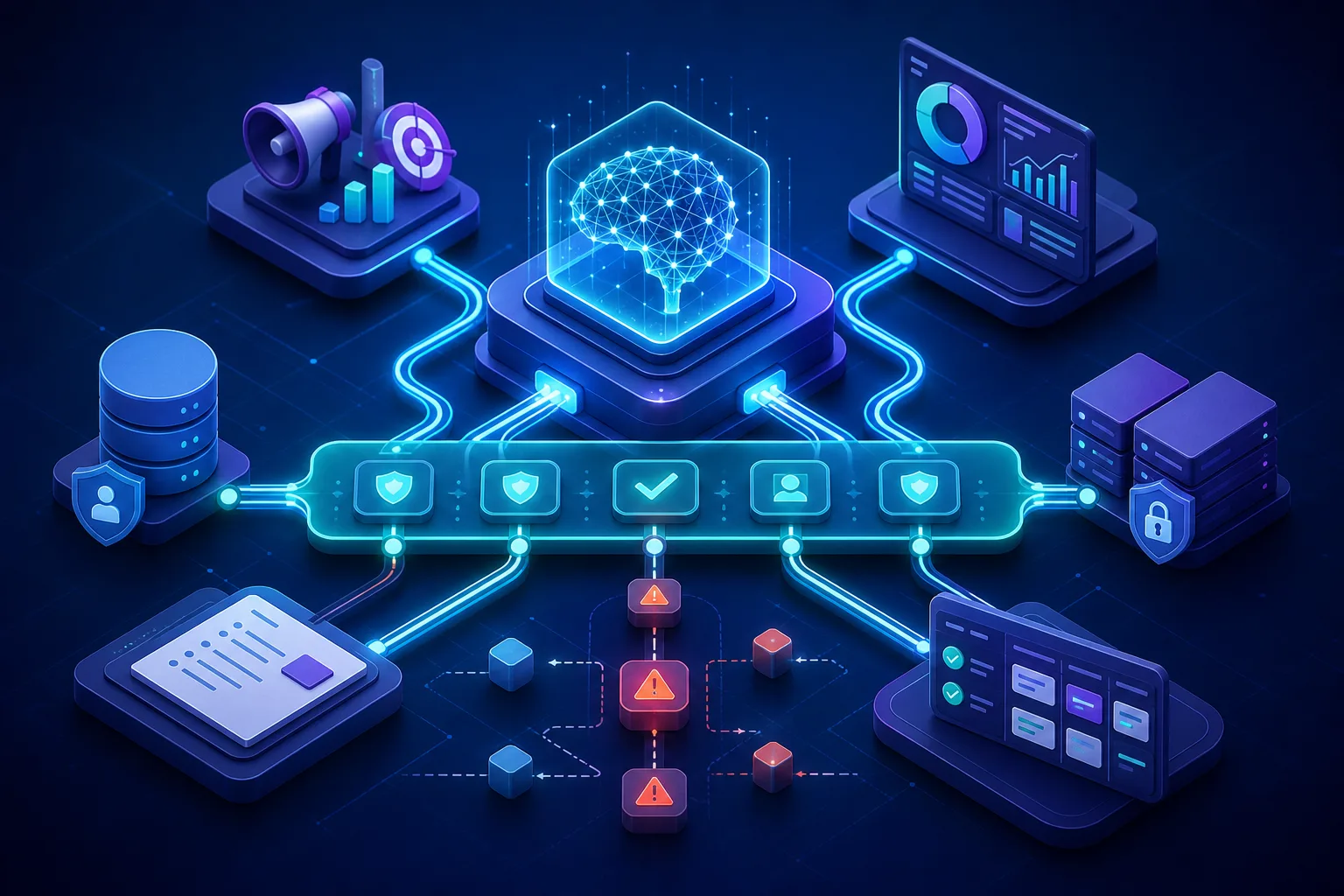
MCP uses a host, client, and server architecture. The host is the AI application people interact with, such as a chat interface or coding assistant. Inside it, an MCP client maintains a connection to a particular server. The server exposes resources, prompts, or tools that the application can use. A server might provide access to brand guidelines, campaign files, reporting queries, or workflow actions. This separation keeps the model from being permanently fused to every external system. It also creates clearer boundaries for ownership, deployment, testing, and replacement as needs evolve safely.
A connection starts with an initialize request. Client and server agree on a protocol version and declare supported capabilities before normal work begins. Clients may advertise features such as roots, sampling, and elicitation; roots can identify relevant filesystem boundaries, sampling lets a server request model generation through the client, and elicitation supports requesting additional user input. Capability negotiation matters because shared vocabulary does not imply identical features. Well behaved participants should call only functions the other side announced. The broader lifecycle also covers operation, errors, timeouts, and shutdown, making the connection more disciplined than an informal prompt plus plugin arrangement.
What Interoperability Changes for Marketing Teams
MCP changes the economics of experimentation before it changes strategy. When analytics, content, and workflow systems expose reusable interfaces, teams can test assistants without rebuilding every connection from scratch. A brand manager could ask for a launch summary grounded in approved messaging, recent performance data, and open production tasks. The assistant could gather inputs through separate servers and present a draft for review. That workflow is more interesting than isolated copy generation because it connects insight, governance, and execution. Still, the value comes from thoughtful orchestration, not merely connecting many tools at once.
Four Practical Use Cases
- Campaign intelligence: Combine metrics definitions, reporting queries, and planning documents so an assistant can explain performance. Keep the source data visible and require a person to approve recommendations.
- Content operations: Retrieve current tone guidance, legal disclaimers, product facts, and audience rules before drafting. This reduces searching but does not replace editorial review.
- Customer insight: Let an assistant query governed research repositories and summarize recurring themes without granting broad access to every customer record.
- Workflow coordination: Create briefs, tasks, or review requests after explicit confirmation. Use narrowly scoped actions rather than giving the agent general administrative privileges.
The Portability Question
A server that follows MCP should be easier to reuse across compatible hosts than a custom connector embedded in one product. Developer tooling offers a concrete signal: GitHub Copilot agent mode in Visual Studio Code gained expanded MCP support, including local and remote servers. Official demonstrations have shown both installing remote servers and building a custom local one. That indicates movement beyond experimental chat interfaces. However, portability should not be confused with identical behavior. Hosts may present permissions, tool approvals, discovery, and user interaction differently. Migration testing remains necessary, especially where actions affect customers or published content.
Risks and Limits of Standardization
Standardization can improve security by creating consistent places to apply controls. It can also increase the blast radius of a mistake because one assistant may reach many systems. MCP messages can carry instructions, data, and requests for action. If a malicious document manipulates the model, a poorly constrained tool could turn misleading text into an unauthorized operation. The protocol therefore belongs inside a security design. Least privilege, explicit consent, input validation, output filtering, logging, server monitoring, and anomaly detection remain essential. Treat every server as a software dependency and every tool call as a transaction.
Prompt based attacks deserve special attention. A model can read untrusted material that contains hidden or persuasive directions, then mistake those directions for legitimate workflow instructions. Traditional API controls are necessary but insufficient because the decision layer is probabilistic and influenced by language. Reduce exposure by separating read tools from write tools, limiting accessible records, requiring confirmation before external changes, and recording who initiated each action. Credentials should stay outside prompts and server descriptions. Teams should also inspect tool metadata for misleading names or instructions and reassess permissions whenever a workflow expands. Convenience should never silently widen authority or access.
Why Gateways Are Emerging
Enterprises are increasingly considering MCP gateways, a control layer between hosts and servers. The idea resembles API management: centralize authentication, policy enforcement, observability, routing, and governance rather than implementing them independently for every connection. A gateway can help inventory servers, restrict destinations, standardize logs, and revoke access quickly. Yet it is not a security wand. Centralization creates a valuable enforcement point and a valuable target. Teams must secure the gateway itself, preserve end user identity, avoid excessive shared credentials, and verify that policy decisions remain visible during incident review and routine compliance audits afterward too.
What MCP Does Not Solve
A common wire protocol is only one layer of interoperability. It does not guarantee that tools use consistent names, return comparable fields, describe themselves clearly, or surface the most relevant capability at the right moment. One server may define “publish” as creating a draft; another may make material public. Both can be technically valid and operationally incompatible. Teams still need semantic standards, curated catalogs, naming conventions, quality checks, and careful interface design. Discovery without organization can overwhelm an agent with choices, raising cost and increasing the chance of selecting the wrong tool during execution.
MCP also does not solve model judgment. An assistant may choose the wrong tool, misread a result, or produce a confident synthesis from incomplete evidence. Good workflows constrain choices and make uncertainty visible. Provide precise tool descriptions, small action surfaces, structured outputs, and examples of valid use. Test ambiguous requests, missing data, conflicting sources, expired permissions, and partial failures. Measure completion quality, correction rates, approval frequency, latency, and error patterns rather than celebrating raw tool counts. A server catalog is infrastructure; reliable outcomes require product management, evaluation, and ongoing maintenance by people who understand the workflow and its consequences well.
Quick Checklist
Use this checklist to separate a promising demonstration from a governable, portable production workflow.
- Define the business outcome and human decision points before selecting any server.
- Inventory data sources, write actions, credentials, owners, and retention requirements.
- Start with read only access and add narrow actions after measured testing.
- Verify protocol compatibility, advertised capabilities, authentication, logging, timeout behavior, and shutdown handling.
- Test prompt attacks, misleading tool descriptions, stale data, partial failures, and unauthorized requests.
- Require explicit approval for publishing, customer contact, spending, deletion, or permission changes.
- Pilot each important workflow across more than one compatible host when portability matters.
A Practical Adoption Path
Start with one bounded workflow where context is fragmented but consequences are manageable. A campaign briefing process is often better than autonomous publishing because the team can compare generated summaries with source material before anything reaches customers. Map every retrieval, decision, transformation, approval, and write action. Then decide which steps belong in MCP servers, which stay in the host, and which must remain human. This prevents a common mistake: turning an unclear process into a faster unclear process with broader system access and fewer visible boundaries for reviewers to understand during routine operational oversight work.
Build the smallest useful server surface. A reporting server might expose approved campaign summaries and named queries rather than unrestricted database access. A project server might create a review task but not delete projects or reassign administrators. Clear descriptions should state what each tool does, what inputs it accepts, what it changes, and what confirmation is required. Return structured results that include source identifiers, timestamps when available, and actionable errors. Design for refusal and recovery, not only the happy path shown in demonstrations because real marketing operations contain missing fields, conflicting approvals, and changing deadlines every day in practice too.
Frequently Asked Questions
Is MCP just another API standard?
MCP uses familiar software ideas, but it is designed around AI applications discovering and using context, prompts, and tools. An API usually defines a service’s own endpoints; MCP defines a shared interaction pattern through which many services can present capabilities to compatible hosts. It complements APIs rather than replacing them, since an MCP server may call existing APIs underneath. The practical benefit is reuse across assistants. The practical caution is that shared messaging does not standardize business meaning, permissions, data quality, or operational reliability automatically across every connected system or team.
Can MCP prevent vendor lock in?
It can reduce integration lock in by separating servers from models and hosts. A compatible server can be easier to move than logic embedded inside one assistant. Yet practical portability depends on host behavior, identity systems, approval flows, extensions, and deployment packaging. Organizations should test important servers in more than one host and document every proprietary dependency. MCP offers leverage, not immunity. The strongest migration position comes from simple tool contracts, exportable configuration, independent logs, and business logic that remains understandable outside any single AI product before teams depend on it for daily work routinely.
Should marketing teams deploy MCP servers immediately?
No team should deploy a server merely because the protocol is fashionable. Start when a defined workflow suffers from repeated integration work, fragmented approved context, or cumbersome handoffs. Choose low consequence retrieval before high consequence action. Confirm who owns the server, data, permissions, evaluation, and incident response. A useful pilot should prove better workflow outcomes and controllable risk, not simply demonstrate that an agent can call several tools. If accountability is unclear, better connectivity will amplify confusion rather than create dependable automation for customers, reviewers, operators, and responsible brand leaders alike in practice.
Final Thoughts
Governance and workflow judgment. Vendors will still compete on models and interfaces, but durable advantage will come from knowing which context to expose, which actions to permit, and where human review belongs. MCP can standardize how capabilities are offered without determining whether those capabilities are accurate, safe, or useful.
That distinction matters for marketing technology in particular, where fragmented systems often contain inconsistent identities, permissions, and business definitions. A reusable connector can make those problems easier to reach, not easier to solve. Teams adopting MCP should therefore measure success by reduced integration friction and improved operational reliability—not by the number of tools an agent can call.
Sources
- Specification - Model Context Protocol
- The Model Context Protocol (MCP): A Beginner’s Guide to Plug-and-Play Agents | Dremio
- Model Context Protocol (MCP): Revolutionizing Developer ... - GitHub
- MCP Ecosystem Complete Guide: AI Tool Integration
- TrueFoundry and the Rise of MCP Gateways in Enterprise AI
- Top 10 AI Trends 2025: How Agentic AI and MCP Changed IT | Splunk
- The Security Risks of Model Context Protocol (MCP)
- Security Issues and Utility Limitations in Model Context Protocol (MCP)
- [PDF] Model Context Protocol (MCP) Security
- Architecture overview
- Lifecycle
- Lifecycle - Model Context Protocol
Ready to Get Started?
Explore production-ready 3D models for your next project. Browse the 3D model catalog to download assets you can use right away.
Turn this workflow into real deliverables
Browse production-ready 3D models for your next project, then step into 3d modeling if you need a custom build.