Virtual Try-On Is Becoming Ecommerce Infrastructure
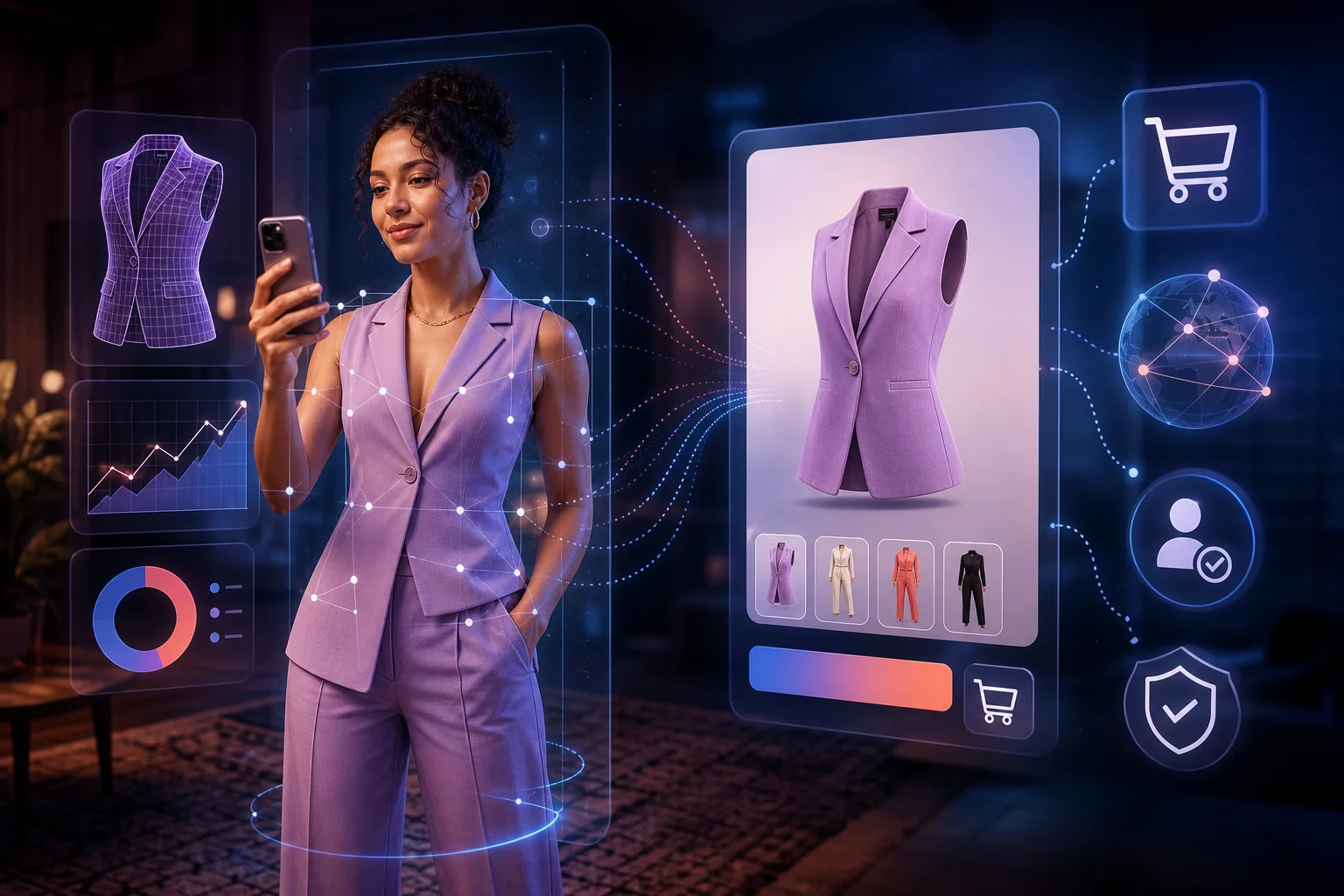
A product page can answer questions about price, color, materials, and delivery. It has traditionally struggled with the question shoppers care about most: What will this look like on me?
Virtual try-on is becoming the ecommerce industry’s answer. Using augmented reality, computer vision, three-dimensional product models, or generative artificial intelligence, it lets customers preview products on their faces, bodies, feet, or surroundings before buying.
The feature is often presented as an entertaining visual effect. That framing misses its commercial role. When implemented well, virtual try-on reduces uncertainty at a decisive point in the shopping journey. It can influence product discovery, add-to-cart behavior, completed purchases, and returns.
That makes it less like a campaign and more like conversion infrastructure: a persistent capability connecting product data, digital assets, customer experience, measurement, and trust.
Why Virtual Try-On Has Become a Conversion Question
Online retail has spent years optimizing buttons, checkout forms, recommendations, and advertising. Yet many conversion problems begin earlier, when a shopper cannot confidently evaluate the product.
A fashion-industry paper reports a 68.3% cart-abandonment rate for fashion ecommerce. In its Pakistan data, 9.4% of visitors added an item to their cart, 74.9% of those shoppers abandoned it, and only 2.4% of all visitors completed a purchase. These figures are specific to the cited research and should not be treated as universal benchmarks, but they illustrate how much intent disappears between browsing and payment.
Virtual try-on cannot fix unexpected shipping fees, weak payment options, or a confusing checkout. It addresses a different group of doubts:
- Does this frame suit my face?
- Will this lipstick work with my skin tone?
- How might this garment drape on my body?
- Does the product’s scale look right?
- Can I picture myself owning or wearing it?
These are not merely informational questions. They are confidence questions. Static product photography shows the item; virtual try-on attempts to place the shopper inside the merchandising experience.
That matters as demand for personalized content grows. A recommendation engine may select a relevant product, but relevance alone does not prove suitability. Virtual try-on adds a personalized evaluation layer between recommendation and purchase.
Useful visualization is not the same as accurate fit
Marketers should distinguish two promises that are frequently blurred together.
Visual try-on estimates appearance. It may show the color and general position of glasses, cosmetics, shoes, or clothing. Fit prediction attempts to recommend a size or estimate physical comfort based on measurements, product dimensions, and previous behavior.
A convincing image does not necessarily mean a garment will fit. Loose fabric, stretch, layering, body movement, and inconsistent sizing make apparel particularly difficult. Brands should describe what an experience does without implying a level of precision it cannot deliver.
Eyewear and beauty often provide cleaner starting points because products can be anchored to relatively stable facial landmarks. Apparel requires more complex simulation or generation, while fit-sensitive categories may need a separate sizing system alongside visualization.
The Technology Is Only One Layer of the System
Virtual try-on is an umbrella term rather than a single technical approach. The right method depends on the product, required realism, available assets, and shopper device.
A typical augmented reality pipeline may include:
- Pose or landmark detection, which locates a face, body, hand, or foot in an image or live camera feed.
- Product transformation, which scales and rotates the digital item to match the detected position.
- Compositing, which places the item into the scene and decides what should appear in front of or behind it.
- Rendering, which creates the final appearance, including color, light, shadow, and material behavior.
- Experience delivery, which loads the feature on a product page, app, or campaign destination.
For garments, a more advanced workflow can transform a three-dimensional clothing asset around the shopper’s pose, map it to body landmarks, reconstruct obscured areas through inpainting, and blend the result into the original image. Generative approaches, including diffusion models, can produce a new try-on image without relying entirely on prebuilt two-dimensional overlays.
These techniques can create more natural results, but they also introduce uncertainty. A generated image may alter details, misrepresent fabric, or create an attractive result that the physical product cannot reproduce. Product fidelity must therefore outrank visual spectacle.
The hidden asset pipeline
A try-on interface is only the visible end of a longer content operation. Products may need clean photography, masks, color data, measurements, two-dimensional patterns, three-dimensional meshes, textures, material definitions, or category-specific metadata.
Tools such as CLO, Marvelous Designer, Blender, and Style3D Atelier can support garment creation and preparation. Their software fees are not a reliable measure of total implementation cost. Publicly listed entry plans for some garment tools begin around $39 or $50 per month, but labor, revisions, quality assurance, and integration usually determine the true cost per stock-keeping unit.
A production-ready garment may require teams to inspect its mesh, repair materials, edit patterns, manage rigging, test interchange formats, and create lighter versions for mobile delivery. An asset that looks excellent in a designer’s workstation may load too slowly or behave incorrectly in a browser.
For brand managers, this changes the business question. Instead of asking only, “What does the try-on software cost?” ask:
- How many products can the team prepare each week?
- Which product attributes must be captured at creation?
- Can assets move between design, ecommerce, advertising, and social channels?
- What happens when a colorway, pattern, or construction detail changes?
- Who approves the digital representation as faithful to the physical item?
Asset interoperability is especially important. A proprietary workflow may produce a polished demonstration while making future migration expensive. Supported formats, export rights, quality controls, and ownership should be evaluated before a large catalog is committed.
Measuring Incremental Value Without Fooling Yourself
Published virtual try-on results are encouraging, but the evidence requires careful reading.
Industry coverage describes marketplace tests in which shoppers who completed a try-on converted at twice the standard rate. Another test recorded 52% more add-to-cart activity and 35% higher conversion among try-on users. These comparisons show a relationship, but they do not automatically prove causation.
People who activate try-on may already have higher intent. They may spend longer on the site, inspect more products, or be more comfortable with technology. A featured try-on assortment may also receive stronger photography, better placement, or promotional support.
Vendor-reported ranges claim conversion increases of 20% to 65%, return reductions of 20% to 40%, and average-order-value gains of 10% to 25%. Those figures are best treated as directional benchmarks, not guaranteed outcomes. The available reporting does not identify an independent controlled study that validates the full ranges while isolating try-on from shopper selection and merchandising changes.
One vendor also describes an unnamed luxury label whose conversion rate moved from 2.8% to 3.6%. That is an increase of 0.8 percentage points, or roughly 29% relative to the original rate, accompanied by a reported 28% reduction in returns. Because the brand and methodology are undisclosed, the example cannot establish that try-on alone produced the change.
A better testing design
Brands should measure virtual try-on as they would any material change to the purchase journey.
Randomly assign eligible visitors to a control experience and a try-on experience. Keep pricing, promotions, product placement, photography, and inventory exposure as consistent as possible. Then track outcomes beyond clicks on the feature.
Useful metrics include:
- Try-on availability and load-success rate
- Activation and completion rate
- Add-to-cart rate
- Checkout starts and completed purchases
- Revenue and gross margin per eligible visitor
- Return rate and return reason
- Customer-service contacts related to fit or appearance
- Page speed, crashes, and camera-permission rejection
Measure at the eligible-visitor level, not only among people who use the feature. “Try-on users converted better” is vulnerable to self-selection. “Visitors randomly offered try-on generated more completed purchases” is a stronger commercial finding.
Return analysis also needs time. A quick experiment may detect conversion changes before enough orders have been delivered and returned. Results should be segmented by device, category, traffic source, new versus returning customer, and product complexity.
Most importantly, calculate contribution after costs. More revenue is not necessarily more profit if rendering, asset creation, customer acquisition, support, or return handling consumes the gain.
From Product Feature to Operating Capability
The ecommerce trends shaping 2026 favor richer product evaluation, but deployment should follow customer need rather than fashion. Not every product requires a digital fitting room, and not every shopper wants one. Industry reporting suggests only about half of online shoppers in the United States express interest, which points to meaningful demand rather than universal adoption.
The feature should therefore remain optional, easy to find, and simple to exit. Conventional images, video, measurements, reviews, and sizing information still matter. Virtual try-on should strengthen the product page rather than become a gate between the shopper and the product.
Start with uncertainty, not novelty
The strongest pilot category is usually one where appearance uncertainty is high, digital representation is feasible, and sufficient traffic exists to measure an effect.
A beauty brand might begin with frequently sampled shades. An eyewear retailer could focus on frame shape and scale. An apparel company might select a stable collection with consistent construction instead of onboarding every short-lived item.
This approach limits asset work and creates a clearer test. It also prevents a common failure mode: launching impressive technology on products where it solves no meaningful customer problem.
Treat performance as part of merchandising
A try-on experience that takes too long to load can erase its own conversion benefit. Mobile networks, older devices, browser permissions, and camera quality all affect performance.
Brands need fallback behavior when a camera is unavailable or a model fails. That might mean photo upload, model imagery, a simpler overlay, or a standard product gallery. The shopper should never encounter a dead end.
Accessibility deserves equal attention. Instructions should be understandable without sound, controls should work with assistive technology where possible, and customers should not be penalized for declining camera access.
Build privacy into the experience
Virtual try-on can process customer photographs, videos, facial geometry, or body measurements. Depending on the implementation and jurisdiction, that information may create biometric-data, privacy, security, and artificial-intelligence governance obligations. Some providers may also fall within the scope of the EU AI Act.
A responsible implementation should disclose:
- What information is collected
- Why it is needed
- Whether processing happens on the device or on remote servers
- How long images and derived data are retained
- Whether information is used to train models
- Which third parties receive it
- How customers can request deletion
Collecting less data is often the strongest protection. If an image can be processed temporarily and deleted immediately, retaining it “just in case” adds risk without necessarily adding customer value.
Marketing teams should participate in these decisions. Consent language, benefit claims, and interface design directly affect trust. Privacy is not a legal notice attached after launch; it is part of the conversion experience.
Quick Checklist
- Identify the specific customer uncertainty that virtual try-on should reduce.
- Separate visual appearance claims from size or fit recommendations.
- Pilot a category with sufficient traffic, stable products, and manageable asset requirements.
- Benchmark asset construction, revision, cleanup, and approval time on representative products.
- Run a randomized test that measures all eligible visitors, not only try-on users.
- Track completed purchases, margin, returns, page performance, and customer-support effects.
- Document consent, retention, deletion, model-training, and third-party data practices.
- Provide accessible fallback content when camera access or rendering is unavailable.
Frequently Asked Questions
Does virtual try-on reliably increase ecommerce conversion?
It can, and reported pilots show promising conversion and add-to-cart improvements. However, many public figures come from vendors or observational comparisons. A brand should confirm incremental value through controlled testing because category, implementation quality, traffic mix, and shopper self-selection can materially affect the result.
Is virtual try-on the same as a sizing tool?
No. Virtual try-on commonly shows approximate appearance, while sizing tools recommend dimensions or fit. Some systems combine both functions, but a realistic preview should not be presented as proof that a garment or shoe will fit comfortably.
Which categories are best suited to virtual try-on?
Beauty, eyewear, footwear, and apparel are prominent applications, but each has different technical demands. Products anchored to facial landmarks can be simpler to position than flowing garments. The best starting category is one where customer uncertainty is costly and the product can be represented faithfully.
Should a retailer build the technology or use a platform?
That depends on scale, differentiation, internal expertise, and data requirements. A platform may shorten deployment, while a custom system can provide more control. In either case, retailers should examine asset ownership, integration effort, supported formats, performance, privacy terms, and migration options.
Can virtual try-on reduce returns?
It may reduce returns caused by appearance mismatch or uncertainty, and vendors report meaningful declines in some deployments. It will not eliminate returns caused by physical fit, product quality, delivery problems, or inconsistent manufacturing. Return reasons should be analyzed separately rather than collapsed into one headline rate.
Final Thoughts
First, virtual try-on should be judged as decision infrastructure, not entertainment. Its value comes from helping customers resolve uncertainty at the moment of choice. A photorealistic demonstration that does not improve purchase confidence is simply an expensive effect.
Second, the asset and operating model matter as much as the artificial intelligence. Product preparation, quality approval, mobile performance, interoperability, and catalog maintenance determine whether a pilot can become a durable capability. The flashy interface is often the easiest part to show and the hardest part from which to infer total cost.
Third, evidence quality must improve as investment grows. Vendor case studies can identify possibilities, but they should not substitute for randomized tests, margin analysis, and return tracking. In practice, the most credible business case will come from a retailer’s own eligible visitors and products.
Finally, trust is part of conversion. Personalized content can reduce distance between a shopper and a product, but customer images and body data make that interaction unusually sensitive. The brands most likely to benefit will be those that combine useful visualization with modest claims, restrained data collection, and a product experience that still works when the customer says no to the camera.
Sources
- Virtual Try-On Technology: Boost E-commerce Conversion Rates with AI - Style3D Blog
- [PDF] Cart Abandonment in E-Commerce: Insights from the Fashion Industry
- The State of Fashion Ecommerce in 2025: Why Virtual Try- ...
- Virtual Try-on: A New Way of Shopping
- Case study: AI/AR-based Virtual Try-on for e-commerce
- Virtual Try-on App Development: Benefits and Use Cases
- Virtual Try-On Platform Market
- Virtual Try-On Hasn't Met The Bar For Consumer Adoption. ...
- Virtual Try-On Market Size, Share & 2030 Trends Report
- How does ASOS hybrid virtual try-on change e-commerce sizing precision? - Style3D Blog
- Virtual Try-On Technology 2026: The Secret to 30% Higher Conversions for Fashion Brands - Style3D Blog
- AI Virtual Try-On: 36% Fewer Returns in Fashion | StyTrix
Ready to Get Started?
Explore production-ready 3D models for your next project. Browse the 3D model catalog to download assets you can use right away.
Turn this workflow into real deliverables
Browse production-ready 3D models for your next project, then step into 3d modeling if you need a custom build.