Why Retopology Still Slows Text-to-3D Production
Introduction
Text-to-3D has made the first draft of a 3D object astonishingly easy. Describe a sneaker, mascot, appliance, or fantasy prop, and a generative AI system may return something recognizable before a traditional modeling session would have cleared its reference board.
That speed is real, but it can also be misleading. A model that looks convincing in a preview window is not necessarily ready for animation, real-time rendering, product visualization, augmented reality, or a campaign that needs dozens of controlled variations.
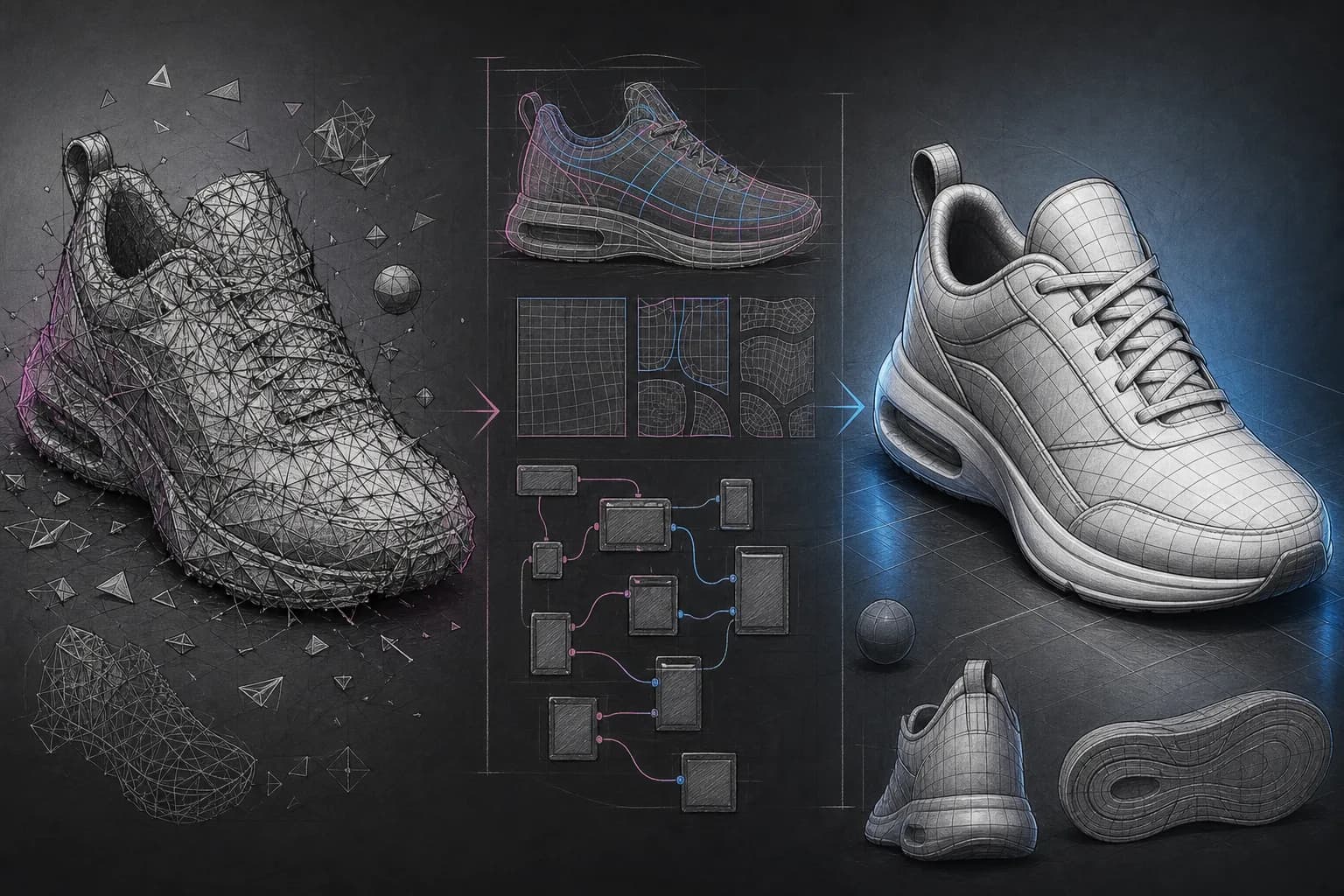
The difference is hidden inside the model. Generated geometry often contains dense, uneven, or irregular triangles arranged to reproduce the visible surface, not to support editing and movement. Retopology—the process of rebuilding that surface with a more deliberate polygon structure—therefore remains one of the hardest bridges between rapid generation and dependable production.
For marketing professionals and brand managers, this is more than a technical inconvenience. It affects schedules, budgets, visual consistency, reuse, and the number of channels one asset can serve. Text-to-3D may compress ideation, but the production clock does not stop when the first attractive render appears.
The Difference Between a Good Image and a Good Asset
A 3D generator is commonly judged by what viewers can see: Does the object resemble the prompt? Is the silhouette plausible? Do the colors and details feel right? These are reasonable criteria for concept development, but professional 3D rendering pipelines ask a different set of questions.
Can an artist revise one feature without damaging another? Can the object bend naturally? Can its materials be edited independently? Will it run efficiently on a phone, website, game engine, or virtual-production stage?
A generated model can pass the first visual test while failing all of these operational tests. Current text-to-3D systems generally prioritize resemblance and surface appearance before deformation-friendly edge flow. Tools such as Meshy and Common Sense Machines can accelerate the creation of visually compelling forms, yet topology quality remains a barrier to direct use in demanding game and visual-effects workflows.
This is why researchers describe the remaining problem as assetization rather than generation alone. A deployable model may need:
- Retopology: Rebuilding the polygon structure for editing, animation, and efficiency.
- UV unwrapping: Flattening the surface into a two-dimensional layout so textures can be placed predictably.
- PBR material separation: Dividing surface properties such as base color, roughness, metallic response, and normal detail into controllable maps.
- Rigging and skinning: Adding a digital skeleton and defining how the surface moves with it.
- Levels of detail: Producing lighter versions for different viewing distances or device capabilities.
- Collision geometry: Creating simplified shapes that interactive systems can use to detect contact.
Integrated systems are beginning to chain some of these steps together. The complete path from prompt to consistently deployable asset, however, is not yet solved.
Why topology matters even when nothing moves
Retopology is often treated as an animation issue, but static campaign objects can also suffer from poor geometry. An irregular mesh may make it difficult to change a product opening, sharpen an edge, replace a logo panel, or create a clean close-up.
The consequences grow when the same model must appear in web experiences, social video, retail visualization, and interactive product demonstrations. Each channel imposes different limits on polygon count, texture size, shading, and file format. A fragile source model makes every adaptation slower.
For brands, the useful question is therefore not, “How quickly did AI make this model?” It is, “How quickly can this model become a controlled, reusable brand asset?”
Why Automatic Remeshing Does Not Fully Solve Retopology
The terms remeshing and retopology are often used as if they mean the same thing. They overlap, but their goals differ.
Remeshing redistributes polygons across a surface. It can turn millions of uneven triangles into a lighter and more regular mesh. That is valuable, especially for dense scans or generated geometry, but a mathematically tidy surface does not automatically understand what the object needs to do.
Production retopology is more intentional. An artist places edges according to future use. On a character, loops around the eyes and mouth support expressions, while loops around shoulders, wrists, knees, and hips help joints bend without collapsing the surface. On a product, edges may be arranged to preserve manufactured seams, hard corners, replaceable components, and areas reserved for branding.
Automatic tools including ZBrush ZRemesher, 3D-Coat Autopo, Quad Remesher, and Instant Meshes can produce useful starting meshes quickly. They may also require guides, repeated parameter adjustments, or manual repairs. Earlier tool comparisons found that even systems targeting quad-based geometry could produce dead ends and patterns unsuitable for a particular production test.
That limitation is not surprising. A tool can inspect shape, curvature, and polygon density, but intended behavior is partly a design decision. The same creature might need one topology for a still image, another for facial performance, and a much lighter one for a mobile experience.
Clean quads are not the whole definition of quality
Quads—four-sided polygons—are popular because they are often easier to edit, subdivide, and organize into flowing loops. Yet an all-quad mesh is not automatically production-ready.
The important questions are where those polygons go, how dense they are, and whether their flow supports the asset's job. A field of technically valid quads can still pinch at a shoulder, distort a logo, waste geometry on an invisible underside, or fail to preserve a hard product edge.
Tripo AI and other vendors promote AI quad remeshing as a route to animation-ready output. Such claims are promising, but production readiness should not be assumed without a deformation test or a benchmark that matches the intended use. A clean screenshot of wireframe geometry is not evidence that a face will emote correctly or that a garment will survive extreme poses.
Manual retopology remains the quality reference for topology-sensitive work because artists can control every vertex, edge, and loop. The tradeoff is time. Automation can shorten the first pass, but its value depends on whether it reduces total correction rather than merely producing a new mesh quickly.
The Bottleneck Moves Downstream
Generative AI changes where labor occurs. Instead of spending all the time constructing a first model, teams may spend more time evaluating, repairing, standardizing, and adapting generated candidates.
This creates a familiar automation paradox: faster output at the beginning can increase the volume of work later. If a creative team generates twenty plausible package concepts rather than three, someone must still assess the geometry, materials, brand accuracy, and channel suitability of those twenty options.
The bottleneck becomes especially visible in four situations.
1. Animated characters and mascots
Characters require topology that follows anatomy and anticipated motion. A smiling preview does not reveal whether the mouth can form controlled expressions or whether an elbow will fold cleanly.
Template wrapping can help when many assets share a known structure. A prepared topology is fitted to a new surface using anchors around important features. GPU-accelerated workflows can make fitting iterations very fast, but final quality still depends on a suitable template and correctly placed anchors.
2. Branded products
Brand assets demand precise proportions, colors, seams, labels, and material boundaries. A generator may produce a plausible bottle or shoe while altering the cap, sole, or logo region in subtle ways.
Retopology cannot correct every design error, but it determines how safely artists can make those corrections. Deliberate edge placement helps isolate editable parts and preserve approved contours through later revisions.
3. Interactive and real-time experiences
A model intended for Unity, Unreal Engine, augmented reality, or a web viewer must balance appearance with performance. That often requires a controlled polygon budget, texture planning, levels of detail, collision meshes, and testing on target hardware.
An asset that renders acceptably on a powerful workstation may still be unsuitable for a mobile campaign. Generation speed has little business value if optimization begins from an unpredictable mesh every time.
4. High-volume content programs
Automation is attractive when campaigns need regional variants, seasonal treatments, product configurations, or social cutdowns. But volume magnifies inconsistency.
One generated asset may need minor cleanup; the next may require reconstruction. Without standards for topology, UV layouts, naming, scale, materials, and export settings, apparent savings become difficult to forecast.
How Teams Should Evaluate Text-to-3D Workflows
A useful test should measure the complete journey from brief to approved deliverable, not the time between prompt and preview. This prevents a fast generation step from hiding expensive downstream work.
Start by defining the endpoint. “Production-ready” is too vague unless the team specifies where the asset will run, whether it will move, how closely it must match approved design, and what future revisions are expected.
A practical evaluation can compare these stages:
| Workflow stage | What to evaluate |
|---|---|
| Generation | Prompt iterations, shape accuracy, missing or invented details |
| Geometry cleanup | Retopology effort, artifacts, edge-flow corrections |
| Materials | Separation, texture quality, editability, brand accuracy |
| Animation | Rigging success, joint deformation, facial performance |
| Optimization | Polygon targets, levels of detail, collision setup |
| Deployment | Export reliability, engine compatibility, device performance |
| Revision | Time required for stakeholder changes and new variants |
Test assets should reflect the real campaign mix. A rigid decorative prop tells little about a mascot, while a neutral standing character does not reveal problems that appear during a crouch, grin, or raised-arm pose.
Teams should also distinguish three output classes:
- Concept output: Good enough to discuss shape, mood, and composition.
- Presentation output: Suitable for controlled stills or limited views after cleanup.
- Reusable production asset: Structured for editing, animation, optimization, and multiple channels.
Text-to-3D is already useful in the first category and can support the second with human intervention. The third category remains highly dependent on the asset, tool, and production standard.
Be cautious with dramatic productivity claims. Cleanup time varies with the object's complexity, required motion, target platform, and quality threshold. Vendor demonstrations and informal comparisons may be informative, but they are not substitutes for a controlled test using the team's own deliverables.
Quick Checklist
Before approving a text-to-3D workflow for campaign production, confirm the following:
- Define whether the output is a concept, a controlled render asset, or a reusable production asset.
- Test topology with the hardest expected edit or pose, not only a static turntable.
- Inspect edge flow around joints, facial features, product seams, and branded surfaces.
- Verify that UVs and PBR materials can be revised independently without rebuilding the asset.
- Measure total hands-on time through cleanup, rigging, optimization, export, and revision.
- Test polygon count, levels of detail, collision geometry, and performance on the target platform.
- Record failure rates and correction patterns across several assets rather than judging one successful example.
- Keep source files, naming, scale, and approval rules consistent so generated assets can enter the existing pipeline.
Frequently Asked Questions
Is retopology always necessary for AI-generated 3D models?
No. A generated mesh used for a distant background object, rough concept, or single controlled render may be acceptable with limited cleanup. Retopology becomes more important when the asset must animate, support close-ups, run in real time, accept repeated revisions, or move between production tools.
Can automatic retopology replace a specialist artist?
It can replace part of the repetitive work in suitable cases. ZRemesher, Quad Remesher, Instant Meshes, and similar tools can create strong starting points, especially for rigid forms or early optimization. Topology-sensitive characters, faces, garments, and branded products may still need an artist to guide loops, correct artifacts, and validate deformation.
What is the fastest way to determine whether topology is usable?
Test the intended task. Bend major joints, animate the face, subdivide the surface, apply the final textures, or make a realistic stakeholder revision. Wireframe neatness is helpful, but behavior under production conditions is the more meaningful test.
Should marketing teams avoid text-to-3D until topology improves?
No. It can be highly useful for ideation, previsualization, background objects, exploratory product forms, and campaign planning. The sensible approach is to match the technology to the deliverable and budget explicitly for assetization when the output must become a durable production asset.
How should return on investment be measured?
Measure the time and cost from approved brief to approved deployment. Include prompt iteration, rejected generations, retopology, UV work, material correction, rigging, optimization, quality assurance, and stakeholder revisions. Generation time alone describes tool speed, not production value.
Final Thoughts
In practice, text-to-3D has made visual possibility cheaper before it has made production certainty cheaper. That distinction matters. A rapid stream of appealing forms can strengthen ideation, but it can also create a larger queue of assets that need technical judgment.
The most important tradeoff is not AI versus manual modeling. It is unpredictable cleanup versus controlled reuse. Manual digital content creation remains valuable when topology, brand fidelity, and downstream changes must be known in advance; generative AI is strongest where exploration and variation matter more than perfect internal structure.
Automatic retopology will continue to improve, particularly when systems combine shape analysis with templates, rig information, and knowledge of the intended platform. The meaningful milestone will not be another attractive wireframe. It will be repeatable evidence that assets survive editing, deformation, optimization, and delivery with less human correction.
For brand leaders, the prudent position is neither resistance nor blind adoption. Use generation to widen the creative funnel, but judge the pipeline at its narrowest point. Until topology and the rest of assetization become reliably integrated, the fastest prompt will not necessarily produce the fastest campaign.
Sources
- From Visual Synthesis to Interactive Worlds:Toward Production-Ready 3D Asset Generation
- AI Impact on Gaming and Media Tooling - Third Point Ventures
- 3D Modeling Workflows: DCC, AI, Scanning, and Hybrid
- Introduction to 3D Generation | Scenario Knowledge Base
- Remesh 3D Model Online - AI Retopology & Mesh Optimizer
- AI-Powered Automated Retopology for 3D Assets | Datameister
- 3D-Coat vs. ZBrush auto-retopology comparison - BlenderNation
- Ultimate Guide - The Best Mesh Retopology Tools of 2026
- AI Retopology: Clean Up High-Poly 3D Models with AI
- 10 Minutes vs 10 Hours: AI vs Human Retopology Test : r ...
- 3D Model Retopology Explained: Tools, Workflow, and AAA Standards
- AI Remesh 3D model - Clean Quad Retopology - Tripo AI
Ready to Get Started?
Explore production-ready 3D models for your next project. Browse the 3D model catalog to download assets you can use right away.
Turn this workflow into real deliverables
Browse production-ready 3D models for your next project, then step into 3d product animation if you need a custom build.