Why Social Media Is Moving Into Private Group Chats
Introduction
The most influential social post may be the one a brand never sees.
A product video appears in a public feed. Someone copies the link into a family WhatsApp group, forwards it to a colleague in Slack, or sends it through an Instagram direct message. The visible post may receive no public comment from those people, yet the private conversation can shape a purchase.
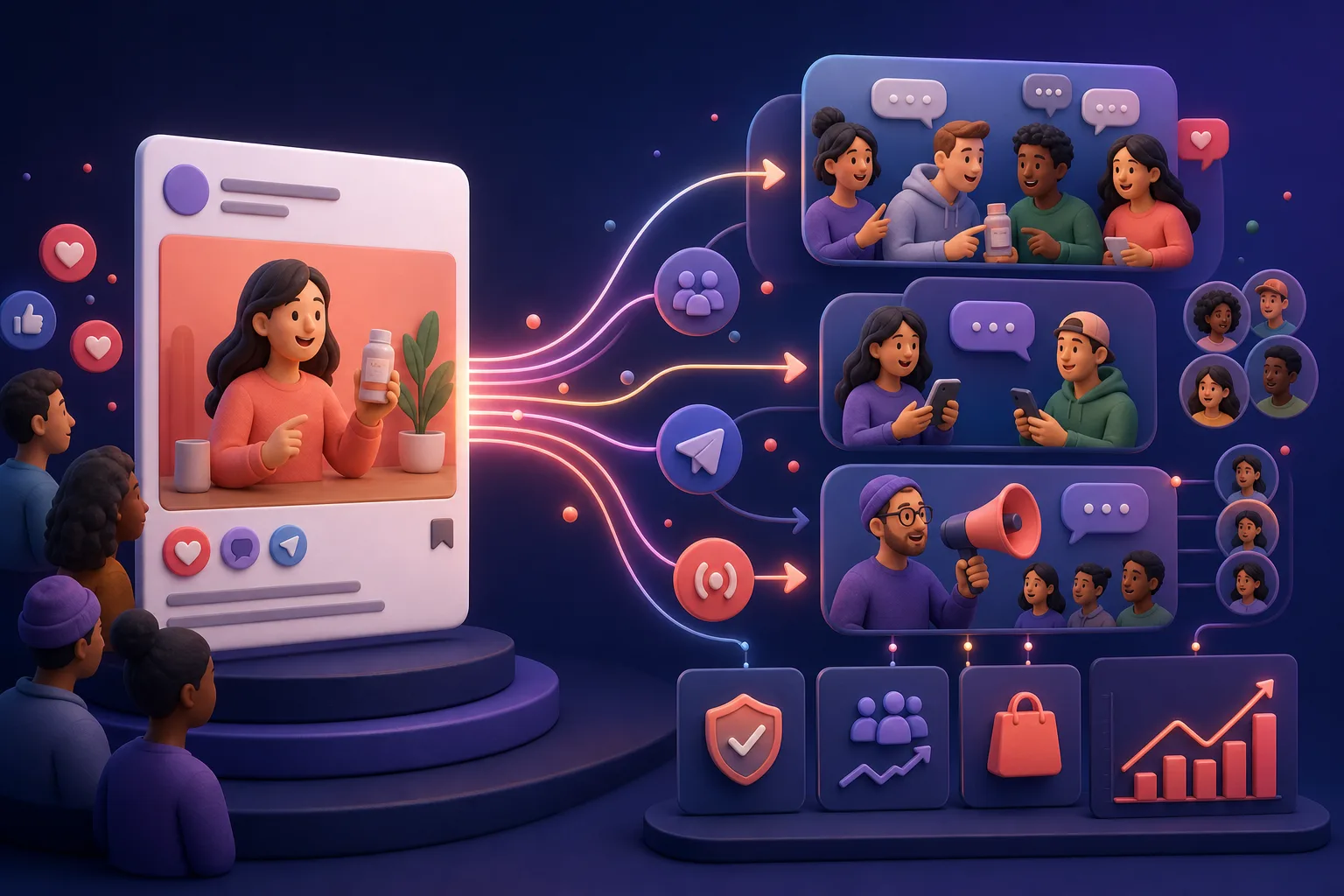
This is the central change in social media: distribution remains public, but discussion is becoming more private. Public feeds are useful for discovery and entertainment. Group chats, direct messages, communities, and broadcast channels offer a smaller social setting where people can ask questions, exchange recommendations, and speak without performing for a broad audience.
For marketers and brand managers, this does not mean abandoning public platforms. It means recognizing that public engagement metrics show only part of the customer journey—and sometimes not the most consequential part.
From the Town Square to the Digital Living Room
Early social media trained brands to think like broadcasters. Build an audience, publish frequently, generate reactions, and maximize reach. That model still matters, but algorithmic feeds have become crowded with creators, brands, entertainment, news, and recommendations selected by software.
Private spaces offer a different experience. A group chat can feel more relevant because its members already share a relationship, interest, profession, or goal. Instead of addressing an undefined crowd, people communicate within a known context.
Several formats sit along this public-to-private spectrum:
- Direct messages support one-to-one or small-group conversation.
- Group chats let friends, customers, peers, or fans exchange messages with one another.
- Broadcast channels allow an administrator or creator to send updates to an opted-in audience, often with limited member participation.
- Communities organize multiple conversations around a shared identity or purpose.
- Paid groups turn access, expertise, or peer connection into a membership product.
These categories are not clean legal or social boundaries. Research examining WhatsApp and Telegram shows why calling an entire platform “private” can be misleading. A small invitation-only chat, a large discoverable channel, and a community with thousands of members create very different expectations, even when they exist inside the same messaging application.
Access rules, audience size, administrator powers, discoverability, and member visibility matter more than the platform label. Marketers should therefore evaluate the design of a space rather than assuming every messaging feature carries the intimacy of a conversation among friends.
Why people prefer smaller spaces
Private communication reduces several pressures associated with public posting. People do not have to polish every opinion for an unknown audience. They can ask basic questions, share niche interests, or recommend products without attaching those actions to a permanent public profile.
Smaller spaces can also reduce noise. A carefully defined Discord server for software developers may be more useful to its members than a broad feed containing unrelated content. A WhatsApp community for local customers can deliver practical updates without requiring people to compete with an algorithm for visibility.
The shift has unfolded over multiple years, suggesting a durable behavioral change rather than enthusiasm for one feature. Platform strategies reflect it as well: Meta leadership has publicly framed private communication as central to the company’s direction.
Public Reach and Private Relevance Work Together
It is tempting to describe private social media as the replacement for public feeds. That framing is too simple.
Public platforms remain powerful discovery engines. Instagram, TikTok, YouTube, and other feed-based services can introduce a creator, idea, or product to people who had no prior relationship with it. Private spaces usually work better after someone has developed enough interest to opt in.
A practical model looks like this:
- Public content earns attention. A useful post, video, or discussion introduces the brand.
- An invitation creates permission. Interested people choose a channel, group, event, or direct conversation.
- Private interaction builds relevance. Members ask questions, compare experiences, and receive more focused information.
- The relationship produces an outcome. That could be a purchase, renewal, referral, event registration, or useful product feedback.
Instagram Broadcast Channels and WhatsApp Communities illustrate the distinction. A creator or brand can attract attention through visual public content, offer lightweight updates through a broadcast channel, and use a WhatsApp community for more focused communication. One environment creates reach; another supports continuity.
The right pathway depends on the audience. Platform use varies substantially by age and context, so there is no universal private-community playbook. A youth-oriented entertainment brand might find messaging and visual platforms central, while a business-to-business company may discover that recommendations circulate through Slack groups, forwarded email, or private team discussions.
Choose a format based on the member’s job
A private channel should solve a recognizable problem. “Join our community” is not a value proposition by itself.
Useful formats include:
- Broadcast channel: Best for concise announcements, previews, reminders, or creator updates.
- Peer group: Best when members benefit from exchanging advice and experiences.
- Support community: Best for practical questions, troubleshooting, and shared learning.
- Advisory group: Best for structured customer feedback and early product insight.
- Paid membership: Best when access includes recurring expertise, programming, or valuable peer relationships.
Patreon, Substack Chats, and Kajabi Communities demonstrate how closed communities can become membership products. However, the business case should not rest on a striking industry statistic alone. One secondary source cites a claim that creators with private communities earn substantially more recurring income than those relying only on public-platform monetization, but the available research context does not provide enough methodological detail to treat that figure as a dependable benchmark.
The safer conclusion is narrower: recurring membership is a plausible model when the community delivers recurring value. Charging for access will not rescue a group that lacks a clear purpose.
Dark Social Changes What Marketers Can Measure
Private sharing is often called dark social. The phrase refers to traffic and influence that standard analytics cannot identify, not to the dark web or inherently suspicious activity.
When someone pastes a product link into a private chat, tracking information may be lost. The eventual website visit can appear as direct traffic or arrive without a meaningful referral source. The same problem occurs when buyers discuss a vendor in Slack, forward an email, hear about a company on a podcast, or copy a link between applications.
Project Liberty has reported an estimate that 95% of online content sharing happens in private messages, leaving a small minority visible on public platforms. It is a powerful illustration of the possible scale of hidden sharing, but it should be treated as a directional estimate rather than a universal law. Definitions of “content,” “sharing,” and “private” can change the result, and the supplied evidence does not establish a comprehensive measurement method behind the figure.
It is also important not to confuse unrelated percentages. A similar range in a global digital report concerns monthly use of mobile image-recognition tools, not private messaging. Numerical resemblance is not supporting evidence.
Replace perfect attribution with useful evidence
Private influence makes conventional last-click attribution especially fragile. In one EMARKETER survey, only one in five marketers expressed confidence in last-click attribution. That method gives the final measurable interaction all the credit, even when private recommendations, public posts, and earlier research did most of the persuasive work.
Brands should use several forms of evidence instead:
- Self-reported attribution: Ask customers how they first heard about the brand or what influenced the decision. Keep the question open enough to capture answers such as “a colleague’s Slack group.”
- Incrementality testing: Compare outcomes between audiences or periods with and without a specific campaign, where a sound test design is possible.
- Cohort analysis: Examine whether people who join a community retain, renew, or purchase differently from comparable customers.
- Unique landing pages or offers: Use them selectively to identify broad patterns without turning every message into a tracking exercise.
- Customer acquisition cost: Track fully loaded acquisition spending against the customers or deals produced.
- CAC payback period: Measure how long it takes the gross profit from acquired customers to recover acquisition costs.
- Qualitative sales evidence: Record repeated mentions of communities, peers, podcasts, or private recommendations in sales conversations.
No single method reconstructs every hidden journey. The goal is triangulation: combine behavioral data, financial outcomes, customer statements, and controlled tests to reach a decision with reasonable confidence.
A private group should not become an excuse for invasive surveillance. Attempts to force visibility into personal conversations can destroy the trust that made those conversations valuable. Measurement should happen at consented touchpoints, not by trying to observe everything members say.
Community Is an Operating Model, Not a Content Format
Opening a group chat is easy. Sustaining a healthy group is operational work.
Public publishing is mainly a one-to-many discipline. Community management requires facilitation, customer care, moderation, escalation processes, and an understanding of group dynamics. Members influence the experience as much as the host does.
Brands should define the social contract before inviting people in. Members need to know who runs the space, what behavior is acceptable, what information may be collected, and whether their posts can be quoted elsewhere. A channel described as exclusive should not quietly become a source of promotional screenshots.
Design for participation without manufacturing it
A new community often faces an awkward choice. Too little activity makes the space feel abandoned; too much brand activity makes it feel like another advertising channel.
A better approach is to create a light but consistent rhythm:
- Share prompts that invite specific, answerable responses.
- Schedule office hours or expert question sessions.
- Summarize useful discussions with member permission.
- Recognize helpful contributors without turning participation into a contest.
- Separate announcements from peer conversation when the platform allows it.
- Close repetitive threads and maintain an accessible knowledge base.
Creator engagement can feel especially natural in private channels because members have actively chosen proximity. That permission is valuable, but it is not unlimited. Constant notifications, artificial urgency, and repetitive sales messages quickly turn access into interruption.
Plan for moderation and platform risk
Private does not automatically mean safe. Harassment, misinformation, impersonation, scams, confidential disclosures, and harmful advice can spread in closed spaces. Smaller audiences may reduce public exposure, but they can also make problems less visible to outside scrutiny.
Every branded community needs named owners, clear rules, reporting paths, and response thresholds. Teams should decide in advance when to warn, remove, escalate, or archive content. Sensitive categories may require legal, safety, or compliance review.
There is also a strategic dependency. A community built entirely on Discord, WhatsApp, Telegram, Instagram, or another service remains subject to that platform’s policies and technical structure. Brands should understand what member information they can legitimately access, what can be exported with consent, and what would happen if the service or its rules changed.
A Practical Measurement Framework
Private social programs need goals that reflect their purpose. Counting members is rarely enough because a large silent group may create less value than a small, trusted one.
Organize measurement into four layers:
1. Community health
Track active members, meaningful replies, unanswered questions, moderation incidents, and the share of conversation initiated by members. Define “meaningful” before reporting it; a reaction emoji and a detailed peer answer are not equivalent.
2. Member value
Use short surveys, recurring feedback, support-resolution data, event attendance, or evidence that members learned something useful. Ask whether the group saves time, improves access, or creates connections.
3. Business outcomes
Depending on the program, examine qualified leads, purchases, renewals, retention, referrals, support deflection, or product-feedback adoption. Compare cohorts carefully and avoid claiming causation from correlation alone.
4. Operational cost and risk
Include staff time, moderation, programming, tooling, incentives, and incident management. A group can show strong engagement while remaining economically unsustainable or exposing the organization to unacceptable risk.
This framework changes the management question from “How much engagement did we get?” to “Did the community create durable value for members and the organization at an acceptable cost?”
Quick Checklist
- Define the member problem before selecting a platform or format.
- Decide whether the space is for broadcasting, peer conversation, support, feedback, or paid access.
- Publish clear rules covering moderation, privacy, promotion, and reuse of member contributions.
- Assign accountable staff for facilitation, customer care, and incident escalation.
- Connect public discovery to private participation through a clear, voluntary invitation.
- Measure community health, member value, business outcomes, and operating cost separately.
- Add self-reported attribution and cohort analysis instead of relying only on last-click reports.
- Review notification frequency, platform dependency, and member consent at regular intervals.
Frequently Asked Questions
Are private groups replacing public social media?
No. They perform different jobs. Public feeds are effective for discovery and broad cultural visibility, while private groups can support focused discussion and stronger continuity. Most brands need a connected system rather than an all-or-nothing choice.
What is the difference between a broadcast channel and a group chat?
A broadcast channel is primarily one-to-many: an administrator or creator sends updates to subscribers. A group chat allows members to converse with one another. Features vary by platform, so brands should examine participation controls and member expectations before choosing.
Does dark social mean marketers cannot measure private influence?
It means they cannot observe it completely through standard referral analytics. Self-reported attribution, cohort comparisons, controlled tests, sales feedback, acquisition cost, and retention data can still produce useful evidence. The result is probabilistic rather than perfectly traceable.
Should a brand create a paid private community?
Only when it can deliver recurring value worth paying for. Expertise, structured programming, access, or valuable peer relationships may support membership. Exclusivity alone is weak; a paywall does not create a community purpose.
How often should brands post in a private channel?
There is no universal frequency. Start with the minimum cadence needed to fulfill the channel’s promise, then use member feedback, notification opt-outs, participation quality, and churn signals to adjust. Relevance matters more than volume.
Final Thoughts
The first judgment is that private social is not primarily a new distribution trick. It is a change in social context. People behave differently when speaking to trusted peers than when reacting beneath a public post, and brands that treat both settings identically will miss the point.
Second, visibility and influence are separating. Public metrics remain useful, but they cannot fully describe recommendations moving through group chats, Slack conversations, direct messages, and forwarded links. In practice, marketers need to become comfortable making decisions from multiple imperfect signals rather than demanding a complete customer-journey map.
Third, access to a private space creates responsibility, not ownership. The brands most likely to benefit will be those that protect consent, moderate consistently, and give members a reason to return beyond promotions.
The bigger picture is a more layered social internet: public feeds for discovery, broadcast channels for permission-based updates, and smaller groups for conversation. The strategic opportunity is not to force every audience into a chat. It is to understand where trust already forms—and to participate without overwhelming it.
Sources
- The new social media: Group Chats - Project Liberty
- Why Private Social Media Is Reshaping Online Engagement Globally - Brill Creations
- How brands can shift their focus from public engagement to private ...
- Shifting Engagement: Feeds to Direct Messages
- Instagram Broadcast Channels vs WhatsApp Communities
- Public or Private Communication? Categorising ...
- Digital 2025 - We Are Social
- Social Media Demographics by Platform Statistics 2026: Guide • SQ Magazine
- Social media platforms generate billions of dollars in revenue from U.S. youth: Findings from a simulated revenue model
- Is Marketing Attribution Dead? Dark Funnel & Dark Social 2026
- Dark Social Traffic Attribution: Track Hidden Sources
- How should companies handle dark social and untracked influence?
Ready to Get Started?
Explore production-ready 3D models for your next project. Browse the 3D model catalog to download assets you can use right away.
Turn this workflow into real deliverables
Browse production-ready 3D models for your next project, then step into 3d modeling if you need a custom build.