AI Beyond Checkout: Personalization That Pays
Introduction
The most valuable ecommerce personalization in 2026 now happens after the buy button. As customer acquisition costs rise, the profit pool shifts to what follows checkout: smart replenishment, frictionless returns, accurate delivery updates, and proactive service. AI is the engine behind this shift, translating messy data into timely, individual actions that lift lifetime value and cut cost-to-serve.
From Segments to the Segment of One
Personalization at scale has matured into hyper‑individualization: optimizing for a single shopper’s timing, channel, and intent rather than cohort averages. Research highlights two forces making this urgent. First, McKinsey links strong personalization to roughly 40% more revenue versus competitors. Second, consumer expectations have caught up; in 2026, most shoppers expect experiences tailored to them.
Rising customer acquisition cost (CAC) intensifies the pressure. Benchmarks show CAC climbing and varying widely by vertical, which means retention economics matter more than top‑of‑funnel growth. Put bluntly: if your post‑purchase experience does not improve repeat purchase rate, subscription retention, and referral, your payback window stretches, and growth stalls.
Hyper‑individualization in 2026 relies on three ingredients:
- Unified identity and consent for first‑ and zero‑party data.
- Real‑time context, including order status and service history.
- AI agents able to reason across unstructured data, triggering the next best action without human triage.
The New Personalization Stack Beyond Checkout
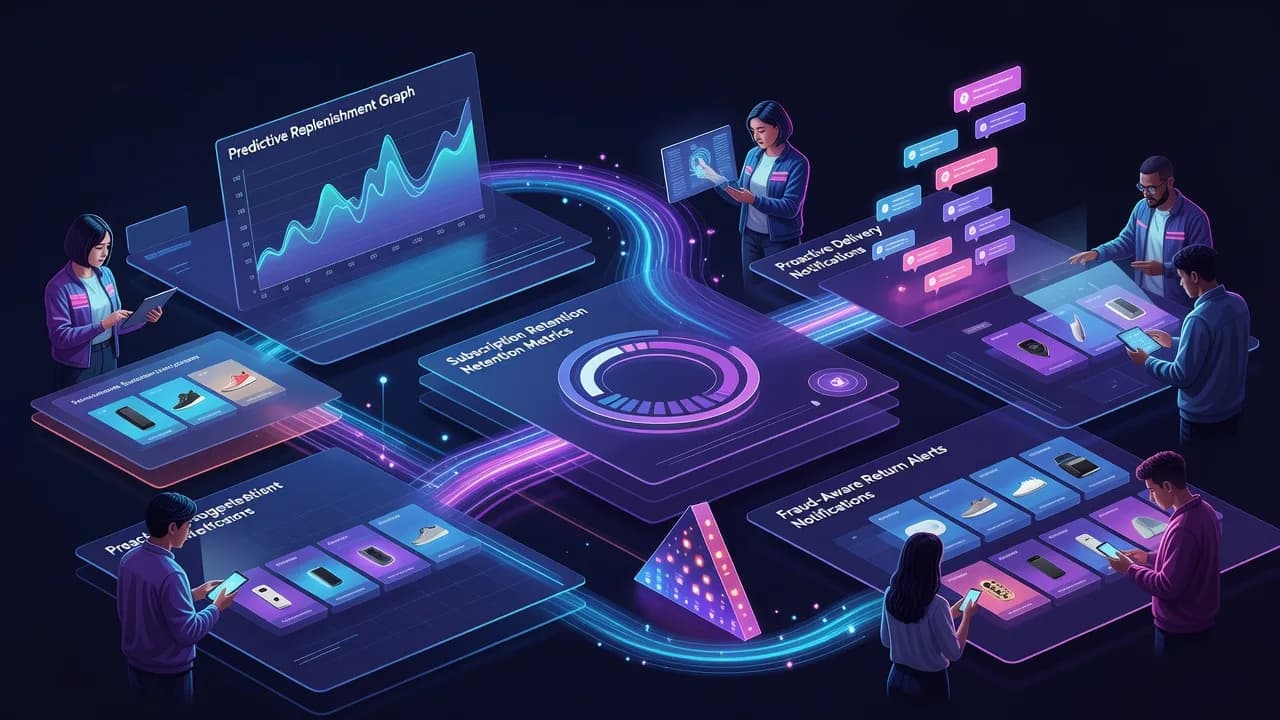
1) Predictive replenishment and subscriptions
AI is turning recurring commerce into a loyalty engine. Tools like Ordergroove, Recharge, and Loop combine purchase cadence modeling with zero‑party inputs to time reminders, optimize bundle suggestions, and prevent skip‑to‑churn spirals. Case studies suggest well‑implemented setups can materially reduce churn and accelerate subscriber growth through A/B‑tested “smart reorder” nudges and dynamic incentives.
What changes with AI in 2026 is orchestration. Rather than static flows, recommendation logic adapts to signals like inventory, delivery ETAs, and customer sentiment. If an order arrived late, incentives shift from upsell to make‑good. If usage runs faster than predicted, the system proposes earlier replenishment with suitable alternatives in stock.
Practical wins to target:
- Predict refill timing using order gaps and self‑reported cadence.
- Personalize subscription save offers by intent: convenience, value, or discovery.
- Trigger bundle swaps when items are back‑ordered, not after a service ticket.
2) Proactive service with AI agents
Large language model (LLM) agents reached a tipping point in 2026. They can now reason across unstructured inputs—emails, product guides, support transcripts—and take actions via ecommerce, ERP, and CRM integrations. That unlocks end‑to‑end flows such as order status, address corrections, warranty checks, and returns initiation without human handoffs.
Performance shows up in operations metrics. Brands measure average handle time (AHT), containment or deflection rate, cost‑to‑serve, and customer satisfaction (CSAT). Generative AI assistants increasingly resolve routine inquiries fully, escalate fewer cases, and leave human agents to complex, high‑judgment issues. The net: faster answers, higher CSAT, and a cheaper support curve.
Key patterns to implement:
- Embedded assistants in tracking pages answer “Where is my order?” using predictive ETAs.
- Policy‑aware agents calculate eligibility, create RMA labels, and recommend exchanges over refunds when appropriate.
- Multi‑agent designs split roles: one verifies identity, another checks order data, a third proposes solutions, and a final agent executes system updates.
3) Delivery communications and logistics personalization
The best post‑purchase experiences feel clairvoyant, not chatty. Delivery models from providers like AfterShip forecast arrival windows more precisely by learning from historical carrier performance and live network signals. Instead of generic “out for delivery,” customers see realistic ETAs and delay alerts, reducing anxiety and inbound contacts.
Narvar, Route, and Malomo extend this with branded tracking portals that blend status with relevant content and offers. The personalization layer matters: a first‑time buyer might see setup guidance and an invite to subscribe; a loyal customer might receive points reminders and early access to refills. Each message becomes a moment to drive utility first, revenue second.
Operational levers to watch:
- Carrier selection optimization based on lane‑level reliability, not just headline rates.
- Dynamic notification frequency that adapts to delay risk and user preference.
- Cross‑sell in transactional messages constrained by utility: a single, context‑relevant offer beats a carousel.
4) Returns as a retention and recovery machine
Returns can erode margin, but AI turns them into value recovery. Vision‑assisted item grading, fraud‑pattern checks, and smart routing compress cycle time and reduce processing cost. Platforms like ReturnGO focus on abuse detection and policy enforcement, while others emphasize exchange‑first flows that keep revenue in the cart.
Kiosks and drop‑off networks expedite refunds, but the personalization is in decisioning: steer habitual returners toward store credit with bonus value; route high‑value customers to instant refunds; surface size or fit advice that prevents the next return. The goal is not to block returns—it is to eliminate avoidable ones and recapture more value from the rest.
Measuring What Matters: From Wow to ROI
A clean measurement stack prevents “AI theater.” Map each initiative to a small set of controllable metrics and tie them to unit economics.
- Predictive replenishment: repeat purchase rate uplift, reorder email/SMS conversion, subscriber retention, average order value on replenishment.
- Proactive service: AHT, first‑contact resolution, containment rate, CSAT, cost‑to‑serve per order.
- Delivery experience: ETA accuracy, WISMO ticket rate, email/SMS unsubscribe rate, on‑time percentage.
- Returns: exchange rate over refund, cycle time, cost per processed return, fraud prevention flags, recovered value.
Roll these up into LTV and CAC payback. Benchmarks in 2026 show CAC rising across categories, sharpening the ROI of retention channels like email and SMS. Vertical ranges differ—beauty and personal care often sustain higher CAC with strong LTV multiples, while food and beverage tends to shorter payback—so calibrate targets accordingly. What counts is momentum: shorter payback months, higher LTV:CAC, and healthier cash conversion.
A helpful habit: publish a weekly “post‑purchase pulse” with six trend lines—replenishment conversion, subscription retention, ETA accuracy, WISMO rate, exchange rate, and support containment. If three trend lines hold or improve for eight weeks, the program is compounding.
Data, Consent, and Design for Trust
Hyper‑individualization depends on trustworthy inputs. Zero‑party data—preferences, goals, sizes, dietary needs—must be earned with clear value exchanges and managed with explicit consent. Keep profiles simple and revisitable. Make it easy to change cadence, skip shipments, or update fit profiles in one tap.
Operationally, unify events across ecommerce, OMS, WMS, and support. AI agents do their best work when they “see” inventory, delivery risk, and policy constraints together. Guardrails matter: cap offer frequency, suppress promos during service recovery, and escalate to humans when sentiment is negative or orders are high value.
Design the experience to reduce cognitive load. One useful pattern is progressive disclosure: give the next choice, not the full menu. Another is intent‑based routing: if a message contains both a question and frustration, prioritize resolution before marketing.
A 90‑Day Playbook to Prove Value Fast
- Weeks 1–2: Instrument your “Where is my order?” flow. Add predictive ETAs to tracking pages and measure the baseline WISMO rate.
- Weeks 3–4: Launch an AI assistant on tracking and order detail pages to answer status, edit addresses, and initiate returns.
- Weeks 5–6: Configure predictive reorder reminders for your top three replenishable SKUs; A/B test timing and incentive.
- Weeks 7–8: Deploy exchange‑first returns with policy‑aware routing; measure exchange lift and processing time.
- Weeks 9–10: Personalize transactional emails with one utility‑first cross‑sell; cap to a single, context‑relevant offer.
- Weeks 11–12: Publish the post‑purchase pulse; set LTV:CAC and payback targets tied to observed gains.
Quick Checklist
- Unify identity, consent, and order history before automating
- Add predictive ETAs and track WISMO containment weekly
- Stand up an AI agent on tracking, not just the homepage
- Pilot “AI reorder” reminders on replenishable categories
- Make exchanges the default over refunds where policy allows
- Personalize transactional messages with utility before offers
- Set guardrails for frequency, sentiment, and high‑value orders
- Report LTV, CAC payback, and cost‑to‑serve every month
Implementation Notes and a Tiny Pattern
Keep the logic simple and testable. A pragmatic way to orchestrate actions is event‑driven rules that an agent can explain. For example:
on_event: delivery_update
if: delay_risk >= 0.6
then:
  - notify: customer
    channel: sms
    template: "Delay alert with new ETA and manage options"
  - offer:
      type: subscription_skip
      condition: subscription_active == true
  - suppress_marketing: true
If humans cannot read the rule and understand why an action fires, neither can your customers.
Vendor Landscape, Without the Hype
- AfterShip: predictive ETAs and multi‑carrier tracking that reduce WISMO.
- Narvar: branded tracking, post‑purchase messaging, and return flows with ML‑driven prevention.
- Route and Malomo: track‑page experiences that blend status with content, offers, and service.
- Recharge, Ordergroove, and Loop: subscription infrastructure powering reorder logic, retention flows, and bundle swaps.
- ReturnGO: abuse detection and policy enforcement for high‑volume returns.
Treat vendors as components, not strategies. Your edge is the data you bring, the guardrails you set, and the problems you prioritize.
FAQ
How do I choose where to start?
Begin where pain is both visible and measurable. For most brands, that is delivery communications and WISMO containment, followed by predictive replenishment for a few SKUs. These areas produce quick, defensible ROI without touching core merchandising.
Will AI agents replace my support team?
They will change the work more than the headcount. Agents shift from copy‑pasting policy snippets to diagnosing exceptions, calming high‑stakes cases, and improving automations. The outcome is faster resolution, better CSAT, and lower marginal cost per order.
What if my data is messy?
That is normal. Start by unifying order, tracking, and ticket data under a common ID. Use this minimum viable dataset to personalize ETAs, containment flows, and replenishment. Expand the model after you are shipping value, not before.
How should I think about privacy?
Anchor on consent and value exchange. Ask for the minimum you need, explain why, and let customers edit or revoke later. Zero‑party data works best when it clearly improves convenience, not just marketing relevance.
Which KPIs prove personalization is paying off?
Track repeat purchase rate, subscriber retention, ETA accuracy, WISMO rate, exchange over refund, AHT, containment, CSAT, cost‑to‑serve, LTV, and CAC payback. Tie each AI initiative to a subset and review them weekly.
Final Thoughts
The evidence from 2026 points to a practical conclusion: efficiency is now the sharpest form of personalization. Predictive ETAs that prevent a ticket, a nudge that lands exactly when a product runs out, or a return flow that prefers exchanges—all read as care, not just commerce.
In practice, agentic AI is an operating model change. It nudges teams to define outcomes, codify guardrails, and let software handle the drudgery. The tradeoff is control: you must trust systems with more decisions while investing in monitoring, safe defaults, and graceful human escalation.
The bigger picture is that logistics and service have become brand media. Tracking pages, delay notices, and return confirmations reach more customers than campaigns do—and they arrive at peak attention. Make those moments useful first, and the revenue follows.
What this suggests for leaders is clear. Build the smallest data spine you need, automate the highest‑friction journeys, and measure relentlessly. The winners will pair empathy with math: they will respect attention, resolve problems before they bloom, and let customers feel seen without being watched.
Sources
- 7 Ways to Modernize Your Ecommerce Post-Purchase Experience in 2026
- AI in Ecommerce Personalization: A Guide for 2026 ROI
- AI and personalization in subscription retention: What's next for 2026 ...
- AI Agents in Retail & Ecommerce: Use Cases & Results (2026)
- AI agents in retail: 12 proven use cases and examples (2026)
- Generative AI in Ecommerce: Use Cases & Case Studies [2026]
- 8 Best AI Returns Management Tools for E-Commerce in 2026
- Master AI-Driven Post-Purchase Delivery: 2026 Definitive Guide
- Agentic AI & Post‑Purchase: Narvar’s Predictions for 2026
- Ordergroove vs Recharge vs Loop: The 2026 Comparison
- Retention Marketing: Your Key to Lower Customer Acquisition Cost in 2024 | Ordergroove
- 45 ecommerce customer acquisition cost statistics for 2026 - Ringly.io
Ready to Get Started?
Explore production-ready 3D models for your next project. Browse the 3D model catalog to download assets you can use right away.
Turn this workflow into real deliverables
Browse production-ready 3D models for your next project, then step into 3d modeling if you need a custom build.