Future-Proofing Ecommerce Tech Stacks for AI Readiness
Introduction
AI is reorganizing ecommerce faster than any single channel shift since mobile. But most stacks weren’t built to feed modern models or to experiment weekly without breaking checkout. In 2026, the question is no longer if brands should modernize; it’s how to future‑proof for AI while keeping revenue safe. This guide distills proven architecture patterns, data moves, and governance steps into a practical playbook for marketing leaders and product teams.
Why AI readiness starts with MACH
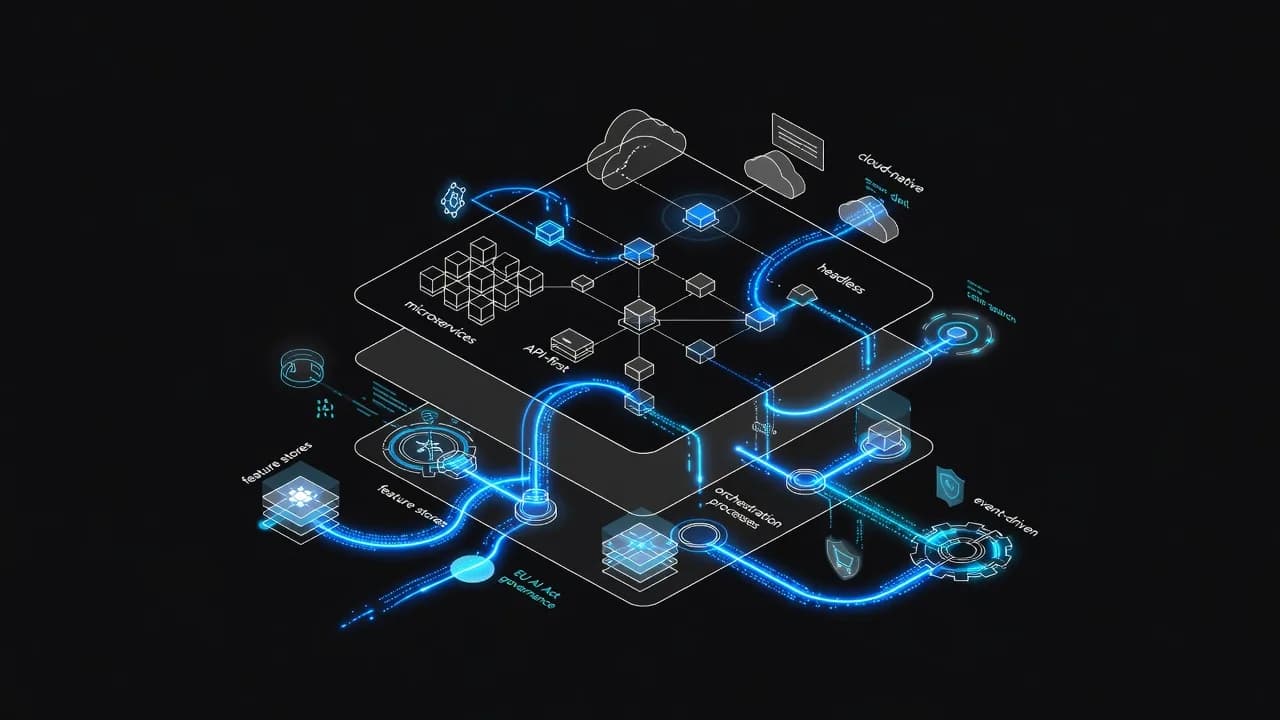
Composable foundations are the difference between rapid iteration and stalled AI pilots. By 2026, MACH—microservices, API‑first, cloud‑native, headless—has moved from emerging idea to accepted baseline for digital experiences. Industry data connects architecture to outcomes: 71% of companies without a composable foundation saw AI projects fail because the stack got in the way. The takeaway is blunt: if services can’t be replaced independently and data can’t be shared cleanly, AI will never be more than a demo.
MACH is the technical substrate; composable commerce is the business strategy layered on top. Together they unlock testable scope: swap a recommendation engine, add a search microservice, or fan out fulfillment logic without freezing the roadmap. For non‑technical leaders, the yardstick is simple: can your team ship an AI trial behind feature flags in one sprint, and roll it back in minutes?
An AI‑ready reference architecture, 2026
Think building blocks, not a big box. Below is a pattern we see working across high‑traffic retailers and direct‑to‑consumer brands.
Data and intelligence layer
Start with a lakehouse for durable truth, then stream change events so models and services stay fresh.
- Event streaming: Use Kafka or Flink to publish orders, inventory changes, and behavioral signals in real time.
- Feature stores: Tools like Tecton, Feast, or Databricks Feature Store keep online and offline data consistent for recommendations and fraud.
- Vector databases: Pinecone, Milvus, Weaviate, or Qdrant power retrieval‑augmented generation over the catalog, content, and help articles.
- Embedding stores: Cache embeddings with strict keys to avoid collisions and speed up repeated lookups.
Compute and delivery
Run microservices on Kubernetes for long‑lived workloads, and use serverless for bursty tasks like image processing or batch scoring. Push latency‑sensitive inference to the edge when feasible, especially for search suggestions and personalization at page render.
Orchestration and resilience
As AI features multiply, coordination becomes a distributed‑systems problem. Use orchestration for complex flows with clear ownership, and choreography for simple, decoupled reactions. Temporal or Step Functions manage retries, timeouts, and compensation; Kafka tracks state through durable events.
saga("checkout")
  .step("reserveInventory").retry(3).compensate("releaseInventory")
  .step("chargePayment").retry(3).compensate("refundPayment")
  .step("confirmOrder")
Observability and evaluation
Standard APM is not enough; you need model‑aware telemetry. Track prompt templates, input tokens, latency, refusal rates, and business outcomes tied to each variant. Guard against silent provider drift by running weekly eval suites and only promoting models through an eval‑gated workflow.
Migration without drama: the Strangler plan
Most revenue still flows through monoliths that can’t be frozen for a year. A phased strangler approach replaces risk with momentum.
Sequence the cutover
- Start with checkout under seasonal load, then carve out search and catalog once teams have telemetry confidence.
- Mirror events from the monolith into Kafka to seed new services without changing user flows.
- Use feature flags plus canary or blue‑green deployments to ramp traffic safely and measure impact.
- Keep the event log as your audit trail and rollback lever until a sustained zero‑traffic window proves the legacy path is obsolete.
What success looks like
Order confirmation times stay flat or improve, product discovery metrics rise, and rollback is measurable in minutes not days. Meanwhile, teams gain independence: the search squad ships weekly, the checkout team hardens flows with Saga patterns, and marketing runs experiments without tickets.
LLM patterns that actually work in ecommerce
The hype is noisy, but several integration patterns have proved reliable, cost‑aware, and measurable.
Search and discovery
Use retrieval‑augmented generation over a vector database built from the catalog, attributes, and content. Ground every answer with product links and structured JSON so the UI can render facets, badges, and availability.
Personalization and recommendations
Blend short‑term signals from the feature store with RAG over content like guides or fit notes. Keep a human‑readable explanation alongside the decision to support audits and customer support follow‑ups.
Service and conversion
Deploy assistants that draft responses but require human approval for refunds and escalations until performance clears your thresholds. Stream tokens to improve perceived speed, and fail closed to safe defaults if latency breaches SLA targets.
Content and merchandising
Use templated prompts to generate descriptions, alt text, and translations, all saved as structured fields in your CMS for review. Deduplicate with embeddings, and keep an eval set that measures clarity, brand tone, and factual grounding before promotion.
Reliable operations
Use two‑tier pipelines for moderation and classification: a cheaper model handles the bulk, with a stronger model catching hard cases. Beware semantic cache poisoning and embedding‑key collisions; harden keys with explicit namespaces and versioning. Run A/B tests online, but also run offline replay tests against a reference set so regressions cannot sneak into production.
Governance you can ship: EU AI Act and beyond
Treat August 2, 2026 as the controlling date for high‑risk obligations under Annex III while monitoring any procedural delays. The heavy lift is operational, not theoretical. Build processes that prove continuous risk management, traceable audit trails, human oversight, and security safeguards from the first experiment onward.
Red teaming as evidence
For high‑risk systems, maintain an AI red‑teaming program that documents methodology, covers the OWASP LLM Top 10, and tracks Attack Success Rate and Mean Time to Detect. Record remediation and retest results so you can show due diligence during audits.
Data duties you already own
Many obligations echo good product hygiene: consent management, transparent disclosures, and controls for human review on critical actions. Bake these gates into workflows, not just policies, so they trigger reliably across services.
A working blueprint: stitching the layers together
Here’s a practical flow that turns architecture into outcomes.
- Product changes publish events to Kafka; the lakehouse stores history, and the vector database updates embeddings.
- Feature store materializes real‑time aggregates like clicks‑per‑session and recent buys for each user or segment.
- LLM services use templated prompts, call RAG over the vector index, and output structured JSON for the UI and analytics pipeline.
- Temporal coordinates multi‑step flows like checkout using Saga compensation so partial failures unwind safely.
- An eval‑gated CI/CD path runs weekly against a reference set, guarding against provider drift and regressions before promotion.
- Observability ties prompts, models, and outcomes to business metrics so teams can answer, with data, whether a change helped.
Minimal contracts keep teams aligned
Agree on a few cross‑team contracts that prevent chaos as features scale.
- Prompt templates versioned like code, with changelogs and owners.
- Schema for LLM outputs, validated before the UI touches them.
- Data contracts on events, with backward‑compatible evolution.
- Fallback behavior that is explicit and testable.
Quick Checklist
- Map current bottlenecks and isolate a first service candidate—checkout, search, or catalog—based on measurable pain.
- Stand up event streaming and mirror monolith events to seed new services without risky rewrites.
- Pilot a vector database and RAG over a carved‑out slice of the catalog; measure relevance and conversion lift.
- Add a feature store for consistent online and offline signals powering personalization and experimentation.
- Choose orchestration for complex flows and document Saga compensations; use choreography for simple event reactions.
- Implement eval‑gated CI/CD and run weekly reference tests to catch provider drift and regressions early.
- Establish AI governance: audit trails, documented oversight, and a red‑teaming program with tracked metrics.
FAQ
Isn’t MACH overkill for a midsize retailer?
If AI is on your roadmap, it is closer to insurance than extravagance. The evidence in 2026 is that teams without composable foundations struggle to move beyond pilots, while modular stacks ship faster and recover faster.
Do we need fine‑tuning, or is prompt engineering enough?
Both appear in production. Start with templated prompts, structured outputs, and RAG; fine‑tune when a stable task repeats at scale and the cost curve says it will pay back.
How do we measure AI features without vanity metrics?
Tie every experiment to a business KPI and a reliability KPI. For example, catalog RAG should move discovery rate and conversion, while also meeting latency and refusal‑rate targets.
What breaks first when we scale to many AI agents?
Handoffs and state tracking. Without explicit state, data contracts, and failure handling, agents drift, data goes stale, and decisions stop being explainable. Choose orchestration for complex flows and enforce schemas on messages to keep the system legible.
Operating model: people, process, cadence
Technology shifts fail without corresponding changes in how teams work. Three operating habits make AI programs stick.
Small, durable teams over projects
Organize around journeys like Search, Checkout, and Service, each owning metrics, budgets, and roadmaps. Give them shared platform support for data, orchestration, and eval tooling to avoid reinventing the wheel.
Ship weekly, learn weekly
Adopt feature flags and canaries so experiments run safely, then commit to a weekly analytics review that decides which changes graduate. Document hypotheses, not just tickets, and capture counterfactuals when you roll back.
Governance as a product
Treat red‑teaming playbooks, oversight checkpoints, and audit artifacts as living deliverables with owners and SLAs. When governance is embedded in pipelines, it accelerates releases rather than blocking them.
Cost control and performance tuning
LLM bills and latency creep can erase gains if you do not plan ruthlessly.
Control the model mix
Use a tiered strategy: default to smaller models, escalate to stronger ones only on hard queries, and cache aggressively. Watch provider drift; a quiet model change can flip your cascade economics unless evals catch it.
Tune the retrieval layer
Index the right chunks and attributes, not every sentence, and prefer product‑level embeddings over raw pages for commerce tasks. Keep separate namespaces for languages, regions, and environments to prevent collisions and bad cross‑talk.
Latency budgets by journey
Set strict budgets: search suggestions under 150 ms at the edge, product pages under your median TTFB plus model time, and service chats streaming within a beat. Fail closed to defaults when needed, and always log why a fallback fired.
Final Thoughts
In practice, AI readiness is less about flashy demos and more about the boring virtues of modularity, clean data flow, and disciplined rollout. MACH gives you the replaceable parts; composable governance gives you the right to operate them at scale. Together, they turn AI from a one‑off experiment into a dependable capability that can ride the 2026 cycle and the one after it.
Two tradeoffs are worth naming clearly. First, orchestration improves reliability but adds central gravity, so reserve it for journeys where a single owner is accountable for the outcome. Second, RAG reduces hallucinations and speeds iteration, yet it demands serious investment in indexing quality and schema discipline. Budget for both, and do not bluff your way through either.
The bigger picture is that ecommerce is becoming a real‑time decision system, not just a storefront. Event streams, feature stores, and vector indexes are the nervous system; microservices and serverless are the muscles; orchestration is the spine. When you wire them with observability and eval‑gated promotion, marketing gains the power to ask sharper questions and to get accountable answers. That is what separates a retailer that plays with AI from one that profits from it.
What should leaders watch next? Expect sharper lines between LLM providers as cost, latency, and quality diverge, making evaluation pipelines a core strategic asset rather than a research hobby. Also expect governance to mature from periodic reviews into continuous controls embedded in workflows, with red‑team results feeding backlog and release gates. Finally, anticipate that the hardest cultural shift will be deciding what not to automate, preserving human judgment where brand trust is fragile and mistakes amplify.
My editorial view is cautious optimism: the parts are ready, the patterns are known, and the evidence in 2026 suggests that the main blocker is legacy drag, not model capability. Leaders who commit to MACH, event‑first data, rigorous evaluation, and verifiable governance will buy speed, resilience, and the right to keep learning in public. Start now.
Sources
- 8 MACH Architecture Companies for SaaS Development (2026) | Brocoders | Brocoders blog about software development
- A comprehensive guide to MACH architecture in 2026 | Contentful
- MACH Architecture Explained: Future of eCommerce
- Feature Stores and MLOps Databases | Introl Blog
- Feature Stores for Real-time AI/ML: Benchmarks, Architectures, and Case Studies
- LLMOps in Production: 457 Case Studies of What Actually Works - ZenML Blog
- EU AI Act Compliance Checklist: 2026 Update
- AI Red Teaming Implementation Checklist | Free Editable Template
- EU AI Act Compliance: Your Practical Roadmap
- From Chaos to Choreography: Multi-Agent Orchestration Patterns ...
- Multi-LLM Orchestration in 2026: 7 Battle-Tested Patterns That Cut AI Costs 60%
- Saga Pattern for Distributed Transactions | Conduktor
Ready to Get Started?
Explore production-ready 3D models for your next project. Browse the 3D model catalog to download assets you can use right away.
Turn this workflow into real deliverables
Browse production-ready 3D models for your next project, then step into 3d modeling if you need a custom build.