Why On-Device AI Is Reshaping Personalization
Introduction
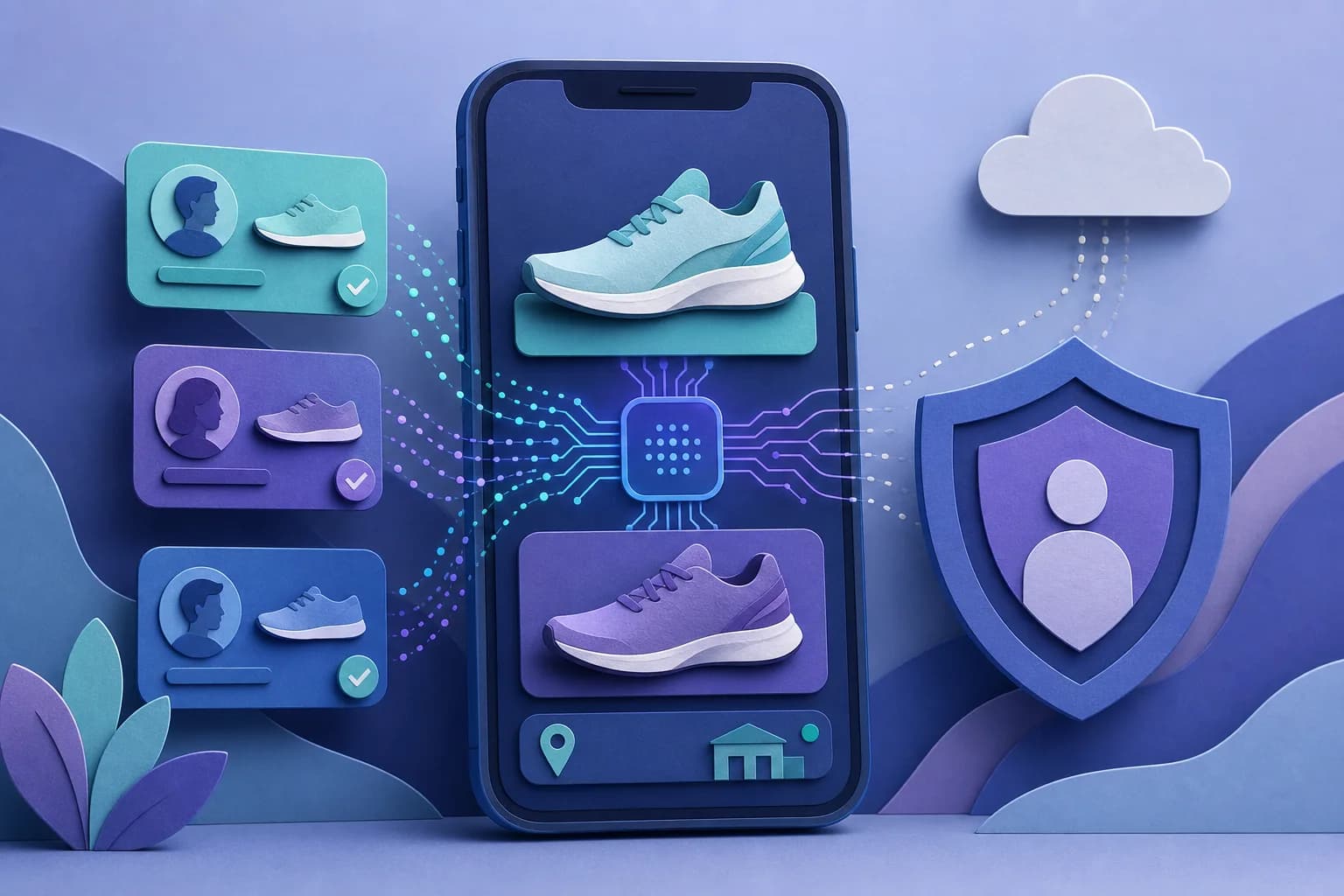
A customer opens a retail app, browses running shoes, pauses over two products, and checks whether a nearby store has their size. A conventional personalization system may send those actions to the cloud, update a profile, score several offers, and return a recommendation.
On-device AI changes that sequence. Some of the interpretation and decision-making can happen directly on the phone, tablet, vehicle, television, or other connected device. The experience can respond while the customer is still deciding, without transmitting every interaction to a remote server.
That combination of speed and data restraint makes on-device AI an important emerging marketing technology. It could support more relevant recommendations, adaptive interfaces, timely reminders, and offline experiences while reducing how much sensitive behavioral information travels across networks.
But local processing is not automatically private, compliant, or effective. It does not eliminate consent requirements, secure a poorly designed application, or replace the enterprise systems that coordinate customer relationships across channels. For most brands, the practical opportunity is not to choose between device and cloud. It is to decide which tasks belong in each place.
What On-Device Personalization Changes
On-device AI refers to models that run partly or entirely on a user’s hardware rather than sending every input to a cloud service. The model might rank products, classify an interaction, recognize a recurring preference, or choose among content variants using information available locally.
The difference matters because cloud processing introduces a round trip. Data must leave the device, reach a service, be processed, and return. That delay may be modest under ideal conditions, but personalization often has a narrow window in which it can influence a decision.
A recommendation shown while someone is comparing products is more useful than one returned after they have moved to checkout. A travel app that can adjust its home screen during a disrupted journey is more helpful than one waiting for a stable connection. Local inference—the act of running a trained model—can make these responses feel immediate.
On-device systems can offer four practical advantages:
- Lower latency: Decisions do not always depend on a network request.
- Greater resilience: Selected features can continue working with weak or unavailable connectivity.
- Less data transmission: Raw behavioral or contextual signals may remain on the device.
- Lower cloud demand: Routine predictions can be handled locally instead of consuming remote computing resources every time.
The marketing value is not simply “more personalization.” It is personalization tied to the customer’s present context. That can include recent in-app behavior, locally stored preferences, time-sensitive actions, or device state—provided the brand has an appropriate purpose and permission to use those signals.
From fixed segments to immediate context
Traditional segmentation places people into broad groups such as frequent buyers, new subscribers, or price-sensitive shoppers. On-device AI can complement those segments with short-lived context.
Consider a grocery app. Its cloud systems may know that a consented customer frequently buys vegetarian products and belongs to a loyalty program. The device may know that the customer has just opened a saved meal plan, dismissed two premium alternatives, and enabled an in-store mode. A local model could rank relevant products without uploading that entire sequence of taps.
This does not make the device’s judgment inherently correct. It does, however, let the experience react to what is happening now rather than relying only on a profile assembled earlier.
The Strongest Model Is Usually Hybrid
On-device and cloud AI have different strengths. Devices are well suited to fast, bounded decisions involving local context. Cloud systems are better for large models, computationally demanding reasoning, organization-wide data, and coordination across channels.
A useful architecture assigns each task according to its actual needs.
Tasks that can fit on the device
Local processing may be appropriate for:
- Ranking a small set of preapproved products or messages.
- Adapting navigation to recent in-app behavior.
- Detecting that a user repeatedly ignores a type of notification.
- Choosing among downloaded content variants.
- Preserving selected preferences for an offline experience.
- Deciding whether a message should be suppressed based on a local frequency rule.
These are usually narrow tasks with clear inputs and outputs. The device does not need unrestricted creative authority. It can make a limited choice within boundaries established by the brand.
Tasks that still belong in the cloud
Cloud infrastructure remains useful for:
- Training and distributing updated models.
- Accessing current inventory, prices, eligibility rules, or loyalty balances.
- Coordinating journeys across email, web, stores, service channels, and multiple devices.
- Running larger generative AI models or complex analytical workloads.
- Applying organization-wide exclusions, legal rules, and campaign governance.
- Measuring outcomes across audiences and channels.
A product recommendation generated entirely from local preferences could still be wrong if the item is unavailable. A locally written promotion could create regulatory or brand risk if it ignores current terms. Real-time speed is valuable, but it cannot substitute for authoritative business data.
A practical division of labor
A hybrid flow might work like this:
- The cloud sends the app an approved product set, content variants, model, and policy rules.
- The device uses consented local signals to rank those options.
- The app displays the selected experience without uploading raw interaction history.
- The device returns only permitted, minimized measurement events.
- Cloud systems aggregate outcomes, update campaign logic, and distribute revised models or content.
This design keeps immediate decisions close to the customer while retaining centralized control over inventory, policy, measurement, and cross-channel orchestration. It also creates a clear question for every data field: Does the server genuinely need to receive this?
Privacy Improves Only When the Whole System Does
Keeping data local can reduce exposure during transmission and limit the number of parties that can access raw information. That is a meaningful architectural benefit, especially for signals that reveal habits, locations, interests, or patterns of behavior.
It is not a blanket privacy guarantee. An application might process data locally but store it carelessly, retain it indefinitely, use it for an unexpected purpose, or expose it through diagnostic logs. A compromised device or overly broad software permission can also undermine the intended protection.
Sensitive personalization context should therefore be protected throughout its lifecycle. Apple Keychain and Android Keystore can help applications manage cryptographic keys and selected secrets. Encryption, platform isolation, access controls, and hardware-backed trusted execution environments can add protection beyond ordinary app storage.
The important principle is that security should cover more than saved files. It should also govern how context is collected, extracted, retrieved, updated, and deleted.
Local does not mean consent-free
Privacy laws and platform rules generally focus on what data is used, for which purpose, and under what authority—not only on the server that processes it. The General Data Protection Regulation, California Consumer Privacy Act, and European Union Digital Markets Act create different obligations, but none turns on a simple claim that “the AI runs on your phone.”
If personalization accesses device information, browsing behavior, precise location, or unique identifiers, the organization may still need consent or another valid legal basis. Where consent is required, it should be specific, informed, freely given, and unambiguous. Withdrawing it should have a real effect, such as disabling certain signals or reverting to a generic experience.
Marketers should also distinguish among three concepts that are often blurred together:
- Personalization: Tailoring an experience to an individual or context.
- Data minimization: Collecting and retaining only what is necessary.
- Local processing: Performing a computation on the user’s device.
Local processing can support data minimization, but it does not prove that the underlying personalization is expected, fair, or proportionate.
Improving models without collecting raw histories
Federated learning offers one possible way to improve shared models. Devices calculate local updates, while a coordinating system combines contributions without receiving each participant’s raw records.
That approach still needs safeguards. Model updates can leak information under some conditions, and privacy-preserving methods add complexity. Differential privacy can introduce carefully calibrated noise to reduce the chance of identifying an individual contribution. Secure multiparty computation and homomorphic encryption can protect information during collaborative processing, while tokenization can replace sensitive values with controlled substitutes.
These techniques are not interchangeable, and some impose substantial computational overhead. They should be selected through security and privacy engineering, not attached to a campaign as reassuring terminology.
Where Marketers Can Apply It—and Where They Should Not
The best early use cases are usually frequent, time-sensitive decisions with limited downside. They should have a generic fallback and should not require a complete customer history.
Product discovery
A commerce app could locally reorder an approved product list using recent browsing behavior. The cloud still determines availability, price, promotion eligibility, and merchandising constraints. The device handles the final ranking while the customer is actively exploring.
Message timing and suppression
A local model could learn that a user routinely dismisses notifications at certain times or has already acted on an in-app prompt. Instead of sending more messages, it could suppress or delay them. This illustrates an important point: good personalization sometimes means showing less.
Loyalty experiences
A loyalty app could prioritize relevant benefits based on locally retained preferences while retrieving current point balances and offer terms from the cloud. The sensitive pattern of which benefits a customer repeatedly considers may not need to become a permanent centralized record.
Travel and offline service
Travel, transportation, and event apps often operate under inconsistent connectivity. Downloaded models and content rules can support basic recommendations or interface adjustments offline, then synchronize permitted events once a connection returns.
Generative content needs tighter limits
On-device generative AI may eventually draft copy, summarize options, or adapt explanations. Yet open-ended generation creates more risk than ranking approved alternatives. A generated claim can be inaccurate, noncompliant, or inconsistent with the brand even when it never leaves the device.
For customer-facing marketing, constrained generation is safer than unlimited generation. Brands can limit models to approved facts, fixed templates, controlled vocabulary, and explicit prohibited claims. High-impact communications should retain server-side validation or human review.
Some decisions should not be delegated to local personalization at all. Pricing, credit, insurance, health-related messaging, and eligibility determinations can carry legal or material consequences. Speed does not justify weak oversight.
Testing Business Value Without Hiding the Tradeoffs
A persuasive demonstration should compare on-device personalization with both a generic experience and a cloud-only alternative. Otherwise, a team may prove that personalization works without proving that local processing adds value.
The scorecard should include customer, commercial, operational, and privacy outcomes:
- Experience: Response time, offline availability, engagement, product discovery, and task completion.
- Commercial: Incremental revenue, conversion rate, add-to-cart behavior, acquisition efficiency, retention, and customer lifetime value.
- Operational: Cloud inference volume, network traffic, error rates, model update success, battery impact, and support incidents.
- Trust: Consent acceptance and withdrawal, privacy complaints, deletion completion, and the amount of raw data transmitted.
- Quality: Recommendation relevance, suppression mistakes, performance across device classes, and unexpected differences among audience groups.
Incrementality matters. Teams should use randomized holdouts or another credible experimental design rather than comparing customers who opted into personalization with those who did not. Those groups may differ before the experience begins.
Measurement should also unfold in stages. Early evidence may include fewer duplicate events, lower network dependence, faster interactions, and successful suppression. Conversion and acquisition effects require more observation, while retention and lifetime value usually need a longer window.
Marketers should define failure conditions before launch. If a model drains batteries, performs poorly on older hardware, confuses customers, or creates unequal experience quality across devices, a conversion lift alone is not enough to declare success.
Quick Checklist
- Choose a narrow, time-sensitive decision where local processing has a clear advantage.
- Map every signal by purpose, consent status, sensitivity, retention period, and destination.
- Separate device tasks from cloud tasks, including authoritative business rules and fallbacks.
- Protect local context with encryption, controlled access, managed keys, and secure deletion.
- Give customers understandable controls for opting in, opting out, and resetting personalization.
- Test against both generic and cloud-only experiences using incremental measurement.
- Monitor latency, relevance, battery use, device coverage, privacy outcomes, and commercial results.
- Establish model update, rollback, incident response, and end-of-life procedures before scaling.
Frequently Asked Questions
Is on-device AI the same as edge AI?
On-device AI is a form of edge AI in which processing happens on the customer’s own hardware. Edge AI is a broader term that can also include nearby gateways, store servers, vehicles, or network infrastructure outside a centralized cloud.
Does on-device personalization eliminate the need for a customer data platform?
No. A customer data platform can still unify consented records, coordinate audiences, manage suppression, and support cross-channel measurement. On-device AI adds a local decision layer; it does not automatically create an organization-wide customer view.
Can an on-device model work without an internet connection?
Some functions can, provided the model, required content, and rules have already been downloaded. Features that depend on live inventory, account balances, current prices, or cross-channel activity will still require connectivity or a carefully designed cached fallback.
Is local processing automatically compliant with privacy law?
No. It may reduce unnecessary transmission, but compliance also depends on purpose, transparency, consent or another legal basis, retention, security, access rights, and the ability to honor withdrawal or deletion requests.
Will on-device AI replace cloud personalization?
That is unlikely for most brands. Devices excel at immediate, private, and offline decisions, while cloud systems remain important for model training, enterprise data, campaign coordination, and larger workloads. A governed hybrid design is generally more practical than an all-or-nothing approach.
Final Thoughts
In practice, the strongest argument for on-device AI is not that it makes personalization more sophisticated. It is that it can make selected decisions faster while requiring less raw customer data to move through the marketing stack. That is a more defensible direction than collecting everything simply because storage and computation are available.
The central tradeoff is control. Local models gain immediacy and resilience, but brands lose some visibility into the signals behind each decision. Good architecture resolves that tension through bounded tasks, approved content, minimized reporting, and reliable fallbacks—not through unlimited surveillance or unlimited generation.
The bigger picture is that privacy and performance do not always have to be opposing goals. Processing less data in fewer places can improve response times and reduce exposure at the same time. But those benefits appear only when consent, security, measurement, and lifecycle governance are designed into the system.
What this suggests for marketing leaders is a disciplined path forward: start with small decisions where milliseconds and connectivity matter, prove incremental value, and treat reduced data movement as a measurable outcome. On-device AI deserves attention not because every experience should become intensely personal, but because it may help brands become more relevant without becoming more intrusive.
Sources
- Edge AI & On-Device Processing: Fast and Private Mobile Experiences
- Medium
- Hyper-Personalization: How AI Delivers Real-Time Experiences
- On-device ai vs cloud ai for mobile: choosing the right split
- On-Device AI and Data Sovereignty: The 2026 Privacy ...
- Data Security within AI Environments | CSA
- Navigating Privacy in the Age of AI: Evaluating the Adequacy of the GDPR and CCPA to Combat Data Exploitation and Deepfake Technology - NHSJS
- Global Data Privacy Laws: Your 2025 Guide (GDPR, CCPA ...
- Privacy of Personal Data in the Generative AI Data Lifecycle – NYU Journal of Intellectual Property & Entertainment Law
- CDP Benefits: 7 Outcomes That Justify Investment
- AI-driven personalization in cloud marketing platforms
- Salesforce Personalization vs. Marketing Cloud Personalization: Key Differences Explained - zivoke
Ready to Get Started?
Explore production-ready 3D models for your next project. Browse the 3D model catalog to download assets you can use right away.
Turn this workflow into real deliverables
Browse production-ready 3D models for your next project, then step into 3d modeling if you need a custom build.